Epson EcoTank ET-2980
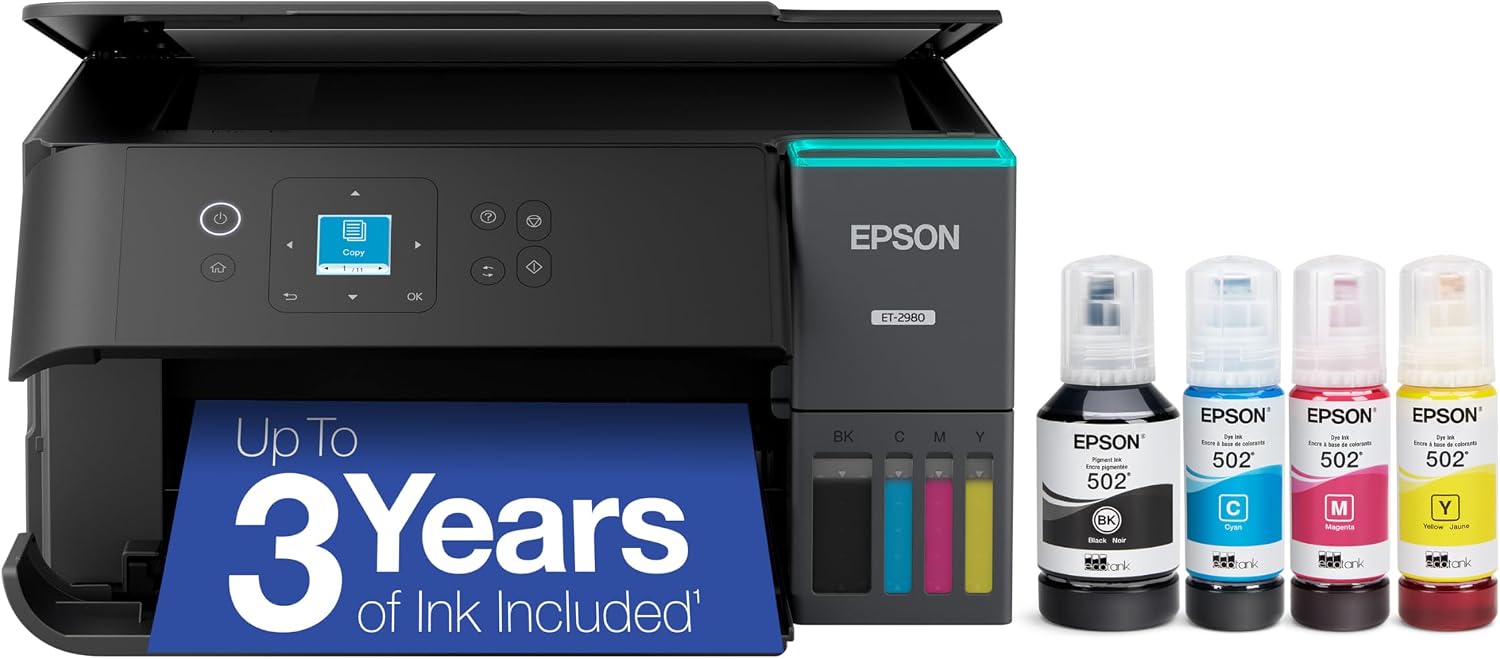
The EcoTank ET-2980 is the entry point to Epson’s supertank line, and it’s essentially the ET-4950’s running-cost twin without the office extras. It uses the same Epson 502 ink — a pigment black plus dye colors — so it prints a black page for under three-tenths of a cent, exactly like the pricier model, at a much lower purchase price. Crucially, unlike the cheapest budget tanks, it includes automatic two-sided printing. What it gives up is the document feeder, fax, Ethernet, and touchscreen. For a home office that wants the lowest running cost and auto-duplex, but doesn’t need to batch-scan or fax, it’s a lot of value for the money.
How We Scored It
Category Deep-Dives
Running Cost / Cost-Per-Page
9.5 / 10 25% weightingOn the category we weight highest, the ET-2980 is every bit the equal of our #1 pick. It uses the same Epson 502 ink as the flagship ET-4950 at the same rated yields, so its cost-per-page is identical: about 0.29 cents for a black page and 1.08 cents for a color page on original ink, with a bottle set rated for roughly 8,500 black and 6,500 color pages. That’s among the lowest running costs anywhere in our guide.
The significance is that you get that flagship-level cost-per-page in the cheapest EcoTank Epson makes. Where the ET-4950 charges more for its office features, the ET-2980 delivers the same ink economics for less up front — the running-cost math doesn’t change, only the feature set does. As always, supply prices move over time, so treat the figures as current estimates and check before buying.
Bottom line on running cost: Identical to our top pick — under three-tenths of a cent per black page on the same 502 ink — at the lowest EcoTank price. A near-perfect score.
Print Quality
8.0 / 10 20% weightingThe ET-2980 shares the flagship’s ink chemistry, and it shows on the page. Its pigment black lays down crisp, dark, smudge-resistant text on plain paper — the trait that makes an EcoTank feel closer to a laser on documents — while the dye-based colors handle graphics and casual photos at up to 4800 × 1200 dpi. For the everyday office material most home offices print, output looks clean and professional.
It lands a small step below the step-up EcoTanks overall — the entry model’s print engine isn’t quite as refined as the pricier machines’ — but the gap is modest and mostly academic for documents. You’re getting genuinely good quality, not budget-compromise quality, which is a big part of why the ET-2980 represents so much value.
Bottom line on print quality: Sharp, smudge-resistant text from the same pigment black as the flagship, with solid everyday color. A touch behind the step-up models, but strong for an entry tank.
Speed & Paper Handling
7.0 / 10 15% weightingSpeed is one of the clearest gains this generation brings: the ET-2980 is rated at about 15 pages per minute in black and 8 in color, up from 10.5 and 5 on the ET-2850 it replaces. That puts it level with the mid-range office tanks on raw print speed. What still marks it as the entry model is paper handling rather than pace — a 100-sheet rear feed and no document feeder, so long or multi-page jobs need more of your attention.
Paper handling, though, has a genuine bright spot that separates it from the cheapest tanks: it includes automatic two-sided printing. The budget Canon MegaTank G3270 at a similar price has no automatic duplex — its driver offers only a manual 2-sided mode that stops to have you reload the stack — so if double-sided documents matter to you, the ET-2980’s auto-duplex is a real, tangible advantage. It feeds from a 100-sheet rear tray and, like the other entry tanks, has no automatic document feeder — copies and scans go on the flatbed one page at a time.
Bottom line on speed & paper handling: Slow for volume printing, but auto-duplex is a real edge over same-price rivals that make you reload the paper by hand. No ADF, as expected at this level.
Features & Connectivity
5.5 / 10 15% weightingThe ET-2980 keeps its feature set lean to hit its price. It prints, scans, and copies, with a small 1.44-inch color LCD for control, and connects over Wi-Fi, Wi-Fi Direct, and USB with Epson’s mobile and app printing. Auto-duplex printing is included, which not every printer at this price offers.
What’s absent is what the fuller office all-in-ones provide: there’s no automatic document feeder, no fax, and no Ethernet, and no color touchscreen. Those omissions are exactly what separates it from the step-up ET-4950, which adds all of them. If you need to batch-scan multi-page documents, fax, or hard-wire the printer to a network, this isn’t the model; if you don’t, the short list of missing extras won’t matter much.
Bottom line on features & connectivity: The essentials plus auto-duplex, over Wi-Fi or USB. No ADF, fax, Ethernet, or touchscreen — the trade you make for the entry price.
Consumable Freedom & Reliability
9.0 / 10 15% weightingAs a refillable-tank printer, the ET-2980 fills from standard Epson 502 bottles rather than cartridges — no chip to authenticate, no firmware behavior restricting supplies, and no per-cartridge cycle to manage. Supply flexibility is high, which is the basis of its low running cost, and this is the dimension our framework scores separately from the raw cost figure.
Epson’s EcoTank line is one of the two most proven names in refillable-tank printing, and the entry ET-2800/2850 models have a solid track record as dependable everyday hardware. As with any inkjet, an occasional print keeps the head healthy. It carries a one-year limited warranty, standard for the category.
Bottom line on consumable freedom & reliability: Bottle-fed tanks mean no cartridge lock-in and durable low costs, backed by Epson’s proven EcoTank reliability. Top marks on supply flexibility.
Value & Warranty
8.5 / 10 10% weightingValue is the ET-2980’s strong suit. It pairs the lowest EcoTank entry price with the same rock-bottom running cost as Epson’s pricier office models, and it typically ships with a generous supply of ink in the box. For a buyer who wants supertank economics and auto-duplex without paying for a fax or a feeder, the cost-to-capability ratio here is excellent.
It carries a one-year limited warranty, standard for the class. Against its closest rival, the similarly-priced Canon G3270, the decision comes down to features: the ET-2980 adds automatic two-sided printing, while the Canon counters with a slightly lower price and its own pigment black. Both are strong budget-tank value; the Epson is the pick if duplex matters to you.
Bottom line on value & warranty: Flagship running costs and auto-duplex at the lowest EcoTank price, with ink in the box. Excellent value; standard one-year warranty.
About the Manufacturer
Epson, part of Japan’s Seiko Epson Corporation, is one of the four major printer manufacturers and the company that brought the refillable ink-tank printer into the mainstream. The EcoTank line replaces disposable cartridges with high-capacity tanks refilled from bottles — the design that reset expectations for the true cost of printing.
The ET-2980 is the accessible entry point to that range. It shares the same Epson 502 ink and low cost-per-page as the pricier office EcoTanks, while trimming the feature set — no ADF, fax, or Ethernet — to reach a lower price, and it keeps automatic two-sided printing that the cheapest rivals omit.
Epson’s combination of a proven tank system, dependable hardware, and the widest range of supertank options across every tier is why it leads our overall printer ranking — and why even its entry model earns a place in the ink-tank top five.