BE600M1 Back-UPS
The APC BE600M1 is the lowest-ranked UPS in our guide — not because APC makes bad products, but because this particular product combines the weakest topology, lowest capacity, and worst value-per-dollar of any unit we evaluated. Its standby-only design with no AVR, 600VA ceiling, and premium brand pricing add up to a difficult recommendation against any alternative in our guide. The APC BR1500MS2 (#2) represents what APC does well; the BE600M1 does not.
How We Scored It
Category Deep-Dives
Power Protection
2.0 / 10 30% weightingThe protection score of 2.0 reflects a genuine floor: this unit does less than any other UPS in our guide to protect connected equipment from the full range of power quality problems. A coaxial and RJ-45 data line protection port is included — a minor positive — but it does not change the fundamental topology limitation.
Bottom line on power protection: Standby topology, no AVR. Protects against complete power failure only — every line-interactive unit in our guide does more.
Power Quality
2.5 / 10 20% weightingThe BE600M1 uses a standby (offline) topology with no automatic voltage regulation. Like the Amazon Basics Standby 800VA (#12), it passes utility power directly to connected equipment in normal operation, providing no protection against the most frequent home office power problems: brownouts, voltage sags, frequency variations, and harmonics. The unit activates only on complete power failure — switching to battery with a brief (4–10ms) transfer gap that active PFC power supplies can find disruptive.
Bottom line on power quality: Simulated sine wave output — the same waveform floor as the other standby units at the bottom of our rankings.
Usability & Features
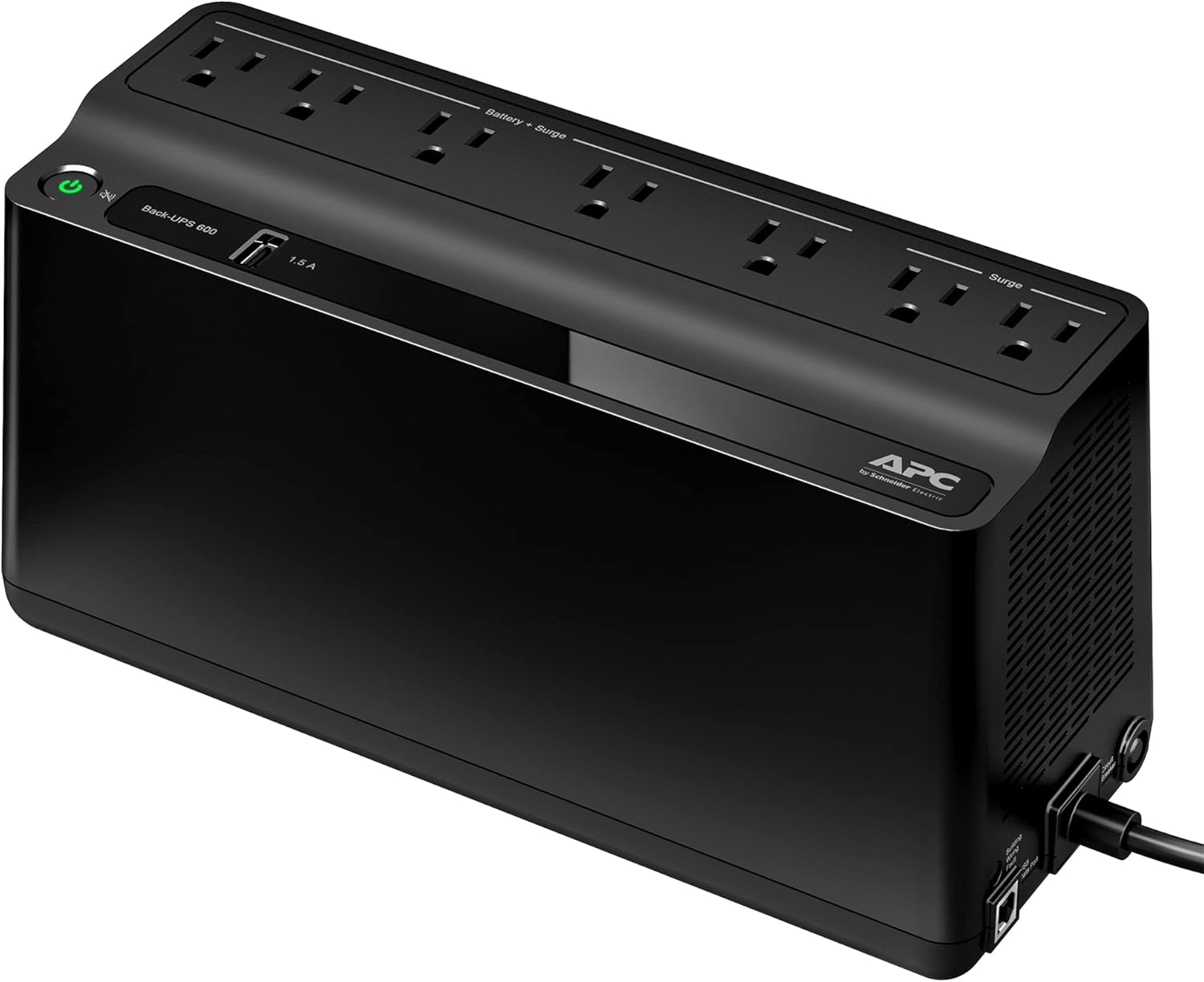
1.5 / 10 20% weightingSeven outlets (five battery-backup, two surge-only) and LED indicators are the core feature story. That is a more generous outlet count than the Amazon Basics 800VA (#12), and the BE600M1 adds a USB-A charging port (900mA) for topping up a phone or small device without occupying an outlet, along with coaxial and data line protection ports. What it lacks is any quantitative readout — there is no LCD display and no numerical telemetry, only LED status lights. The desktop (horizontal) form factor is unique in our guide and may suit certain desk configurations where vertical clearance is a constraint, but this is a minor ergonomic note rather than a meaningful feature advantage.
PowerChute Personal Edition is available via USB and provides automated graceful OS shutdown — the same capability as CyberPower’s PowerPanel. This is a genuine asset that the Amazon Basics standby units lack. This is not a reflection on PowerChute’s quality, but on the unit’s capacity and topology limitations: software-triggered shutdown works correctly but cannot compensate for the fundamental inadequacy of 330W standby-only protection for a real home office workstation.
Bottom line: Seven outlets, LED indicators, and a USB-A charging port give the BE600M1 a slightly richer feature set than the Amazon Basics 800VA Standby — but the low 1.5 score reflects the LED-only display, absent monitoring, and standby topology, which the feature extras cannot offset.
Battery & Longevity
1.5 / 10 15% weightingAt 600VA / 330W, the BE600M1 has the lowest capacity in our guide. 330W is barely enough for a router, modem, and a small monitor — there is no realistic home office desktop configuration that fits within this ceiling without careful, intentional equipment selection. Even at modest loads, the approximately 2 minutes of full-load runtime provides only a narrow window for shutdown before battery exhaustion.
The battery and longevity score of 1.5 sits at the bottom tier of the scale: this unit cannot protect a workstation, and its runtime margin at any real home office load is minimal.
Bottom line: 600VA/330W is the lowest capacity in our guide. Suitable only for a minimal networking setup.
Value
1.0 / 10 10% weightingThe value score of 1.0 is the lowest in our guide, and it reflects a specific market reality: the BE600M1 typically prices at or above the Amazon Basics Standby 800VA (#12, 3.5/10), despite providing 25% less wattage capacity, the same standby topology, and no meaningful additional features beyond a USB-A charging port. APC’s brand premium — justified in its higher-performing product lines — does not translate to value at this entry-level tier.
The comparison that matters most: the Amazon Basics UPS 1500VA (#8, 7.3/10) typically sells for a comparable price and delivers nearly five times the wattage capacity, line-interactive topology, and a simulated sine wave that at least performs better than a standby unit’s handling of brownouts. Any buyer considering the BE600M1 will find better value at virtually every other price point in our guide.
Bottom line: The lowest value score in our guide. APC brand premium at this tier does not correspond to better protection or features versus less expensive alternatives.
Physical Design
5.0 / 10 5% weightingBuild quality is the BE600M1’s only category that doesn’t score at the bottom of our guide. APC’s hardware manufacturing is consistently solid — the chassis is well-constructed, outlets are firmly seated, and the desktop horizontal form factor is cleanly designed. PowerChute Personal Edition software (free, USB connection) is included and provides automated graceful OS shutdown via the USB data port — the same software stack as the BE650G1 and APC’s wider product line. The 3-year warranty is standard APC coverage. Battery replacement is user-accessible.
Bottom line: APC’s hardware quality is real — the physical product is well-made. It just isn’t the right product for a home office at any realistic budget.
About the Manufacturer
APC (American Power Conversion) was founded in 1981 in West Kingston, Rhode Island, and was acquired by Schneider Electric in 2007. APC is one of the most recognized names in power protection, with products ranging from consumer desktop UPS units through enterprise three-phase systems. The Back-UPS series spans a wide range — from the entry-level BE600M1 reviewed here through the Back-UPS Pro line that includes the genuinely excellent BR1500MS2 (#2 in our guide).
The BE600M1’s low ranking reflects the product tier, not the brand. APC’s engineering is evident in its higher-performing units; this review should not be read as a general indictment of APC as a manufacturer. If APC’s build quality and brand support are important to you, the BR1500MS2 (#2) is where that investment pays off.