RT-BE88U
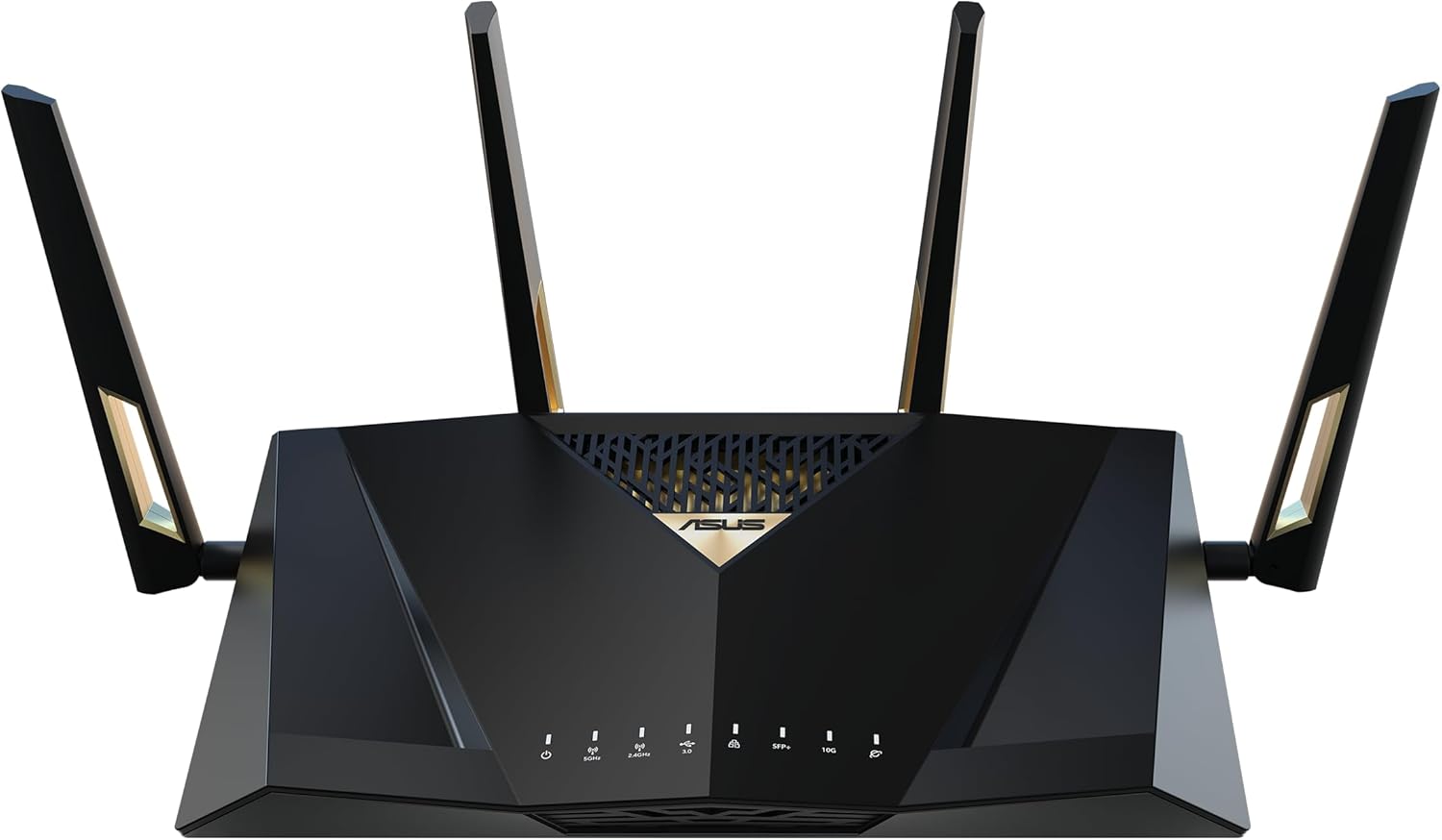
The ASUS RT-BE88U is the wired-office specialist of our router guide: a dual-band Wi-Fi 7 router that pairs a flagship-class processor with the most extraordinary port array in the category — a 10G Ethernet port, a 10G SFP+ port, four 2.5G ports, and four gigabit ports, for 34G of combined capacity. It is effectively a router and a multi-gig switch in one box. The deliberate omission is the 6 GHz band, which caps wireless throughput and is the reason it ranks below its tri-band siblings. If your home office lives on Ethernet — desktop, dock, NAS, access point — and Wi-Fi is the supporting act, this is the most wiring you can buy without going rackmount.
How We Scored It
Category Deep-Dives
Coverage & Range
7.0 / 10 20% weightingSingle-unit coverage is rated at roughly 3,000 sq ft — apartment, condo, or modest single-story territory. There is a quiet upside to the dual-band design here: with no short-reaching 6 GHz band in the mix, the RT-BE88U’s coverage story is more consistent than tri-band rivals whose headline band fades after a wall or two. Its strong 5 GHz radio holds useful signal at range, and the 2.4 GHz band is there for the far corners and the smart-home fleet.
AiMesh provides the growth path: the RT-BE88U can anchor a mesh with nearly any other ASUS router — and its port array makes it an unusually good mesh hub, with 10G available for a wired backhaul to a satellite while the desk, NAS, and dock stay on their own multi-gig drops.
Bottom line on coverage: Honest single-unit reach for small-to-medium spaces, with best-in-guide wiring for a future wired-backhaul mesh. If you need whole-home wireless coverage today, a mesh kit remains the right starting point.
Reliability & Stability
9.0 / 10 20% weightingThe RT-BE88U runs the same quad-core 2.6 GHz processor and 2 GB of RAM as the flagship RT-BE96U — serious headroom for a router that will typically front a smaller wireless fleet, which translates to a device that simply never feels busy. Routing 34G of potential wired traffic is exactly what this hardware was specified for, and owner-reported stability since its 2024 release has been strong on the mature ASUSWRT platform.
ASUS’s multi-year firmware support record is among the strongest in consumer networking — security and stability updates routinely continue for many years after release, with automatic updates available. The USB port’s 4G/5G tethering failover adds work-from-home continuity when the main line drops.
On long-term support risk, the RT-BE88U is clean: ASUS is a Taiwan-based manufacturer unaffected by the 2026 FCC restrictions on newly certified foreign-made routers and by the TP-Link-specific U.S. review.
Bottom line on reliability: Flagship-grade hardware running a light wireless load, ASUS’s long update record, cellular failover, and zero U.S. regulatory exposure. Only eero’s auto-managed platform rates higher for set-and-forget consistency.
Speed & Throughput
7.5 / 10 15% weightingThis is the category where the RT-BE88U’s deliberate design choice costs it. As a BE7200-class dual-band router — up to 1,376 Mbps on 2.4 GHz and 5,764 Mbps on 5 GHz — it carries genuine Wi-Fi 7 advantages on the bands it has: 4K-QAM, MLO across 2.4 and 5 GHz, and Multi-RU puncturing all work, and a Wi-Fi 7 laptop near the router can sustain well over a gigabit. What it lacks is the 6 GHz band entirely: no 320 MHz channels, no clean private lane for the work machine, and a lower wireless ceiling than every tri-band unit in this guide.
The wired side is the inverse story. With 10G Ethernet, 10G SFP+ (fiber or DAC), four 2.5G ports, and four gigabit ports, the RT-BE88U moves traffic between wired devices at speeds no other router in this guide matches — full 10G between the WAN and a NAS, 2.5G to every desk. For an office whose heavy data lives on Ethernet, the missing 6 GHz band is close to academic; for one that depends on peak wireless throughput, it is the whole argument for spending up to the RT-BE96U.
Bottom line on speed: Best-in-guide wired throughput, mid-pack wireless ceiling. The 7.5 prices in the missing 6 GHz band — buy this router for its back panel, not its antennas.
Call & VPN Performance
8.5 / 10 15% weightingFor a call-heavy workday, the RT-BE88U’s best feature is the one this guide recommends for every router: a wired desk. With four 2.5G ports plus 10G to spare, hard-wiring the work machine — the single most effective call-quality upgrade — costs nothing here, and call stability over Ethernet is as good as networking gets. On the wireless side, Adaptive QoS prioritizes conferencing traffic in one toggle, and MLO across 2.4 and 5 GHz gives Wi-Fi 7 clients a resilient two-band link that rides through interference hits mid-call.
The VPN suite is the full ASUS toolkit: built-in WireGuard, OpenVPN, and IPSec servers, one-tap Instant Guard, and VPN Fusion for routing only the work laptop through a tunnel. The 2.6 GHz quad-core gives it the same encryption headroom as the flagship — comfortably covering the multi-gig plans its 10G WAN invites.
As across this guide, the specialist ceiling belongs to the GL.iNet Flint 2 and its ~900 Mbps WireGuard throughput; choose that if router-level VPN is the center of your workflow.
Bottom line on calls & VPN: The easiest router in the guide to build a fully wired, rock-solid call setup around, with the broadest built-in VPN feature set in the mainstream market behind it.
Security & Management
9.5 / 10 15% weightingThe full ASUS security stack, nothing held back. AiProtection Pro — commercial-grade threat protection powered by Trend Micro, with malicious-site blocking, intrusion prevention, and infected-device quarantine — is free for the life of the device, as are complete parental controls. Several major competitors paywall the equivalent features behind eero Plus or NETGEAR Armor subscriptions that can exceed the hardware’s cost over a five-year window. Our framework applies an explicit penalty for subscription-gated security; the RT-BE88U takes none of it.
Network segmentation comes via Guest Network Pro SSIDs that isolate IoT gadgets, guests, and kids’ devices from the network your work machine lives on — and with this many wired ports, VLAN-aware segmentation of the physical network is a realistic option too. WPA3 is standard, and firmware updates can be scheduled or fully automated.
Management is the ASUS dual-track: the ASUS Router app for daily tasks, plus the full web UI with VLANs, per-device QoS, link aggregation, and detailed logs — depth this router’s wired-centric buyer is exactly the person to use. Setup remains longer than eero’s five-minute flow, which is all that keeps the score off a 10.
Bottom line on security: Lifetime subscription-free protection, real segmentation in both Wi-Fi and copper, and the deepest management toolkit in the category.
Connectivity & Value
8.5 / 10 15% weightingNo router in this guide comes close to the RT-BE88U’s back panel: a 10G Ethernet WAN/LAN port, a 10G SFP+ cage, a 2.5G WAN/LAN port, three more 2.5G LAN ports, and four gigabit ports — 34G of combined capacity. The SFP+ port is a genuine rarity in consumer gear, accepting fiber modules or DAC cables for a noise-immune 10G run to a NAS, switch, or fiber ONT. In practical terms: multi-gig internet, a 10G NAS link, 2.5G to the desk, the dock, and an access point — simultaneously, with ports left over and no external switch purchased. The USB port adds 4G/5G tethering failover for outage continuity.
On value, the calculus is unusually clear-cut. Against the similarly priced tri-band competition you are trading the 6 GHz band for roughly a switch’s worth of multi-gig ports — a good trade for a wired-centric office, a poor one if peak wireless matters. The full subscription-free ASUS software stack (AiProtection Pro, VPN suite, AiMesh, Adaptive QoS) comes along either way, so the sticker price remains the whole price.
Bottom line on connectivity & value: The best wired connectivity ever fitted to a consumer router in this class — 34G across ten ports plus SFP+. Worth every penny to the right buyer; the wrong buyer should put the same money into a tri-band sibling.
About the Manufacturer
ASUS is a Taiwan-based electronics manufacturer whose networking division has built the strongest enthusiast reputation in consumer Wi-Fi. Its router lineup spans the RT standalone series, ROG gaming routers, and the ZenWiFi mesh family — all sharing the same ASUSWRT firmware platform, which is the foundation for the brand’s signature features: AiMesh cross-model mesh networking, AiProtection security included for the life of the device, Adaptive QoS, and the most complete built-in VPN toolkit in the mainstream market.
The RT-BE88U, announced in March 2024, took a deliberately different path from the rest of the Wi-Fi 7 wave: ASUS billed it as the world’s first Wi-Fi 7 router with 34G of combined wired capacity, trading the 6 GHz radio for an SFP+ cage and a stack of multi-gig ports. It has become the default recommendation for wired-centric home offices and homelab-adjacent buyers.
For home office buyers, ASUS’s multi-year firmware support record and its freedom from the 2026 U.S. regulatory concerns surrounding some competitors are practical reasons it is our most-recommended router brand for work-from-home networks.