Task Chair
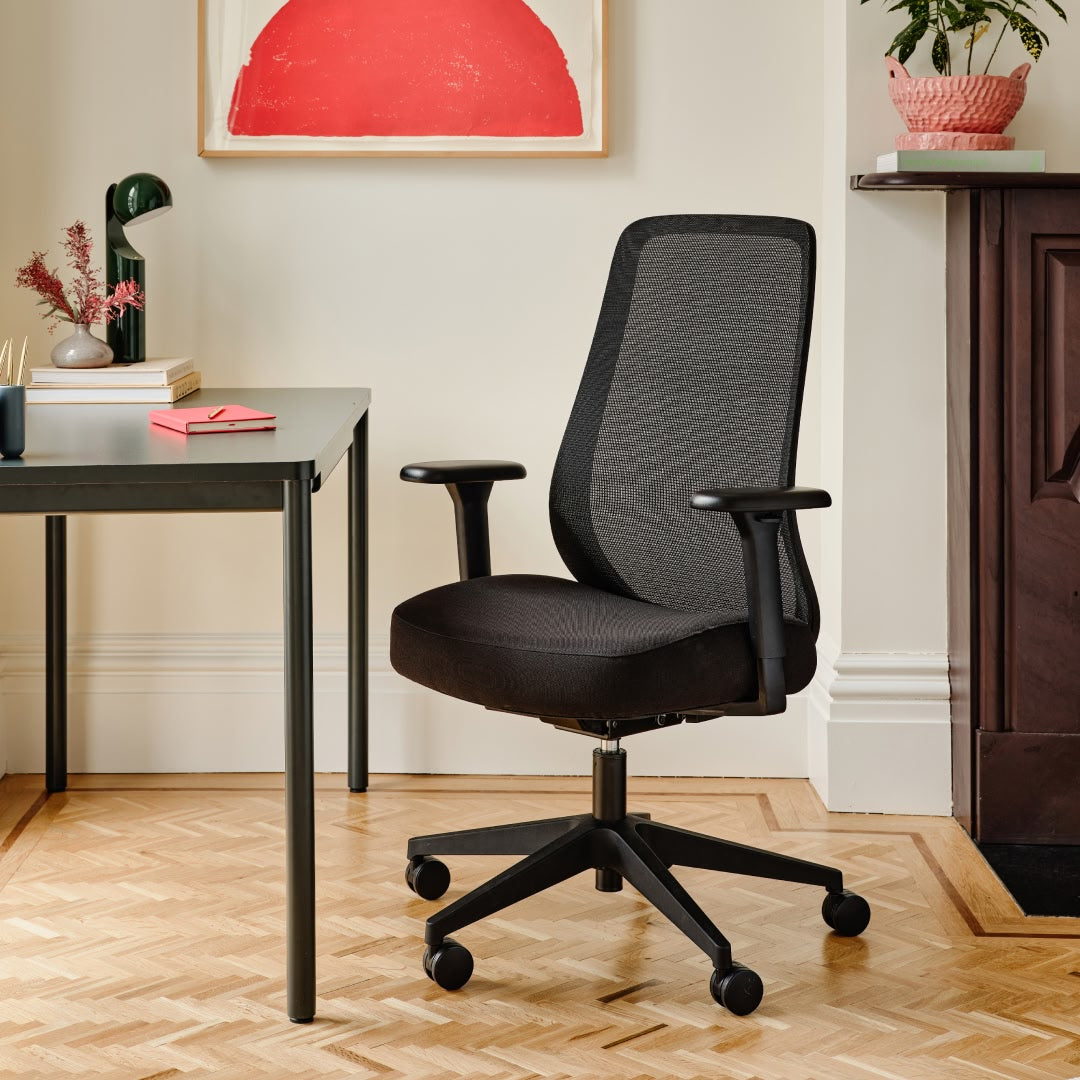
The Branch Task Chair is Branch’s accessible entry point: the same AirWeave mesh construction and clean aesthetics as the Ergonomic Chair Pro, at a meaningfully lower price. What it trades away is the Pro’s most ergonomically significant features — independent lumbar adjustment, seat depth adjustment, and full 4D arms. The Task Chair uses a fixed backrest curve for lumbar support, a fixed seat depth, and 3D arms without depth adjustment. For buyers who fall within a typical seated height range and do not have specific lumbar or seat depth requirements, these trade-offs are manageable and the Task Chair delivers solid value: good mesh quality, a confident 5-year warranty, and Branch’s characteristic understated design. For buyers who are shorter or taller than average, who have documented back or hip discomfort from poorly fitted chairs, or who are planning to use this as their primary working chair for eight or more hours per day, the absence of seat depth and lumbar adjustability is a genuine functional limitation. The Ergonomic Chair Pro’s additional investment buys the adjustments that make correct ergonomic fit possible for a wider range of users — and that comparison is worth making explicitly before purchasing.
Score Breakdown
Detailed Review
Ergonomics & Support
6.5 / 10 30% of scoreThe Task Chair’s ergonomic case rests on what its mesh backrest provides passively rather than what its mechanisms provide actively. The backrest has a built-in lumbar curve — a shaped contour in the mesh structure that promotes natural spinal alignment when the user sits fully back in the chair. This passive approach works adequately for users whose lower back curvature aligns reasonably well with the chair’s fixed profile, which is broadly true for users in the 5’6"–5’11" range using the chair for moderate daily sessions. The backrest also reclines in a synchro-tilt motion, which keeps the seat angle relatively stable as the back tilts — an ergonomically sound motion pattern that prevents the forward seat-tipping that undermines some tilt mechanisms.
The meaningful limitation is the absence of independent lumbar adjustment. A fixed backrest curve is a best-fit average, not a custom fit. Users whose lumbar curve is shallower or deeper than the chair’s profile — or who simply need the lumbar pad positioned higher or lower along their back — cannot correct this. The same constraint applies to seat depth: with no adjustment available, users significantly shorter than average (under 5’4") may find their legs dangle without back support, while taller users may find the seat too short to support the full length of the thigh. Neither of these is a catastrophic failure for a chair in this tier, but they are functional limitations that the Ergonomic Chair Pro’s modest premium is specifically designed to solve.
The 3D arms adjust for height, width, and pivot (rotation). They position the forearms adequately for standard typing postures. The missing fourth dimension — forward/back depth — means the arms cannot be pulled in close enough for users with shorter reaches, or pushed back far enough for users who prefer arms further from the desk. For buyers who do not typically rest their forearms on chair arms while typing, this is a non-issue. For buyers who actively use arm support throughout the day, 4D adjustment provides meaningfully more precise positioning.
Bottom line: The fixed lumbar curve and seat depth are the Task Chair’s primary ergonomic limitations. Both work acceptably for users near average height in moderate daily use. Both become material limitations for users at height extremes, those with specific lumbar requirements, or anyone planning 8+ hour daily use as a primary work chair.
Comfort & Materials
7.5 / 10 25% of scoreThe Task Chair uses the same AirWeave mesh as the Ergonomic Chair Pro — a full-mesh construction across both the back and seat pan that provides consistent breathability throughout a sitting session. In warm environments or for users who run warm, this is a tangible comfort advantage over foam-backed or vinyl-covered alternatives. The mesh holds tension appropriately, provides even weight distribution without pressure concentrations, and does not retain body heat the way foam or fabric upholstery does. These properties hold across the colors Branch offers (Black, Weathered Grey, Warm White, and Saddle Brown), all of which use the same underlying mesh construction.
Seat comfort feedback on the Task Chair is generally positive at its price point. The firm-density seat foam beneath the mesh is firmer than softer alternatives, which some users find comfortable for extended periods (less tendency to “bottom out” or develop pressure points) and others find initially stiff. As with the Ergonomic Chair Pro, buyers who strongly prefer a soft seat cushion will find the Eurotech Vera’s higher-density foam seat a more comfortable match. The mesh seat panel provides some give and prevents the unpleasant rigidity of hard plastic seats.
The synchro-tilt recline is smooth and the adjustable tension allows the chair to be calibrated for different body weights — lighter users can reduce tension so the backrest reclines with light pressure, heavier users can increase it for a firmer feel. The multi-position tilt lock allows the chair to be locked in a reclined position for reading or calls, a useful feature for buyers who rotate between focused desk tasks and more relaxed postures throughout the day.
Bottom line: AirWeave mesh delivers the same breathability advantage here as in the Ergonomic Chair Pro — a genuine comfort strength at this price. Seat firmness is the primary variable that divides user feedback; the smooth synchro-tilt is a consistent positive.
Value for Money
7.0 / 10 20% of scoreThe Task Chair’s value proposition depends entirely on which alternatives you compare it against. Against non-ergonomic office chairs, desk chairs, and gaming chairs at a similar price, it is a clear upgrade — its mesh construction, synchro-tilt, and 3D arms provide genuinely better support than a budget chair with a foam back and fixed 2D armrests. Against other ergonomic alternatives in its tier, the comparison is tighter. The HON Ignition 2.0 offers similar mesh quality, an adjustable lumbar, and a limited lifetime warranty at a comparable or lower price. The SIHOO M57 and Ticova chairs in the budget section of this guide offer higher feature counts on paper for less money, though with shorter warranties and less consistent reliability feedback.
The most important internal comparison is with the Branch Ergonomic Chair Pro at a modest premium. For that delta, the Pro adds independent lumbar adjustment (height and pressure), seat depth adjustment (~3 inches), and a fourth dimension on the arms (depth/reach). If you are buying a chair for 6–8 hours per day of use and plan to keep it for five or more years, that premium spreads to a modest amount per year — which the ergonomic fit improvements will justify for most buyers who need them. The Task Chair is best value for buyers who genuinely do not need seat depth or lumbar adjustment, not as a compromise for buyers who need them but want to save money.
Branch sells the Task Chair exclusively direct through branchfurniture.com and does not list it on Amazon. This removes the convenience of Prime shipping and returns but also avoids the retail markup, keeping pricing direct and stable. Branch occasionally offers promotional pricing and bundle deals on its site.
Bottom line: Good value against non-ergonomic alternatives and chairs without mesh or synchro-tilt. The value case weakens when compared directly with the HON Ignition 2.0 (similar price, more lumbar adjustability) or the Ergonomic Chair Pro (more complete ergonomics for a manageable step up in price).
Build Quality & Longevity
7.5 / 10 15% of scoreThe Task Chair shares its core construction quality with the Ergonomic Chair Pro: nylon base and frame structure, AirWeave mesh stretched across the back and seat, and a gas lift cylinder and tilt mechanism that operate with appropriate solidity for the price tier. Branch’s build quality feedback across both its chairs is consistently positive — there are no widely documented failure patterns, mechanism complaints, or mesh delamination issues that would suggest a quality control problem. The simplified adjustability of the Task Chair relative to the Pro also means fewer moving parts to develop play or failure over time.
The 5-year warranty is the same as on the Ergonomic Chair Pro and covers parts and structural defects. This is above-average for mid-range ergonomic chairs and provides meaningful assurance relative to the 1–3 year terms typical of budget alternatives. Branch is a young brand (founded 2019) without multi-decade reliability data, but the build quality observed over its short product history has been solid, and the warranty coverage represents a genuine commitment that backs the physical product.
Assembly takes approximately 20–30 minutes and is generally reported as straightforward. The simplified adjustment set of the Task Chair relative to the Pro means slightly less assembly complexity — there are fewer mechanism components to configure out of the box.
Bottom line: Solid construction with no documented quality issues and a competitive 5-year warranty. The same caveats apply as to the Ergonomic Chair Pro: no long-term track record yet, though current evidence is positive.
Adjustability Range
5.5 / 10 7% of scoreThis is the Task Chair’s lowest-scoring category and the one that most clearly defines its positioning relative to the Ergonomic Chair Pro. The available adjustments are: seat height (pneumatic, standard range), backrest recline angle, recline tension, tilt lock, arm height, arm width, and arm pivot. These cover the basics that allow the chair to be set to an approximate fit for most users. What they do not cover — seat depth, lumbar height, and lumbar pressure — are the adjustments that allow fine-tuned ergonomic fitting for users whose proportions or back curvature fall outside the average range the chair is designed for.
The 3D arms (height, width, pivot) are a step above the 2D arms found on cheaper chairs but a step below the 4D arms on the Ergonomic Chair Pro. The pivot/rotation adjustment is more useful than it might initially appear — rotating the arm surface inward to support the forearm in a natural typing position, rather than forcing the elbow to point outward, makes a difference in shoulder tension over long sessions. The missing depth dimension matters most for users with shorter reaches who want the arms positioned close to the body, or for users who want the arms further from the desk to support a wider grip.
For buyers whose daily use pattern keeps them in a relatively consistent seating posture and whose body proportions align well with the Task Chair’s fixed seat depth and backrest curve, the adjustability limitations are not daily obstacles. For everyone else — and particularly for buyers who have previously experienced discomfort from chairs that could not be fitted properly — the Ergonomic Chair Pro’s broader adjustment range is worth the additional cost.
Bottom line: Basic adjustability that covers the essentials but omits the three adjustments — seat depth, lumbar height, lumbar pressure — that matter most for fitting a chair to a specific user. This is the category where the Task Chair most clearly trails the Ergonomic Chair Pro.
Who Should Buy the Branch Task Chair
The Branch Task Chair earns its place in the guide for a specific buyer: someone who wants Branch’s mesh quality and build confidence at a lower price point and genuinely does not need independent lumbar or seat depth adjustment. This is most likely someone in the 5’6"–5’11" height range, using the chair for moderate daily sessions (4–6 hours), who has not experienced significant discomfort from chairs without seat depth adjustment and has no documented lumbar fitting requirements. For that buyer, the Task Chair delivers a clean, breathable, well-built chair with a 5-year warranty at a reasonable price.
The buyers who should think carefully before choosing the Task Chair over the Ergonomic Chair Pro are those who are shorter or taller than average, who work 8+ hours per day at their desk, who have experienced back or hip discomfort from chairs that could not be fitted properly, or who plan to use this as their sole work chair for five or more years. For those buyers, the seat depth and lumbar adjustability on the Ergonomic Chair Pro are not optional extras — they are the features that determine whether the chair can be correctly fitted to the user at all.
Before purchasing, compare the Task Chair directly against the HON Ignition 2.0 at a similar or lower price — the HON offers an adjustable lumbar mechanism that the Task Chair lacks, with a lifetime warranty, making it a stronger ergonomic value for the same budget. If the Ergonomic Chair Pro’s price is the main obstacle, also check current Branch promotions: Branch occasionally offers bundle pricing or discounts that narrow the gap between the two models.
Bottom line: The right choice for buyers who want Branch quality at a lower price and fall within the average height and use-case range where fixed seat depth and lumbar are not limiting. For buyers outside that range, the Ergonomic Chair Pro or the HON Ignition 2.0 are stronger recommendations.
Furn.
Branch is a direct-to-consumer office furniture brand founded in 2019. Its seating lineup consists of two chairs: the Task Chair (this review) as the accessible entry point, and the Ergonomic Chair Pro as the flagship model with full adjustability. Both use the same AirWeave mesh construction and share Branch’s design language — minimal, office-appropriate, available in the same four colorways. Branch sells direct through branchfurniture.com; the Task Chair is not listed on Amazon, which removes Prime shipping convenience but also keeps pricing stable and direct.
Branch also offers sit-stand desks and accessories. Buyers purchasing a Branch chair may find bundled desk and chair promotions on the Branch website. The 5-year warranty on both chairs is serviced directly by Branch.