RT-BE92U
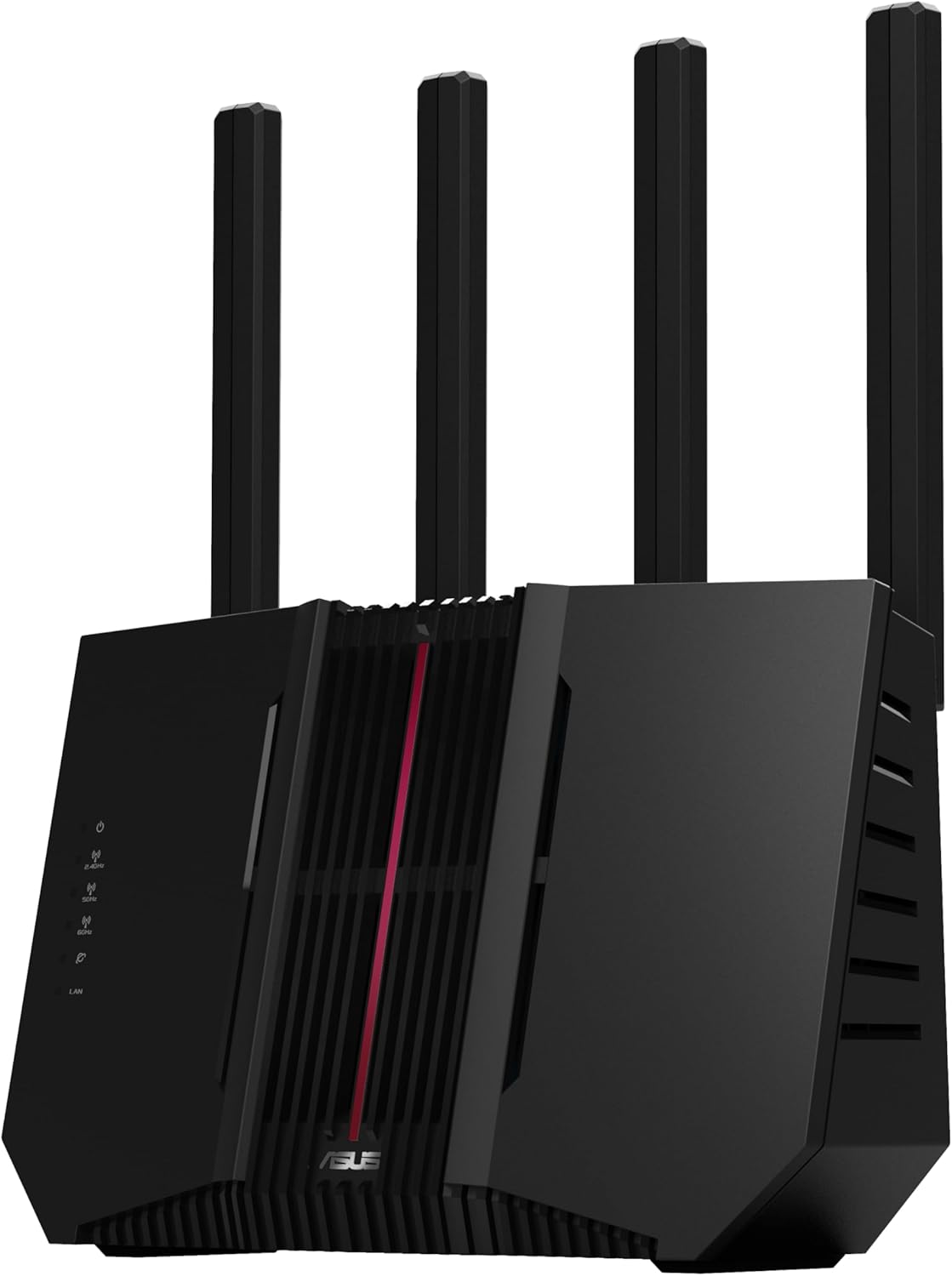
The ASUS RT-BE92U is the just-right standalone router in our home office guide: a BE9700-class tri-band Wi-Fi 7 unit that keeps everything that makes ASUS our most-recommended brand — lifetime subscription-free AiProtection Pro, the full VPN toolkit, AiMesh expandability — at a far friendlier price than the flagships. Its 10G WAN/LAN port and four 2.5G LAN ports mean every wired drop is multi-gig. The trade-offs are honest ones: 2×2 radios on the 5 and 6 GHz bands limit coverage to roughly 3,000 sq ft and cap peak wireless throughput. For an apartment or modest home with a desk you can wire, this is the smartest money in the standalone tier.
How We Scored It
Category Deep-Dives
Coverage & Range
6.5 / 10 20% weightingThis is where the RT-BE92U’s mid-tier positioning shows. Its four external antennas drive a 3×3 radio on 2.4 GHz but only 2×2 configurations on the 5 and 6 GHz bands, and the practical result is single-unit coverage of roughly 3,000 sq ft — solid for an apartment, condo, or modest single-story home, but with less signal held at the far edges than the flagship RT-BE96U manages, particularly on the short-reaching 6 GHz band. The strong 2.4 GHz radio is a quiet plus for households thick with smart-home and IoT devices, which live on that band.
As with every modern ASUS router, AiMesh is the escape hatch: if you move somewhere bigger, the RT-BE92U becomes the hub — or the node — of a mesh network with nearly any other ASUS unit, over a wireless or wired backhaul. That keeps a coverage shortfall from ever turning into a replacement purchase.
Bottom line on coverage: Fine for the small-to-medium spaces this router is priced for, with AiMesh as the growth path — but the 2×2 high bands are the lineup’s clearest hardware compromise, and our top mesh picks cover double the area. If your office sits two floors from the modem, look elsewhere.
Reliability & Stability
9.0 / 10 20% weightingThe RT-BE92U runs a quad-core 2.0 GHz processor with 1 GB of DDR4 RAM — less raw headroom than the flagship tier, but comfortably more than this router’s realistic device load demands, and owner-reported stability since its late-2024 release has been strong. It runs the same mature ASUSWRT platform as the rest of the lineup, so it inherited years of Wi-Fi 7 firmware refinement from the RT-BE96U rather than debuting with new-platform quirks of its own.
ASUS’s multi-year firmware support record is among the strongest in consumer networking — security and stability updates routinely continue for many years after release, and automatic updates can be enabled and forgotten. A practical extra for work-from-home continuity: AI WAN detection monitors the internet connection and can fail over to a tethered 4G/5G phone or USB modem automatically, turning an ISP outage into a hiccup instead of a lost workday.
On long-term support risk, the RT-BE92U is clean: ASUS is a Taiwan-based manufacturer unaffected by the 2026 FCC restrictions on newly certified foreign-made routers and by the TP-Link-specific U.S. review.
Bottom line on reliability: Mature shared firmware, automatic cellular failover, ASUS’s long update record, and zero U.S. regulatory exposure. Only eero’s auto-managed platform rates higher for set-and-forget consistency.
Speed & Throughput
8.5 / 10 15% weightingThe RT-BE92U is a BE9700-class tri-band Wi-Fi 7 router: up to 1,032 Mbps on 2.4 GHz, 2,882 Mbps on 5 GHz, and 5,764 Mbps on 6 GHz, with the full feature set that matters — 320 MHz channels, 4K-QAM, and MLO. A Wi-Fi 7 laptop near the router can sustain well over a gigabit on the 6 GHz band, which means the wireless link comfortably outruns the gigabit-class internet plans most home offices actually have.
The honest comparison: the flagship RT-BE96U’s 4×4 radios roughly double the rated ceiling on both high bands, and that gap is real if you regularly move huge files over Wi-Fi or have a 5 Gbps fiber plan. But for the core home office workload — calls, cloud apps, large uploads — the BE92U’s headroom goes unused most days. Wire the desk to a 2.5G port (or the 10G port if your plan is gigabit-class) and the distinction disappears entirely.
Bottom line on speed: Genuine Wi-Fi 7 performance with all the protocol’s latency benefits, scaled to mid-tier radios. More than a typical home office can use — just not the multi-gig wireless monster the flagships are.
Call & VPN Performance
8.5 / 10 15% weightingThe call-quality toolkit is identical to ASUS routers costing twice as much. Adaptive QoS prioritizes video-conferencing traffic or the work machine in one toggle, and MLO lets a Wi-Fi 7 client hold simultaneous links on two bands, so an interference hit on one band mid-call shifts traffic to the other instead of freezing your video. The strong 2.4 GHz radio also keeps a houseful of IoT chatter from crowding the bands your calls ride on.
The VPN story is the full ASUS suite: built-in WireGuard, OpenVPN, and IPSec servers, one-tap Instant Guard, and VPN Fusion to route only the work laptop through a tunnel while the household runs clean. The 2.0 GHz quad-core delivers respectable encrypted throughput — enough for the broadband plans this router will realistically front — though with less headroom than the RT-BE96U’s 2.6 GHz part.
As across this guide, the specialist ceiling belongs to the GL.iNet Flint 2 and its ~900 Mbps WireGuard throughput; choose that if router-level VPN is the center of your workflow.
Bottom line on calls & VPN: Flagship feature set at a mid-tier price — Adaptive QoS, MLO, and the broadest built-in VPN toolkit in the mainstream market, with CPU headroom that covers typical plans.
Security & Management
9.5 / 10 15% weightingNothing is cut down here. AiProtection Pro — commercial-grade threat protection powered by Trend Micro, with malicious-site blocking, intrusion prevention, and infected-device quarantine — is free for the life of the device, as are full parental controls. Several major competitors paywall the equivalent features behind eero Plus or NETGEAR Armor subscriptions that can exceed the hardware’s cost over a five-year ownership window. Our framework applies an explicit penalty for subscription-gated security; the RT-BE92U takes none of it — and on a budget-conscious purchase, the absence of a recurring fee matters even more.
Network segmentation comes via Guest Network Pro: purpose-built SSIDs that isolate IoT gadgets, guests, and kids’ devices from the network your work machine lives on. WPA3 is standard, and firmware updates can be scheduled or fully automated.
Management is the usual ASUS dual-track — the ASUS Router app for daily tasks, plus a full web UI exposing VLANs, per-device QoS, and detailed logs. The setup flow remains longer than eero’s five-minute experience, which is all that keeps this score off a 10.
Bottom line on security: The same lifetime subscription-free protection and deep management toolkit as ASUS’s flagships, undiluted. At this price point, nothing else in the guide matches it.
Connectivity & Value
9.5 / 10 15% weightingThis is the RT-BE92U’s signature category. The port array — one 10G WAN/LAN port plus four 2.5G LAN ports — makes it the rare mid-priced router with no gigabit bottleneck anywhere on the back panel. Take a multi-gig plan in on the 10G port, and the desk, dock, NAS, and a future access point each get a full 2.5G wired drop without a switch. Many routers costing more still pad their port count with plain gigabit; here every drop is multi-gig. The USB port adds 4G/5G tethering failover, business-class continuity that pairs with AI WAN detection.
On value, the RT-BE92U is the easiest recommendation in the ASUS standalone line: it delivers the brand’s complete software stack — AiProtection Pro, the full VPN suite, AiMesh, Adaptive QoS — for mid-range money, with subscription-free security keeping the sticker price the whole price. The deliberate compromises (2×2 high-band radios, 1 GB RAM) are exactly the ones a typical home office never collides with.
Bottom line on connectivity & value: All-multi-gig wiring, cellular failover, and the full ASUS software stack at a mid-tier price. The best value in the standalone tier — buy the RT-BE96U for headroom, buy this for sense.
About the Manufacturer
ASUS is a Taiwan-based electronics manufacturer whose networking division has built the strongest enthusiast reputation in consumer Wi-Fi. Its router lineup spans the RT standalone series, ROG gaming routers, and the ZenWiFi mesh family — all sharing the same ASUSWRT firmware platform, which is the foundation for the brand’s signature features: AiMesh cross-model mesh networking, AiProtection security included for the life of the device, Adaptive QoS, and the most complete built-in VPN toolkit in the mainstream market.
The RT-BE92U, released in November 2024, is the mid-tier model in the RT Wi-Fi 7 line, slotting below the flagship RT-BE96U. ASUS aimed it at the largest part of the market: buyers who want genuine Wi-Fi 7, multi-gig wiring on every port, and the full ASUS software stack without flagship pricing.
For home office buyers, ASUS’s multi-year firmware support record and its freedom from the 2026 U.S. regulatory concerns surrounding some competitors are practical reasons it is our most-recommended router brand for work-from-home networks.