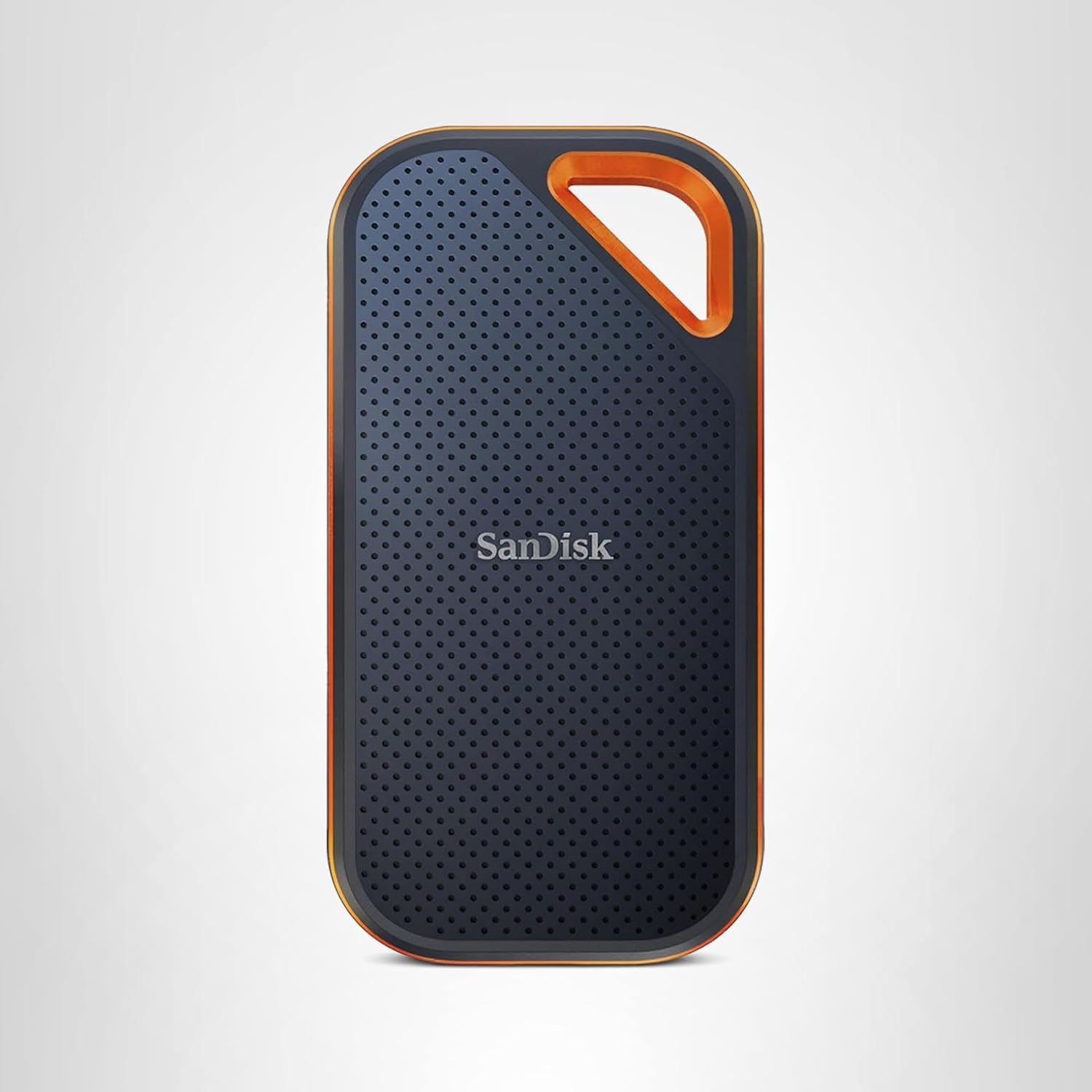
Extreme Pro Portable SSD (V2)
The Extreme Pro is SanDisk’s fast, rugged 20 Gbps drive — a USB 3.2 Gen 2×2 design rated to roughly 2,000 MB/s, IP65-sealed, drop-resistant, and protected by hardware AES-256. On hardware alone it would rank among the high-speed leaders. But it belongs to the SanDisk Extreme family at the center of the widely reported 2023 data-loss failures and an ongoing, still-unsettled class action, and for a drive whose whole job is safeguarding data, that history can’t be waved away. We credit the strong engineering, apply a deliberate reliability penalty, and keep it out of our top picks. If you want this speed and toughness with a clean record, the Crucial X10 Pro and Samsung T9 deliver it without the asterisk.
How We Scored It
Category Deep-Dives
Real-World Performance
8.0 / 10 25% weightingThis is where the Pro earns its name. It runs over USB 3.2 Gen 2×2 (20 Gbps) and is rated for up to 2,000 MB/s read and write — roughly double the everyday-tier drives — and on a Gen 2×2 host it delivers that headline speed in real transfers. For shuttling large video projects, RAW photo libraries, or virtual-machine images, the extra bandwidth is genuinely felt.
Internally it’s a DRAM-less design built on SanDisk/WD BiCS TLC with host memory buffer, so very large sustained writes step down once the SLC cache fills — the same caveat that applies to most pocket SSDs. But for burst and everyday creative work it’s quick and consistent, and the 20 Gbps interface gives it real headroom the 10 Gbps Extreme can’t match. We score Performance at 8.0: a clear strength, just shy of the USB4/Thunderbolt drives that sit higher in our rankings.
Bottom line on performance: A true 20 Gbps drive that hits ~2,000 MB/s on a Gen 2×2 port — fast enough for serious creative work, with sustained-write step-down on the very largest transfers.
Reliability & Endurance
6.0 / 10 25% weightingThis is the category that defines the Extreme Pro’s score, and it’s worth being direct about why. In 2023, a wave of SanDisk Extreme and Extreme Pro portable SSDs (sold by Western Digital) failed and lost user data. Western Digital acknowledged a firmware issue in May 2023 and released a firmware updater; a class-action lawsuit followed in the Northern District of California, and as of mid-2026 that case remains active and unsettled, with plaintiffs arguing the firmware update did not fully resolve the failures — a point Western Digital disputes.
Current stock, including this listing, ships with the updated firmware, and many units run without issue. The underlying hardware — SanDisk/WD’s own BiCS TLC NAND, a 5-year warranty — is, on paper, sound, and the Extreme Pro was specifically named in the failure reports alongside the standard Extreme. For a device whose entire purpose is to safeguard data, an unresolved, documented data-loss history in this exact product family is a legitimate reliability concern, not a footnote. So we apply a deliberate penalty here: 6.0, the amber band, which is the single biggest reason the drive sits at 7.1 overall rather than near the top of the high-speed tier — and why it falls short of our top picks.
We treat this the same way we treat long-term-support risk elsewhere on the site: score the hardware honestly, then reflect the documented risk transparently. You can read the full background in the reliability note on our main SSD guide.
Bottom line on reliability: Capable hardware under a real cloud. The 2023 data-loss failures and ongoing litigation earn a deliberate penalty — and an extra-firm reminder to keep a second backup. If you want a clean record at this speed, choose the Crucial X10 Pro or Samsung T9.
Durability & Build
8.0 / 10 15% weightingRuggedness is the Extreme Pro’s strongest hardware area. This revision is rated IP65 — full dust protection and resistance to low-pressure water jets — and is built to survive drops of up to 2 m (6.5 ft). The forged aluminum core doubles as a heatsink to help hold speed under load, wrapped in a grippy silicone shell, and the molded carabiner loop is a genuinely useful touch for clipping the drive to a bag or belt in the field.
That puts its physical protection ahead of the high-speed rivals it competes with — the Samsung T9 has no IP rating, and the Crucial X10 Pro is IP55 — making the Extreme Pro a natural fit for photographers and videographers who shoot on location. It trails only the IP68, crush-rated field drives higher in our rankings.
Bottom line on durability: IP65, a 2 m drop rating, an aluminum heatsink core, and a carabiner loop make this one of the toughest fast drives — its clearest hardware win.
Connectivity & Compatibility
7.0 / 10 15% weightingConnection is via a single USB-C (USB 3.2 Gen 2×2) port, and SanDisk includes both a USB-C–to–C cable and a USB-C–to–USB-A adapter. The catch is the interface itself: USB 3.2 Gen 2×2 (20 Gbps) is not universally supported. It’s mostly a Windows-PC feature; Macs don’t implement 2×2, and many laptops and docks top out at 10 Gbps — on those machines the Extreme Pro falls back to roughly 1,050 MB/s, the same as a far cheaper Gen 2 drive.
So while it’s broadly compatible — it works on virtually anything with USB-C — it only reaches its headline speed on a specific subset of hosts. That host-dependency is why we score Connectivity at 7.0 rather than higher: you have to match this drive to a 2×2 port to get what you paid for. Buyers on Macs or Thunderbolt-only machines should look at a USB4/Thunderbolt drive instead.
Bottom line on connectivity: Plug-and-play everywhere, but full 20 Gbps speed needs a USB 3.2 Gen 2×2 host — which rules out Macs and many laptops. Match the drive to the port.
Value
7.0 / 10 15% weightingOn raw specifications the Extreme Pro is a lot of drive — 20 Gbps speed, IP65 ruggedness, an aluminum heatsink, hardware encryption, and a five-year warranty — and it’s frequently discounted. In a vacuum, that would earn a higher value mark.
But value isn’t only about the sticker. It carries a premium over both 10 Gbps drives and even some of its high-speed peers, and given the unresolved reliability history in this product family, the rational comparison is against drives that offer similar speed without the asterisk — the IP55, class-leading Crucial X10 Pro and the encryption-and-software-strong Samsung T9. Measured against those, the Extreme Pro’s value is fair rather than compelling, which is why this lands at 7.0. If it’s meaningfully cheaper than both at the moment you buy — and you have a 2×2 port to exploit — the calculus shifts, but we’d still weight a clean record heavily for storage.
Bottom line on value: Strong hardware for the money, but the reliability cloud and a premium price mean similarly fast rivals are usually the smarter spend unless the Extreme Pro is materially cheaper.
Software & Security
7.0 / 10 5% weightingThe Extreme Pro includes password-enabled 256-bit AES hardware encryption, managed through SanDisk’s security software, so you can lock the drive independently of the host computer — useful for a portable drive carrying work files. The bundled software covers password setup and firmware updates across Windows and macOS.
Feature-wise that’s solid and on par with Samsung and WD. We hold it to 7.0 rather than higher in this lightly weighted (5%) category mainly because keeping the drive’s firmware current is, in this specific case, more than routine housekeeping — it’s tied directly to the reliability concern above. Encryption and tooling are good; the context is what tempers the score.
Bottom line on software & security: Capable hardware AES-256 and tidy tooling — just make absolutely sure you’re on the latest firmware with this particular drive family.
About the Manufacturer
SanDisk is one of the most recognized names in flash storage, owned by Western Digital, which manufactures its own BiCS NAND. The Extreme line — the standard Extreme and the faster Extreme Pro reviewed here — is SanDisk’s rugged, field-oriented portable SSD family, long popular with photographers and videographers for its IP rating, compact build, and carabiner loop.
That popularity is also why the 2023 data-loss failures drew so much attention: these were widely used drives, and the Extreme Pro was named alongside the standard Extreme. Western Digital issued a firmware update and continues to sell the line, and current units ship with that update — but the episode, and the ongoing litigation, are the reason we score the Extreme family more cautiously than its hardware alone would suggest.
For buyers who specifically want SanDisk’s speed and ruggedness, it remains a capable choice with eyes open. For maximum peace of mind at this speed, our top high-speed picks come from Crucial and Samsung.