E7 Plus (4-Leg) Standing Desk
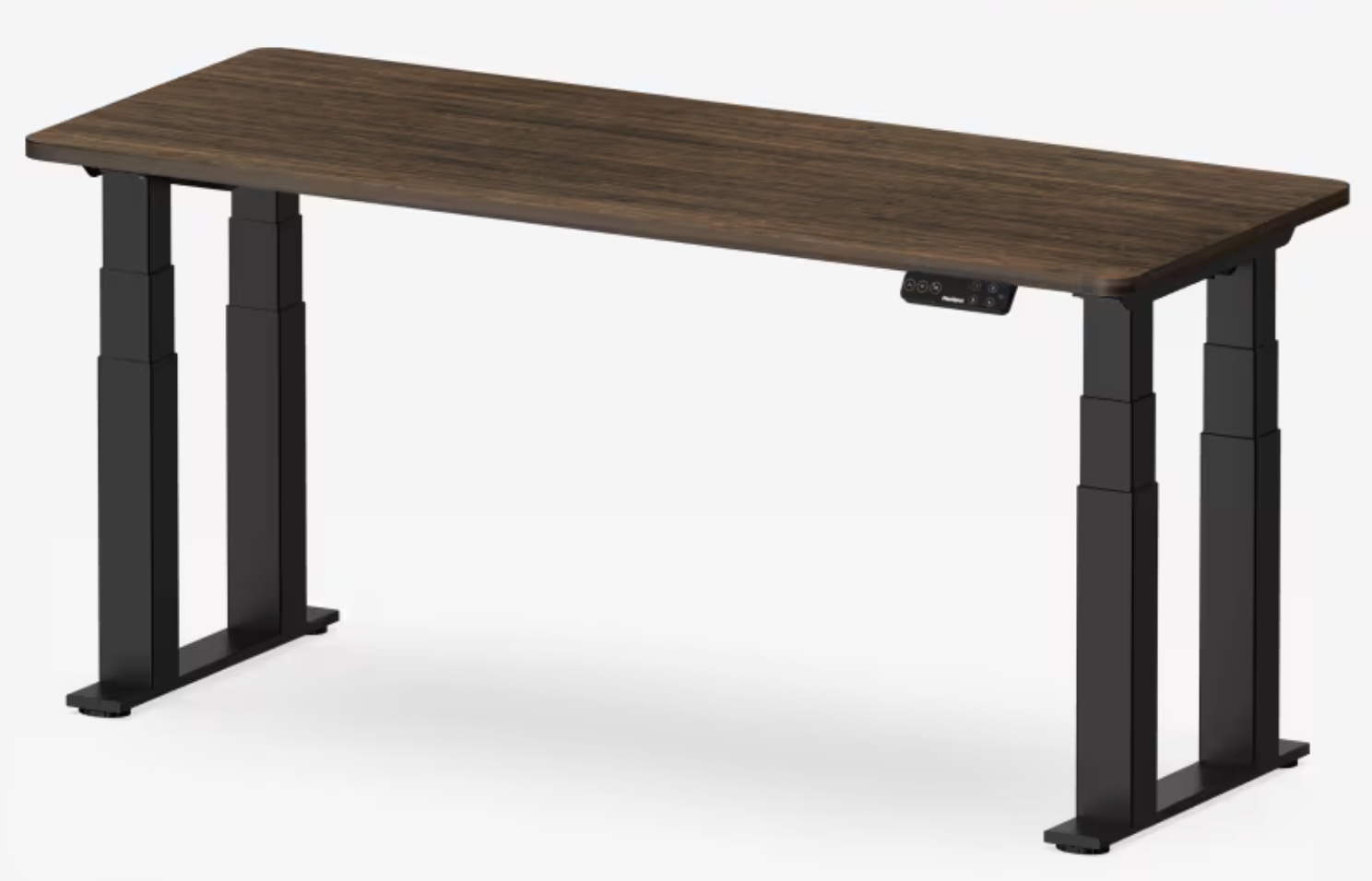
The FlexiSpot E7 Plus is the right desk for a specific and real use case: very wide setups with very heavy loads. Its four-leg, four-motor platform delivers the highest lifting capacity in our guide at 440 lbs and provides enhanced stability for configurations that would expose the limitations of a standard two-leg desk — wide dual-monitor arrays, heavy solid-wood tops, desktop towers, and large monitor arms. For that narrow audience, the E7 Plus is the strongest option available at its price point. For the majority of home office users who fall within the E7’s capabilities, the two-leg E7 delivers the same 3-stage engineering and 15-year warranty at lower cost, lower noise, and easier assembly.
How We Scored It
Category Deep-Dives
Structural Stability
8.5 / 10 30% weightingThe E7 Plus’s four-leg design addresses the central structural challenge of wide standing desks: lateral flex and torsional instability across large desktop spans. A standard two-leg desk — even a well-engineered one with a 3-stage frame — relies on a single crossbar and two lifting columns to maintain rigidity across the full desktop width. At 60 or 72 inches wide, the mechanical advantage of any lateral force increases with span, and even a high-quality two-leg platform will exhibit more flex at large widths than it does in a narrower configuration. The E7 Plus solves this by adding a second pair of legs: four lifting columns with front and rear crossbars create a fundamentally stiffer rectangular structure that resists lateral sway and torsional forces across any desktop width.
This stability advantage is most meaningful in specific scenarios. Users running a 72-inch or wider desktop with a heavy solid-wood top, multiple large monitors on arms, and a desktop tower — a total load approaching or exceeding 200 lbs — will notice a genuine stability improvement over the E7. Users with a 55-inch laminate top and two 27-inch monitors will notice essentially no difference; the standard E7’s 3-stage frame handles that configuration with stability to spare. The E7 Plus also carries BIFMA certification, validating its stability claims through independent testing — and its 440 lb lifting capacity is the highest in our guide, providing structural headroom that no two-leg desk can match.
The 8.5 structural score matches the standard E7 rather than exceeding it for a practical reason: the additional stability benefit of the four-leg design is load-dependent and width-dependent. In a BIFMA test at standard load and width, the performance difference between a 3-stage two-leg desk and a 3-stage four-leg desk is smaller than the absolute lift capacity figures suggest. Where the E7 Plus genuinely pulls ahead is at large spans under heavy loads — the use case for which it was designed.
Bottom line on structural stability: The four-leg platform provides the highest capacity and best stability under large, heavy loads in our guide. The 8.5 score reflects genuine engineering strength that is maximally relevant for wide, heavily loaded setups and incrementally relevant for standard home office configurations — where the standard E7’s three-stage two-leg design is already more than adequate.
Ergonomic Range
6.0 / 10 25% weightingErgonomic range is the E7 Plus’s most significant weakness relative to the rest of the FlexiSpot lineup, and it deserves direct attention before purchase. The E7 Plus’s height range of 26.0″ to 51.0″ at the frame (add ~1″ for desktop thickness) results in a work surface height range of approximately 27″ to 52″. The 27-inch minimum work surface is meaningfully higher than the standard E7’s 23.8-inch minimum and the UPLIFT V3’s 25-inch minimum. BIFMA’s G1 guideline identifies a work surface minimum of approximately 22–24 inches as necessary to accommodate shorter users at the 5th percentile of adult height.
At a 27-inch sitting minimum, users below approximately 5’4″ may find the desk cannot reach a comfortable seated ergonomic position — their elbows will be slightly elevated and their shoulders slightly raised to reach the keyboard surface. This is not a hypothetical edge case; it affects a meaningful portion of the adult population, particularly women. Users who fall within this height range should carefully measure their ideal seated keyboard height before purchasing the E7 Plus. The trade-off is inherent to the four-leg design: the additional leg pairs and their associated hardware increase the minimum collapsed height of the frame.
The upper end of the range fares better. A 52-inch maximum work surface height accommodates taller users comfortably — the 51-inch frame maximum is the highest in our guide alongside the Fully Jarvis — and is appropriate for users at 6’4″ and above who may find other desks at full extension uncomfortably short for standing. The 440 lb lifting capacity is the highest in the guide and provides extraordinary operational headroom; even the heaviest realistic home office setup (solid hardwood top, multiple large monitors, desktop tower, full accessory complement) will fall well short of this ceiling.
Bottom line on ergonomic range: The 6.0 score reflects a real and important limitation: the E7 Plus’s 27-inch minimum work surface height excludes shorter users from comfortable seated ergonomics. Taller users are well-served by the upper range; the 440 lb capacity is exceptional. Shorter users should measure their ideal sitting height before purchasing and seriously consider the standard E7 if they fall below 5’5″.
Motor & Controls
7.5 / 10 20% weightingThe E7 Plus uses a four-motor system — one motor per leg — electronically synchronized to provide a level, balanced lift across all four columns simultaneously. Four-motor synchronization is the most mechanically reliable approach to consistent height adjustment on a wide four-leg frame: each column is independently driven rather than receiving torque through a mechanical linkage, which eliminates the drift and misalignment risk that accumulates in systems using fewer motors than legs. Under asymmetric loads — where one side of the desk carries significantly more weight than the other, as is common in practice — all four motors maintain synchronized lift without the mechanical compensation required in simpler configurations.
The motor noise specification of under 50 dB is higher than the standard E7’s <45 dB rating, reflecting the four-motor system’s combined acoustic output. At 50 dB, the E7 Plus is audible during adjustment — roughly equivalent to a quiet office conversation level — though it falls within the range most users find acceptable for a brief height transition. The IKEA IDASEN, by comparison, runs at 58–63 dB, which is noticeably louder; the E7 Plus sits between the IDASEN and the quieter two-motor FlexiSpot desks. Users who share a space with others on calls or in quiet work environments will perceive the E7 Plus’s motor operation as more intrusive than the standard E7.
The keypad provides four height memory presets with one-touch recall and real-time height display — the same control interface as the standard E7 and the practical standard for this category. Anti-collision detection is included, stopping and reversing all four motors simultaneously when unexpected resistance is encountered. The coordination of four motors for anti-collision response is mechanically more complex than in a two-motor system; FlexiSpot’s implementation handles this reliably in normal home office use.
Bottom line on motor and controls: Four synchronized motors provide balanced, reliable lift with no drift risk on asymmetric loads. The <50 dB noise level is the trade-off for four-motor operation — audibly louder than the standard E7’s <45 dB but within acceptable range for most environments. Four memory presets and anti-collision are present as standard.
Warranty & Longevity
9.0 / 10 15% weightingThe E7 Plus carries the same 15-year comprehensive warranty as the standard E7, covering frame, motors, electronic control box, and keypad under a single term. This is the strongest warranty position in our guide alongside the UPLIFT V3 — and it applies to all four motors and their associated control electronics, not just the frame. For a desk built around a four-motor system that is more mechanically complex than a two-motor platform, a comprehensive 15-year warranty on those motors is a meaningful assurance of manufacturer confidence in their long-term reliability.
FlexiSpot’s four-motor architecture in the E7 Plus introduces more mechanical components than the standard E7 — four motors, four motor controllers, and a synchronization system that must coordinate all four simultaneously. More components means more potential failure points over a 15-year period. The comprehensive warranty mitigates this risk substantially, ensuring that any motor or controller failure during the warranty period is covered. FlexiSpot maintains aftermarket parts availability for the E7 Plus, and their customer support has a solid reputation for warranty claim handling across the lineup.
Bottom line on warranty and longevity: A comprehensive 15-year warranty on all four motors and the full electrical system provides strong long-term ownership protection on a desk with more mechanical complexity than the standard E7. The 9.0 score matches the standard E7 — the same comprehensive warranty applies to both, and FlexiSpot’s track record holds for the four-leg platform.
Value
5.0 / 10 5% weightingThe E7 Plus commands a significant price premium over the standard E7 — typically 60–80% more for a comparable desktop and size configuration. That premium buys two additional motors, two additional leg pairs, a second crossbar, and the structural headroom of 440 lb capacity. Whether those additions justify the premium depends entirely on the user’s actual setup requirements. For a home office user running a 60-inch laminate top with two 27-inch monitors and a laptop stand — a realistic and common configuration — the standard E7 handles the load with stability to spare. The E7 Plus’s additional capability is idle overhead rather than functional value.
The use cases where the E7 Plus’s premium is genuinely justified are specific: a 72-inch or wider desktop, a solid hardwood or stone top, three or more large monitors on arms, a full-size desktop tower, and a total load above 250 lbs. Users who can clearly check these boxes get a desk that the standard E7 cannot match in stability or capacity. Users who cannot check them are paying a significant premium for capabilities they will never use — and absorbing the trade-offs in ergonomic range and motor noise that come with the four-leg design.
Bottom line on value: The 5.0 score reflects a premium that is only justified for users with genuinely heavy, wide setups. The E7 Plus delivers real additional capability for those users — but for the majority of home office configurations, the standard E7 provides 90%+ of the performance at substantially lower cost and without the ergonomic range and noise trade-offs.
Assembly & Usability
5.5 / 10 5% weightingThe E7 Plus is materially more complex to assemble than the standard E7. Four lifting columns must be individually connected, two crossbars must be installed and aligned (front and rear), four motor cables must be routed and connected to the central control box, and the desktop must be positioned and attached across a wider span. Estimated assembly time for one person is 90–120 minutes; two people are effectively required for the desktop attachment step given the desk’s width and weight. FlexiSpot provides video instructions and organized hardware packaging, but the assembly process is inherently more demanding than any two-leg desk in the guide.
The initial height calibration sequence after assembly is the same as the standard E7: a button-hold procedure that establishes motor reference points for all four legs simultaneously. The synchronization process is slightly more complex than a two-motor calibration because four motors must be initialized in sequence, but FlexiSpot’s instructions document this clearly and it requires no special tools or expertise. Once calibrated, the day-to-day operation — keypad preset recall, anti-collision behavior — is identical to the standard E7 from a usability standpoint.
Bottom line on assembly and usability: Assembly is the E7 Plus’s most demanding category — two people and 90–120 minutes is a realistic expectation. The 5.5 score reflects a genuinely harder and longer assembly experience than any two-leg desk in the guide, though the instructions are adequate and the process is straightforward once organized. Daily usability after assembly is identical to the standard E7.
About the Manufacturer
Spot
FlexiSpot is a direct-to-consumer ergonomic furniture brand manufactured through its parent company Loctek Ergonomic Technology, which produces its own lifting columns, motors, and control systems. The E7 Plus sits at the top of FlexiSpot’s two-leg-expandable lineup, positioned above the standard E7 for users whose setup requirements exceed what a two-leg platform can optimally serve. FlexiSpot’s vertical integration through Loctek allows the E7 Plus to deliver a four-motor, four-leg platform with a 15-year comprehensive warranty at a price point significantly below what equivalent four-leg configurations from premium competitors command.
FlexiSpot’s standing desk lineup spans from the entry-level E5 (two-stage, dual motor, 5-year warranty) through the E7 (three-stage, dual motor, 15-year warranty) to the E7 Plus — a deliberate tiering that matches desk capability to user requirements without forcing unnecessary upgrades. The E7 Plus is designed for users who have outgrown what the E7 can reliably handle, not as a marketing premium on identical hardware. The engineering differences — additional legs, additional motors, higher lift capacity, dual crossbars — reflect genuine performance requirements for the heavy and wide configurations the E7 Plus is designed to support.
FlexiSpot’s 15-year comprehensive warranty applies to the E7 Plus’s four-motor system with the same terms as the standard E7 — a meaningful commitment on a more mechanically complex platform that reflects genuine confidence in Loctek’s motor reliability over a 15-year service period.