ST425 425VA Standby UPS
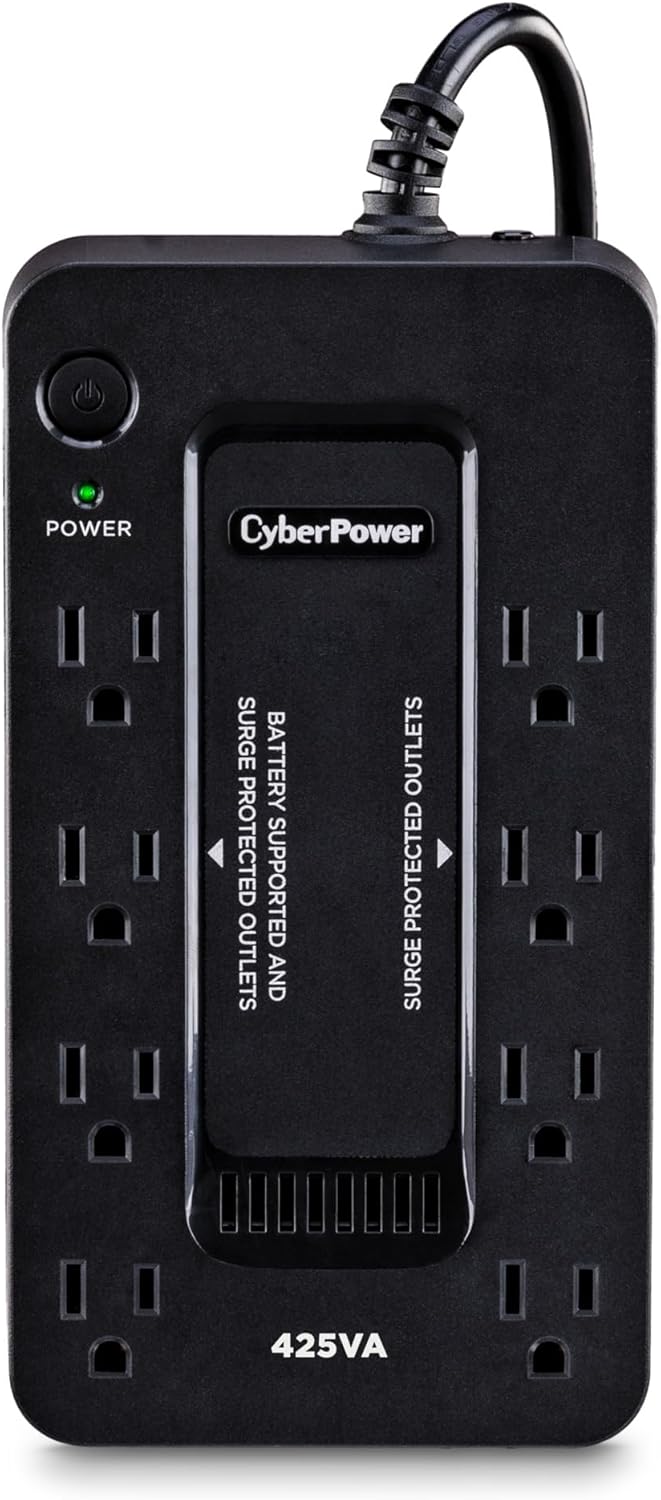
The CyberPower ST425 ranks last in our guide for reasons that are easy to state plainly: it is the lowest-capacity UPS we evaluated, offers the shortest runtime of any unit in our rankings, uses standby topology with no voltage regulation, and provides no software support for graceful shutdown. It exists to keep networking equipment alive through brief outages at the lowest possible price point — that narrow use case is the only scenario where it earns a recommendation. For protecting any home office workstation, it does not have the capacity to try.
How We Scored It
Category Deep-Dives
Power Protection
1.5 / 10 30% weightingThe ST425 uses a standby (offline) topology with no automatic voltage regulation. In normal operation, utility power passes directly to connected equipment while the unit sits idle. It activates only when it detects a complete power failure — and only then does the battery engage. Against brownouts, voltage sags, line noise, or any power quality event short of a full outage, the ST425 provides zero protection. Connected equipment absorbs every voltage fluctuation that the utility delivers, unfiltered.
The protection score of 1.5 reflects what this unit delivers in this category: basic battery failover against complete outages, with no active conditioning, no regulation, and a waveform that limits compatibility with higher-end equipment. Among all 15 units in our guide, this is the thinnest protection specification.
Bottom line on power protection: Standby topology means no protection against brownouts, voltage sags, or power quality events — battery failover for complete outages is the entire feature set.
Power Quality
2.5 / 10 20% weightingThis is the defining limitation of standby topology across all units in our guide, but the ST425 compounds it with a simulated (stepped) sine wave output during battery operation. Modern desktop computers with Active PFC power supplies are designed to operate on a clean sine wave. A simulated sine wave — an approximation that steps between discrete voltage levels rather than following a smooth curve — can cause audible buzzing, reduced efficiency, or in some cases, compatibility issues with sensitive electronics. For the equipment the ST425 is actually capable of powering (routers, modems, small switches), this limitation is less consequential — networking gear is generally tolerant of simulated sine wave output. But it further constrains the use case and earns the lowest protection score in our guide.
Bottom line on power quality: Simulated sine wave output on the smallest inverter in our guide — suitable for a modem and router, nothing more.
Usability & Features
2.0 / 10 20% weightingThe ST425 provides four battery-backed NEMA 5-15R outlets and LED status indicators — that is the complete feature summary. All four outlets are battery-backed, which is the most practical configuration for a unit of this size: at 260W capacity, there is no point in dedicating outlets to surge-only protection when the entire load must be managed carefully to stay within the watt ceiling. LED indicators report on-battery status, overload, and approximate charge level without any numerical readout.
There is no USB data port, no USB charging, no coaxial or RJ-45 data line protection, no LCD display, and no support for CyberPower’s PowerPanel software. The absence of data line protection is worth noting specifically for networking setups: a router and modem connected to this unit are protected from power surges through the power outlet, but a coaxial cable or phone line entering the modem is an unprotected path through which voltage spikes can travel. For a complete surge protection solution, an additional coax surge protector is recommended for any cable internet or DSL modem connection.
The ST425 has no USB data port and no support for CyberPower’s PowerPanel Business or Personal Edition software. This means there is no automated graceful shutdown capability: if the ST425’s battery is depleted during an unattended outage, any connected computer will experience an abrupt power cut with no warning and no opportunity to save open work. For a networking-only setup — the primary legitimate use case for this unit — the absence of software is less consequential, since a router and modem do not require graceful shutdown procedures. But it places the ST425 categorically below every CyberPower unit ranked above it in our guide, all of which include USB management connectivity and PowerPanel support.
Bottom line: Four battery-backed outlets and LED indicators. No USB port, no software, no data line protection, no display. Add a coaxial surge arrestor inline on any cable or DSL modem connection for complete protection.
Battery & Longevity
1.0 / 10 15% weightingAt 425VA / 260W, the ST425 is the lowest-capacity UPS in our entire guide. The Amazon Basics Standby UPS 800VA (#12, 3.5/10) — which itself sits near the bottom of our rankings — offers nearly double the wattage at a small price premium. A typical home office setup with a mid-range desktop computer, monitor, and basic peripherals will draw 200–350W under load — right at or exceeding the ST425’s 260W ceiling before the router, modem, and any other peripherals are added. In practice, the ST425’s capacity limits its useful load to networking equipment: a router (15–25W), modem (10–20W), and perhaps a small switch (5–15W) add up to 30–60W, comfortably within what the unit can handle and meaningful for maintaining internet connectivity during brief outages.
The approximately 1.5 minutes of runtime at full 260W load is the shortest in our guide. At a realistic partial load of 60–80W (networking gear only), runtime extends more usefully — perhaps 10–15 minutes depending on battery condition and ambient temperature — but the unit will never be useful for providing extended uptime to a desktop computer, because the desktop can’t be connected in the first place. The 425VA capacity is the hard ceiling that defines the ST425’s entire use case: it is a networking-equipment UPS, not a workstation UPS.
Bottom line: 425VA / 260W is the lowest capacity in our guide — too small for any desktop computer or workstation. Approximately 1.5 minutes at full load; longer at the realistic networking-only load of 60–80W. The capacity limitation defines the entire use case.
Value
3.0 / 10 10% weightingThe ST425’s value score of 3.0 acknowledges that it is inexpensive and, within its narrow scope, costs very little. But context is necessary: the Amazon Basics Standby UPS 800VA (#12, 3.5/10) offers nearly double the capacity (450W vs 260W) and slightly longer runtime for a small price premium. Both are bare-minimum standby units with no AVR and no software, and both are limited to networking equipment protection — but the 800VA buys meaningfully more capacity for a modest additional cost. The price gap between these two units does not justify the capability gap for buyers who can stretch even a small amount.
The value case for the ST425 is genuinely narrow: a buyer who needs a UPS only for a single router and modem, has no plans to expand the setup, and is working under the tightest possible budget will find the ST425 adequate for that specific purpose. Anyone with a slightly broader need — a second device, a NAS, a printer, any computer — should spend slightly more on a higher-capacity unit. Spending toward the bottom of our guide is not the path to value in UPS purchases; it is the path to inadequacy.
Bottom line: The least expensive UPS in our guide, but the Amazon Basics 800VA (#12) offers nearly double the capacity for a small premium. Genuine value only for buyers with a strict single-router use case and the tightest possible budget.
Physical Design
4.0 / 10 5% weightingThe ST425’s physical construction is the one area where CyberPower’s brand heritage partially offsets the product tier. The unit uses standard ABS housing consistent with budget UPS construction — compact desktop form factor, functional outlet seating, and an audible alarm for low battery and overload conditions. CyberPower includes a 2-year warranty — one year longer than the Amazon Basics Standby UPS 800VA’s 1-year coverage — and the standard CyberPower $75,000 Connected Equipment Protection (CEP) guarantee that covers equipment damaged while connected, subject to claim terms.
Battery replacement on the ST425 is user-accessible, following the standard CyberPower procedure of removing a panel to access the sealed lead-acid battery. Replacement batteries are available from CyberPower and third-party suppliers. The expected battery lifespan of 3–5 years under normal conditions is consistent with SLA batteries across our guide. The 4.0 build score is the one category where the ST425 distinguishes itself from the absolute bottom of our guide — the warranty and CEP coverage are genuine positives relative to the cheapest alternatives.
Bottom line: Adequate construction with a 2-year warranty and $75,000 CEP. CyberPower’s warranty terms are better than the Amazon Basics standby unit. Battery is user-replaceable. The one relative strength in the ST425’s scorecard.
About the Manufacturer
Power
CyberPower Systems (USA) is the North American division of Cyber Power Systems, Inc., headquartered in Zhonghe District, New Taipei City, Taiwan, with US operations in Shakopee, Minnesota. Founded in 1997, CyberPower is one of the largest UPS manufacturers globally and produces units across the consumer, small business, and data center segments. Their PowerPanel software suite is available for all CyberPower UPS units with USB management connectivity — the ST425 does not include that port and cannot use it.
CyberPower’s standard warranty on consumer UPS products is 2 years on parts and labor, with the Connected Equipment Protection (CEP) program covering damage to equipment connected to the UPS at the time of a qualifying surge event, up to $75,000. CEP claims are subject to CyberPower’s published terms and conditions.