Nighthawk RS700S
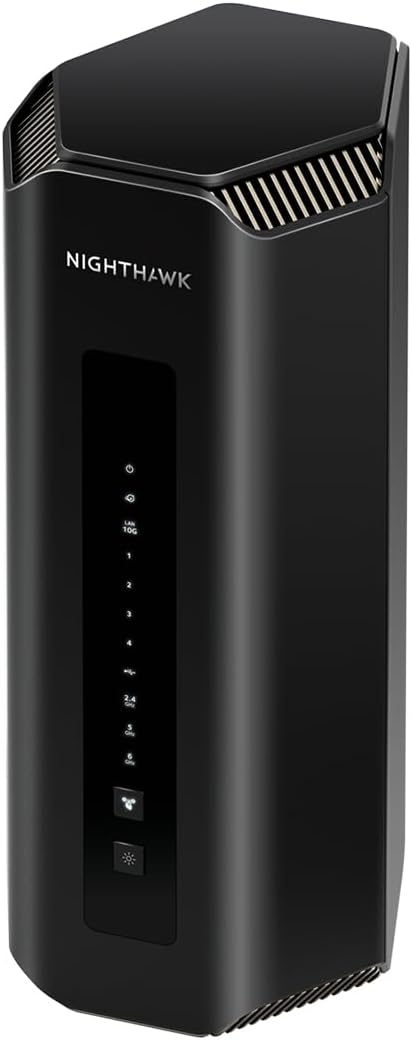
The NETGEAR Nighthawk RS700S is the pure-speed play among standalone routers in our guide: a BE19000-class tri-band Wi-Fi 7 unit whose wireless throughput trades blows with anything we have evaluated, wrapped in a clean tower design with 10G ports on both the internet and LAN side. The reasons it ranks #12 rather than higher are the familiar NETGEAR ones: its best security features become a paid Armor subscription after the first year, the VPN story is a single dated OpenVPN server, the remaining LAN ports are plain gigabit, and NETGEAR’s firmware record trails ASUS and eero. Superb radio; the software economics are what you are weighing.
How We Scored It
Category Deep-Dives
Coverage & Range
7.5 / 10 20% weightingThe RS700S is rated for roughly 3,500 sq ft of 360-degree coverage from its internal antenna array — the same figure as the flagship ASUS RT-BE96U, and genuinely strong for a single unit. The tower design radiates evenly in all directions, which makes central placement effective, and independent testing shows it holds usable 6 GHz signal at better range than most Wi-Fi 7 towers. Centrally placed in a typical single-family home, it reaches every room.
What it lacks is a growth path. Unlike ASUS’s AiMesh ecosystem, the Nighthawk RS700S is standalone only — there is no satellite to add and no mesh mode to enable. If your needs outgrow it, the answer is a different product (NETGEAR would point you at Orbi), not an addition to this one. For buyers confident their footprint fits inside 3,500 sq ft, that is academic; for anyone on the boundary, it is a real consideration.
Bottom line on coverage: Excellent single-unit reach that matches the best standalone towers — with no expansion path if you outgrow it. Buy it for the home you have, not the one you might move to.
Reliability & Stability
7.5 / 10 20% weightingThe hardware foundation is flagship-grade: a quad-core 2.6 GHz Broadcom processor with 2 GB of RAM and 512 MB of storage — the same silicon class as the top ASUS units, with headroom to route multi-gig traffic and a busy household’s device fleet without strain. Day-to-day owner-reported stability is solid, and the platform has matured considerably since its 2023 launch as one of the first Wi-Fi 7 routers to market.
The deduction is the vendor track record. NETGEAR’s firmware reputation trails ASUS and eero: updates have historically arrived less predictably, early-firmware feature gaps on this platform took longer to close than ASUS’s equivalent teething issues, and the long-term support horizon for any given model is less consistent than the multi-year cadence ASUS has established. None of this makes the RS700S unreliable as a daily driver — but our framework weights the multi-year picture, because a home office router is a five-year purchase.
On long-term support risk of the regulatory kind, NETGEAR is clean: a U.S.-headquartered company with no exposure to the 2026 FCC restrictions on newly certified foreign-made routers or the TP-Link-specific review.
Bottom line on reliability: Strong hardware and solid daily stability, marked down for NETGEAR’s less consistent firmware history — the same deduction we apply to the Orbi 970. Zero U.S. regulatory exposure.
Speed & Throughput
9.5 / 10 15% weightingThis is why the RS700S exists. It is a BE19000-class tri-band Wi-Fi 7 router — up to 19 Gbps of combined rated throughput across 2.4, 5, and 6 GHz — with 320 MHz channels, 4K-QAM, and MLO all present. In independent benchmarks it has consistently placed at or near the top of the standalone field, trading the wireless crown back and forth with the ASUS RT-BE96U: multi-gigabit real-world speeds to a Wi-Fi 7 client at close range, and excellent throughput retention at distance on the 6 GHz band.
The wired side covers the essentials for a fast home office: take a multi-gig fiber plan in on the 10G internet port and hard-wire the work desktop or a NAS to the 10G LAN port at full speed. The four remaining gigabit ports handle the printer-and-console tier. For a buyer pairing one fast wired desk with top-shelf wireless everywhere else, the port budget is spent in exactly the right places.
Bottom line on speed: Among the fastest wireless performers we have evaluated, with 10G in and 10G out. Nothing about this category holds the RS700S back from the top tier.
Call & VPN Performance
7.5 / 10 15% weightingCall quality on the RS700S is carried by raw capacity rather than controls. With this much spectrum and processing headroom, a video call simply does not contend for airtime in most households, and MLO gives Wi-Fi 7 clients two-band resilience when interference hits mid-call. The 10G LAN port makes the wired-desk setup — still the best call-quality move — trivial. What is thinner is the active layer: the Nighthawk app offers only basic QoS-style prioritization, well short of the per-device control ASUS’s Adaptive QoS provides, so on a congested network you have fewer levers to pull.
The VPN column is better than NETGEAR’s Orbi line — but only just. The RS700S includes a built-in OpenVPN server for remote access back to your home network, which works but shows its age: setup requires Dynamic DNS, client compatibility is finicky with current OpenVPN releases, and there is no WireGuard, no IPSec, and no per-device tunnel routing. Every ASUS unit in this guide ships all of the above; the GL.iNet Flint 2 makes a specialty of it.
Bottom line on calls & VPN: Dependable call performance through sheer capacity, plus a functional-but-dated OpenVPN server. Remote workers with serious router-level VPN needs should buy ASUS or GL.iNet instead.
Security & Management
7.0 / 10 15% weightingThe fundamentals are present: WPA3, automatic firmware updates, a guest network, and a separate IoT network option to keep smart-home devices away from the work machine. The “S” in RS700S buys the first year of NETGEAR Armor — the Bitdefender-powered suite covering threat protection, vulnerability scanning, and device-level security across the network — included in the box.
Then year two arrives, and Armor becomes a subscription at roughly $99.99/year. Our framework applies an explicit penalty to subscription-gated security, and it lands here exactly as it does on the Orbi 970: over a five-year ownership window the recurring cost rivals the hardware’s price, while ASUS includes its equivalent suite free for the life of the device. The included first year softens the comparison without changing its direction — the RS700S’s best security features are rented, not owned.
Management follows the NETGEAR pattern: the Nighthawk app is clean for daily tasks but shallow and salted with Armor upsell prompts, while the web UI exposes a usable middle tier of settings — more than eero, far less than ASUS — with modest segmentation and QoS control capping what a power user can do.
Bottom line on security: Solid fundamentals and a genuinely good Bitdefender suite — for $99.99/year after the trial. The subscription penalty plus middling management depth earn the amber score, the same call we made on the Orbi 970.
Connectivity & Value
8.0 / 10 15% weightingThe port array is a study in priorities: one 10G internet port, one 10G LAN port, and four gigabit LAN ports, plus a USB 3.2 port for shared network storage. The two 10G ports are the right two — full-speed multi-gig WAN in, one full-speed wired desk or NAS out. The gap is the middle tier: there are no 2.5G ports at all, so a second fast device means choosing between the lone 10G LAN port and falling to gigabit, where the ASUS RT-BE92U gives every port multi-gig and the RT-BE88U adds a switch’s worth. No 4G/5G tethering failover either; the USB port is for storage.
On value, the RS700S sits in premium territory — typically between the RT-BE92U and RT-BE96U — and the math depends on what you count. Counted on launch-day wireless speed per dollar, it holds its own with anything in the guide. Counted over five years with Armor’s annual fee added to reach feature parity with what ASUS includes free, the total cost of ownership climbs past hardware that outranks it. That second view is the one our framework weights.
Bottom line on connectivity & value: The right two 10G ports and top-shelf wireless for the money — undermined by an all-gigabit middle tier and a subscription that compounds the price every year you own it.
About the Manufacturer
NETGEAR is a U.S. networking company (founded 1996, headquartered in San Jose) and one of the longest-standing names in consumer Wi-Fi. Its modern identity rests on two lines: the performance-oriented Nighthawk routers and the premium Orbi mesh family. The Nighthawk badge has anchored NETGEAR’s standalone performance tier for over a decade.
The Nighthawk RS700S, released in 2023, was among the first Wi-Fi 7 routers on the market and marked a design reset for the line — the aggressive winged look of earlier Nighthawks gave way to a clean tower with internal antennas. The “S” designation bundles the first year of NETGEAR Armor security. It remains the company’s flagship standalone router.
For home office buyers, NETGEAR’s profile is consistent across both lines: premium hardware engineering and class-leading radio performance, paired with a subscription-forward software strategy (Armor) and a firmware reputation that trails the best in the category. A U.S.-headquartered vendor, NETGEAR has no exposure to the 2026 FCC import restrictions.