Facecam MK.2
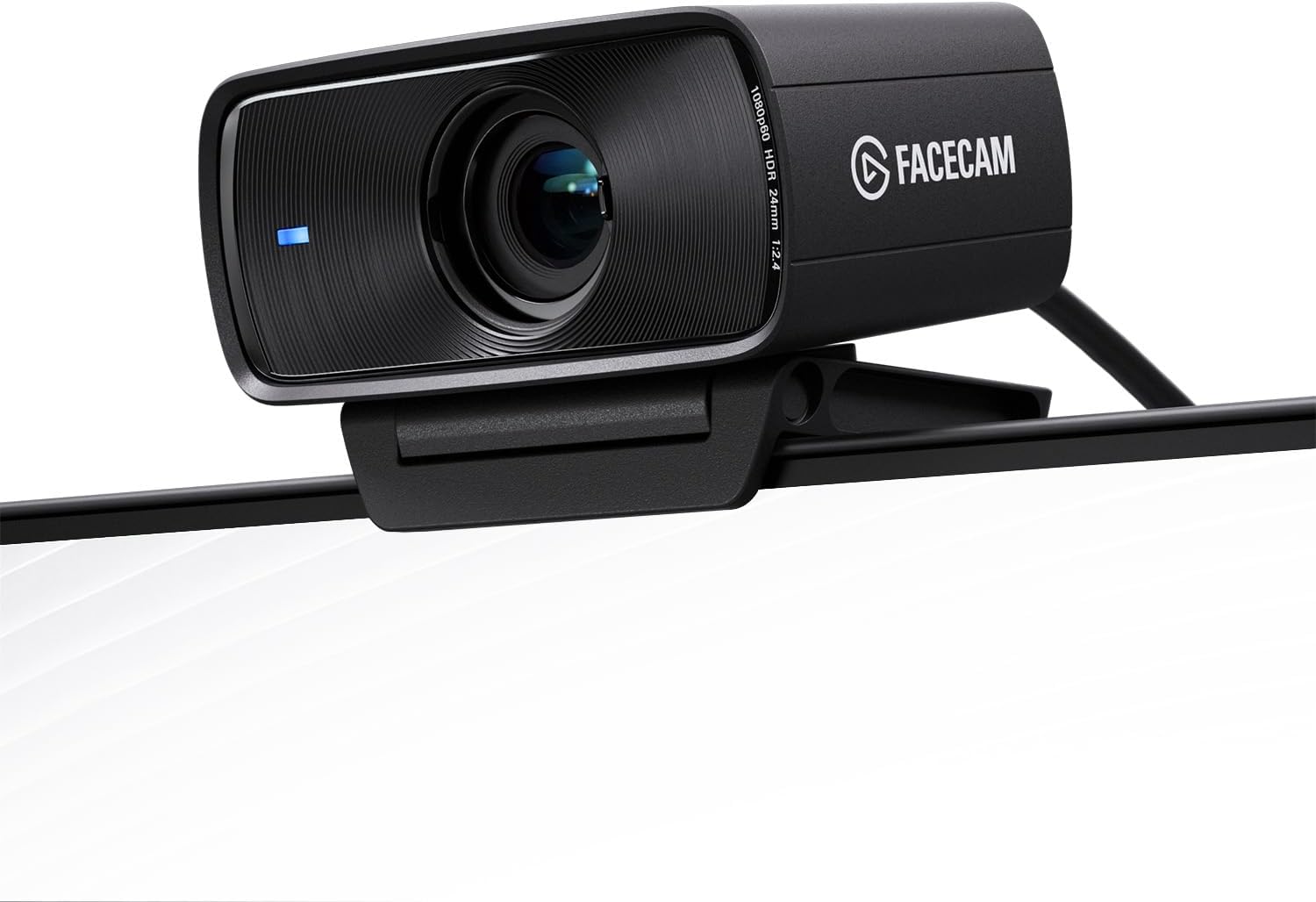
The Elgato Facecam MK.2 is a 1080p/60fps webcam built around a Sony Starvis sensor — the same sensor family that powers the Facecam Pro — and controlled through Elgato Camera Hub, the best webcam software in the category. The MK.2’s key upgrade over the original Facecam is autofocus: the first-generation model’s fixed-focus system was its most-cited limitation, and the MK.2 addresses it cleanly. The result is a camera with exceptional image quality for its resolution class, smooth 60fps output, and precise manual control that no competing 1080p webcam at this price offers in the same depth. The ceiling is the resolution itself: at its price, 4K competitors exist — the Facecam Pro at twice the price delivers 4K at 60fps on the same Sony Starvis platform — and buyers who are resolution-limited should weight that trade-off carefully. For users who are committed to 1080p and want the best-performing camera in the class, the MK.2 makes a compelling case. Its built-in microphone is decent for calls without being exceptional, and the absence of AI tracking or framing reflects Elgato’s deliberate philosophy of manual control over automation.
How We Scored It
Category Deep-Dives
Image Quality
7.5 / 10 30% weightingThe Facecam MK.2’s core imaging advantage is its Sony Starvis sensor — the same sensor family that powers the Facecam Pro at 4K. At 1080p, the Starvis sensor delivers per-pixel quality that most competing webcams in its price range cannot match: better low-light sensitivity, more accurate color reproduction, and cleaner images in the mixed, often inadequate lighting of real home office setups. At f/2.4, the aperture admits more light than the f/2.8 or slower lenses found in competing 1080p cameras, further strengthening performance in dim environments.
The 60fps output at 1080p is genuinely smoother than 30fps alternatives in the same class. For video calls, the practical difference is modest but perceptible — motion is rendered with less judder during head movement, and the overall impression of a live connection is more fluid. For recording and streaming, 60fps is a meaningful specification step up from what most 1080p webcams offer. The MK.2 retains 60fps as its maximum frame rate at all resolutions, unlike cameras that cap 60fps to 720p.
The autofocus system — the MK.2’s defining upgrade over the original Facecam — is reliable and well-tuned for stationary desk use. It acquires and holds focus on a face at typical webcam distances without the hunting behavior that plagues some autofocus systems, and the transition when refocusing is gradual rather than abrupt. The original Facecam’s fixed-focus implementation required buyers to sit at a precise distance from the camera; the MK.2 eliminates that friction entirely.
The 7.5 image quality score reflects a camera with genuinely excellent quality for its resolution tier, held back only by the resolution ceiling itself. At 1080p, the MK.2 is the best-performing webcam in its class. That said, the Facecam Pro captures the same image characteristics at 4K — twice the linear resolution — and several 4K webcams in our guide sit at similar price points. For buyers who specifically want the best 1080p camera, the MK.2 earns its position. For buyers who are resolution-neutral, the value comparison with 4K alternatives is worth examining.
Bottom line on image quality: Sony Starvis sensor and 60fps combine to produce the best image quality of any 1080p webcam at this price tier. Autofocus is reliable and well-calibrated for desk use. The 1080p ceiling is the constraining factor against the broader webcam market, where 4K has become increasingly accessible at similar price points.
Audio Performance
6.5 / 10 25% weightingUnlike the Facecam Pro — which made the deliberate choice to omit a microphone entirely — the Facecam MK.2 includes dual built-in stereo microphones. The inclusion addresses the most practical limitation of the Facecam line for home office use: the Pro required a separate audio input for video calls, making it a two-purchase solution for call-only users. The MK.2 is a self-contained solution for both video and audio in a call context.
Audio quality is adequate for the intended use case. The microphones capture voice intelligibly with reasonable clarity at standard webcam-to-speaker distances of 50–80cm. Background rejection is present but limited — the microphones will capture keyboard clicks, HVAC noise, and ambient room sound at noticeable levels in open office environments or rooms with hard surfaces. Dedicated USB desk microphones at the same price tier, such as the Blue Snowball iCE or Elgato’s own Wave series, will outperform the built-in mics on voice isolation and overall quality by a meaningful margin.
For the primary webcam use case — video calls from a quiet home office — the MK.2’s microphones perform well. Colleagues on the other end of a Zoom or Teams call will hear clear, natural voice reproduction without significant complaints. The limitation reveals itself in noisier environments or in recordings where audio quality is scrutinized rather than merely functional. The 6.5 score reflects microphones that are a genuine positive over no microphone (as on the Pro), but that fall short of the best integrated microphone implementations in the webcam category.
Bottom line on audio performance: Dual stereo microphones provide an all-in-one solution for video calls — a meaningful improvement over the Facecam Pro’s no-mic approach. Audio quality is adequate for calls in quiet environments; not competitive with dedicated USB microphones for recording or noisy setups. The 6.5 score reflects honest utility without overstating performance.
Usability & Features
7.5 / 10 20% weightingElgato Camera Hub is the defining feature of the MK.2’s usability story, and it remains the best webcam control software in our evaluation. Where the vast majority of webcam applications offer basic sliders for brightness and contrast — or worse, make the camera fully automatic with no user control — Camera Hub exposes the full imaging pipeline: shutter speed, gain (ISO equivalent), white balance, and focus, each individually adjustable or restorable to automatic. Users who understand these parameters can dial in a consistent, optimized image for their specific lighting conditions and maintain it across sessions via saved presets. Scene presets allow quick switching between call setups, streaming configurations, and recording looks without re-adjusting every parameter individually.
The MK.2 connects via a detachable USB-C cable — a practical upgrade over webcams with captive cables, as cable damage no longer renders the camera unusable. The camera is plug-and-play on Windows, macOS, and ChromeOS as a standard UVC device; Camera Hub is optional enhancement rather than a functional requirement for basic use. All major video conferencing platforms — Zoom, Microsoft Teams, Google Meet, Webex — recognize the MK.2 without additional configuration.
The Facecam MK.2 has no AI tracking or AI framing. Competitors including the Obsbot Meet 2 and Insta360 Link 2C include motorized pan/tilt gimbal systems that automatically keep the subject centered as they move; the Logitech MX Brio 705 offers software-based Show Mode auto-framing. The MK.2 is a fixed camera — you are framed where you sit. This reflects Elgato’s explicit product philosophy: manual control and manual setup over automated assistance. For users who sit in a consistent position and value predictability and control, this is the correct approach. For users who move around their workspace during calls, AI tracking competitors address a real need the MK.2 does not.
There is no privacy shutter. The lens is physically exposed at all times; disabling the camera in software is the only mechanism for privacy. This is consistent with the Facecam Pro and reflects a content-creator lineage where a dedicated privacy shutter is not typically a priority. For home office users who share their workspace or work in regulated environments with camera-off requirements, this is worth noting.
Bottom line on usability and features: Camera Hub is the strongest webcam software in the category, providing DSLR-level manual control unavailable elsewhere. Detachable USB-C cable and reliable autofocus are practical positives. The absence of AI tracking and a privacy shutter are deliberate Elgato choices that serve some users well and will disqualify the MK.2 for others who depend on those features.
Value
7.0 / 10 15% weightingThe Facecam MK.2 is priced at the mid-tier of the webcam market. At that price, its combination of Sony Starvis sensor, 60fps, Camera Hub software, autofocus, and built-in microphone represents a strong specification set for a 1080p camera. No other webcam in its price tier combines all of those elements; the value case for 1080p buyers is genuine.
The value calculation changes when the comparison is extended to 4K alternatives. At a similar price, the guide includes the Logitech Brio 4K (7.3/10, #8) and the Anker PowerConf C300 (7.1/10, #10). The Brio 4K offers four times the pixel count at a similar price. For buyers who are camera-agnostic and simply want the best overall package at this price, the resolution comparison is worth examining. The MK.2 earns its score against those alternatives by delivering better per-frame image quality at its native 1080p resolution than most 4K webcams deliver at 1080p — 4K webcams that also support 1080p generally do so with acceptable but not exceptional image quality in that mode.
The higher-tier comparison is the Facecam Pro at roughly twice the price. The Pro adds 4K at 60fps, a slightly larger f/2.0 aperture, and a larger sensor — but removes the built-in microphone. For buyers who do not own a dedicated microphone, the MK.2’s included audio makes it a more complete solution than the Pro despite the resolution step down. For buyers who already own a microphone and want maximum image quality, the Pro is the more logical choice. The MK.2 fills a real position between the budget 1080p market and the premium Pro.
Bottom line on value: The best-specified 1080p webcam at its price point — Sony Starvis, 60fps, Camera Hub, autofocus, and microphone is a package no competitor fully replicates. The value case narrows for buyers comparing 4K alternatives at similar prices, where resolution becomes the deciding factor. The 7.0 score reflects strong value for a defined audience and honest competitive pressure from the broader market.
Physical Design
8.0 / 10 10% weightingThe Facecam MK.2 carries the same premium design language as the Facecam Pro: a compact, matte-finished enclosure with an angular silhouette that reads as professional rather than consumer-grade. The build quality is above the webcam category standard — there is no creaking or flex in normal handling, port fitment is solid, and the overall finish is consistent with Elgato’s streaming equipment aesthetic. Sitting on top of a monitor, the MK.2 is one of the more visually refined cameras in the guide for buyers to whom desk aesthetics matter.
The detachable USB-C cable is a practical design advantage. Webcams with captive cables are permanently compromised if the cable is damaged at the connector or along its length; the MK.2’s detachable design allows cable replacement without camera replacement and supports routed cable management more cleanly. The mount clip accommodates standard monitor bezels reliably and includes a standard tripod thread for alternative mounting positions. The 82° diagonal field of view is appropriate for solo framing at a typical desk distance.
As noted in usability, there is no privacy shutter. The design also omits an LED indicator light visible to the camera user when the camera is active — activity status is visible only through the operating system’s camera-in-use indicator. The 8.0 score reflects genuinely excellent construction and design coherence for the category, with the privacy shutter omission being the one gap against competitors that include it.
Bottom line on physical design: One of the better-designed webcams in the guide — premium build quality, clean aesthetic, detachable USB-C cable, and a reliable monitor clip. The absent privacy shutter is the design’s main limitation relative to the best-equipped competitors. The 8.0 is the MK.2’s highest category score.
About the Manufacturer
to
Elgato is a brand owned by Corsair, which acquired the company in 2018. Founded as a consumer electronics firm, Elgato pivoted to become one of the defining brands in the streaming and content creation equipment market — best known for its Stream Deck macro controllers, capture cards, key lights, and Facecam line of broadcast-oriented webcams. The Facecam MK.2 sits below the Facecam Pro in Elgato’s lineup and targets buyers who want the Elgato Camera Hub experience and Sony Starvis image quality at a more accessible price point without the 4K requirement.
Elgato’s product philosophy across the webcam line is consistent: prioritize image quality and manual control over automated AI features, pair the hardware with best-in-class software, and build to a material standard above the consumer norm. The MK.2 extends that philosophy to 1080p while addressing the original Facecam’s autofocus gap. Corsair’s ownership provides manufacturing scale and stable retail distribution. Camera Hub is actively maintained and has received consistent feature additions since the Facecam line’s introduction. Elgato products are sold through Amazon, the Elgato direct store, and major electronics retailers.