Embody
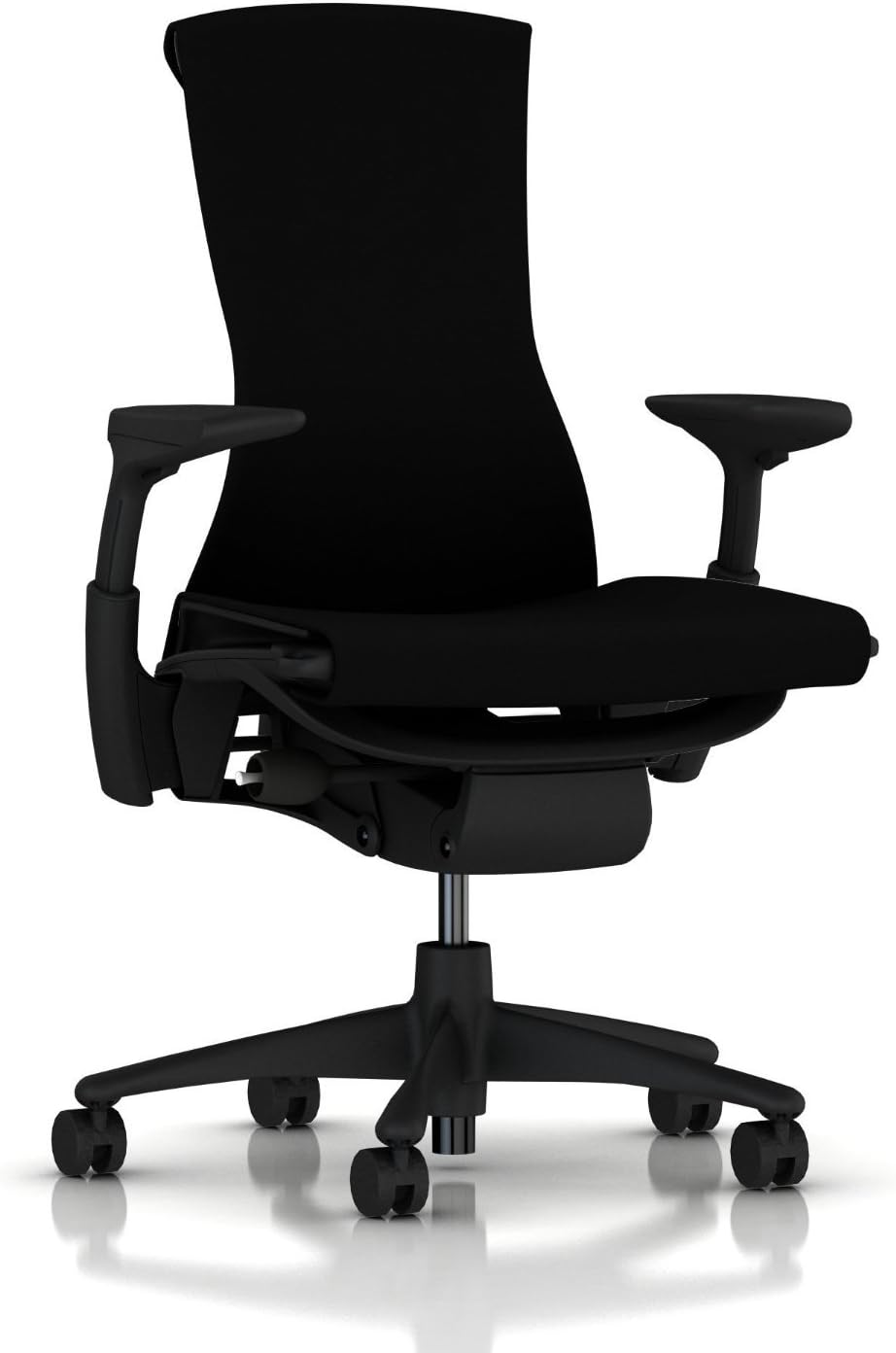
The Embody holds the most sophisticated back system of any chair in our guide — a three-layer Pixelated Support matrix designed to equalize pressure across the entire spine, not just the lumbar zone. Its 9.5 build quality score is the highest we’ve awarded, backed by nearly two decades of commercial deployment in healthcare and research environments.
How We Scored It
Category Deep-Dives
Ergonomics & Support
9.0 / 10 30% weightingThe Embody’s Pixelated Support system consists of three concentric layers: an outer rigid frame that defines the back shape, an inner matrix of flexible polymer ribs, and hundreds of small “pixel” cells that independently contact and respond to the user’s spine. The design intent is micro-adaptation — not just lumbar support, but distributed pressure equalization across the entire back surface. Where most ergonomic chairs target a single lumbar zone, the Embody is engineered to maintain support contact across the full spinal column simultaneously.
Backfit 2.0 provides a tilt adjustment of the upper back angle to match individual thoracic curvature. This is a meaningful distinction from chairs that assume a uniform spinal profile: the thoracic spine angle varies considerably between individuals, and a back that aligns correctly with the lumbar for one user may impose an incorrect angle on the thoracic curve for another. Backfit 2.0 decouples these adjustments to allow proper alignment across the full back, not just the lower portion.
In practice, the Embody is the most pressure-equalizing back in our guide. It is designed to maintain blood flow and reduce static loading across the full spine — Herman Miller’s own research cites this as the primary design goal, and independent long-term user feedback confirms that the chair’s approach to distributed contact is effective at reducing back fatigue in extended sessions. The 9.0 reflects this sophisticated back system; the marginal gap versus the Gesture (9.2) is in seat pan ergonomics — the Embody’s tilt mechanism is excellent, but the seat interaction under recline is slightly less sophisticated than the Gesture’s Natural Glide system, which moves the seat pan forward and downward as the user reclines to maintain a consistent pelvis-lumbar relationship.
Bottom line on ergonomics: The most pressure-conscious back system in our guide. Full-spine contact equalization rather than point lumbar support. A genuine architectural distinction, not a marketing claim.
Comfort & Materials
8.0 / 10 25% weightingThe Embody’s open mesh provides good breathability — better than foam-backed alternatives like the Gesture, and in the same performance range as the Aeron and Haworth Fern. Heat retention is not a concern for the back; the open structure allows airflow during extended sitting. The seat uses a foam cushion that is well-reviewed for long-term retention.
The Pixelated Support system, while ergonomically sophisticated, can feel firm at initial contact for some users compared to the Gesture’s foam back or even the Aeron’s mesh. This is by design: the Embody is engineered for pressure distribution and micro-adaptation rather than cushioned softness. Users who expect a chair in this tier to feel immediately plush sometimes find the Embody’s initial feel less welcoming than alternatives — even though its long-term ergonomic performance is strong. The polymer pixel cells have a specific tactile quality that is different from what most people’s experience with chairs has led them to expect.
In extended sessions of six hours or more, the pressure-equalization approach tends to outperform conventional chairs at reducing lower-back fatigue and discomfort. The tradeoff is onboarding: the Embody is a chair that frequently improves with user familiarity. First-time sitters from foam or standard mesh chairs occasionally find the initial feel neutral to slightly firm before the chair’s distributed contact system demonstrates its advantage over longer periods.
Bottom line on comfort: Excellent long-term comfort profile; the onboarding feel is different from conventional chairs. Breathability is strong. Users who prioritize immediate plushness should evaluate the Gesture or Aeron alongside it.
Value for Money
7.5 / 10 20% weightingThe Embody is priced at the upper range of our guide at new retail. The 12-year warranty is strong and the durability track record is excellent — the cost-per-year calculation is favorable when amortized across the chair’s actual working life, which in documented commercial environments frequently exceeds the warranty period.
The primary value-side limitation relative to the Steelcase options is the certified refurbished market. Herman Miller operates a certified pre-owned program through select authorized dealers, but it is less mature and has significantly less consistent availability than the Steelcase refurb ecosystem. Dealers like Crandall Office Furniture specialize in Steelcase remanufacturing with fresh warranty coverage; the equivalent pipeline for Herman Miller chairs requires more searching and has more variable inventory. For buyers who can access new retail or an authorized pre-owned dealer directly, the value case is reasonable given the build quality and longevity. For buyers hoping to access the deep-discount certified-refurb tier that the Steelcase market offers, the path is less straightforward.
The Embody’s resale value is strong — it is a recognized, sought-after chair with an established user community. Buyers who purchase and later resell will not face the significant depreciation that mid-market chairs exhibit. This partially offsets the higher acquisition cost on a net-cost basis.
Bottom line on value: Defensible on a cost-per-year basis given durability; the refurb market is less developed than Steelcase’s. Evaluate total cost of ownership rather than sticker price alone.
Build Quality & Longevity
9.5 / 10 15% weightingHerman Miller has manufactured the Embody since 2008 and it is used in healthcare, research, and institutional environments where durability is a prerequisite rather than a preference. This is a meaningful data point: chairs that fail in commercial environments are removed and replaced; the Embody’s continued presence in demanding professional settings across nearly two decades of production is a real-world durability signal that no amount of marketing copy can substitute for.
The polymer pixel cells, the flexible rib matrix, and the outer back frame are all engineered for long-term fatigue resistance — the mechanical property that determines whether a component degrades under repeated loading cycles. The 12-year warranty covers all mechanical components, the cylinder, and the base. Herman Miller’s warranty service through its authorized dealer network is well-documented in long-term owner communities.
At 9.5 — the highest build quality score in our guide — the primary driver is the Embody’s documented commercial durability record. Herman Miller’s manufacturing standards are among the most rigorously documented of any chair maker in our guide, with ISO certifications and published materials specifications that go beyond standard marketing claims. This is a chair designed and proven for institutional-grade lifetimes.
Bottom line on build: The highest build score in our guide. Institutional-grade durability backed by nearly 20 years of commercial deployment, not just warranty language.
Adjustability Range
8.5 / 10 7% weightingThe Embody includes standard 4D arms (height, width, depth, and pivot), seat height, seat depth adjustment, recline tension, and Backfit 2.0 thoracic tilt. The overall adjustment inventory is comprehensive and appropriate for the majority of users across a wide range of body types and working styles.
The primary distinction from the top-scoring chairs in this category is the absence of a seat-forward tilt mechanism analogous to the Gesture’s Natural Glide or the Leap V2’s flexible seat. The Embody’s recline operates as a more conventional pivot rather than a forward-sliding system. This is a genuine ergonomic distinction for users who spend time in reclined postures: the Natural Glide system maintains the pelvis-lumbar relationship through the recline arc in a way the Embody’s mechanism does not fully replicate. For users who primarily work in a moderately upright position, this distinction is minor. For users who recline significantly for calls or reading, it is worth evaluating directly against the Gesture.
The Backfit 2.0 adjustment adds meaningful capability that most chairs in this tier lack — the ability to tune thoracic curvature alignment independently is not a trivial feature, and it contributes meaningfully to the ergonomic depth of the Embody’s adjustment set.
Bottom line on adjustability: Comprehensive and well-considered. The absence of a seat-forward tilt mechanism is the primary gap versus the top adjustability scores in our guide.
Aesthetics & Footprint
9.0 / 10 3% weightingThe Embody has a distinctive, technical aesthetic — the visible ribs, the pixel back structure, and the central spine create an immediately recognizable profile that reads as purposefully engineered. It is the most visually distinctive chair in our guide; where the Gesture is understated and the Aeron has its iconic mesh silhouette, the Embody’s structure is openly mechanical in a way that some users find appealing and others find busy.
Multiple fabric colorways are available, including neutral grays and darker tones that integrate well into professional home office settings. The chair is slightly more visually complex than the Gesture — there is more visible structure from any angle — but its technical profile is consistent and coherent rather than arbitrary. For home offices where the chair will be prominent in video calls or photography, the Embody makes a strong visual impression. The footprint is standard for this class of chair.
Bottom line on aesthetics: The most visually distinctive chair in our guide — purposefully engineered rather than conventional. A genuine aesthetic statement for those who want it; may be more than some users want visually.
About the Manufacturer
Miller
Herman Miller was founded in 1905 and is headquartered in Zeeland, Michigan. It is one of the most recognized names in premium office seating globally — the Aeron chair, introduced in 1994, is the defining product of its category and remains one of the most widely recognized office chairs ever produced. The Embody was developed in collaboration with designers Bill Stumpf and Jeff Weber and has been in continuous production since 2008.
In 2021, Herman Miller merged with Knoll to form MillerKnoll. Both brands continue to operate independently under the combined parent. Herman Miller chairs are sold through authorized dealers and via Amazon; the authorized dealer network includes specialty ergonomics retailers and corporate furniture outfitters. Herman Miller products are standard equipment in many Fortune 500 corporate offices and healthcare installations — the Embody specifically is documented in hospital, research laboratory, and extended-use professional environments where chair reliability is tied to occupational health requirements rather than consumer preference.
Herman Miller’s design and manufacturing standards are among the most thoroughly documented in the office furniture industry, with published materials specifications, BIFMA compliance, and ISO certifications that provide verifiable independent validation of the quality standards the company claims in its marketing.