CP1350PFCLCD PFC Sinewave UPS
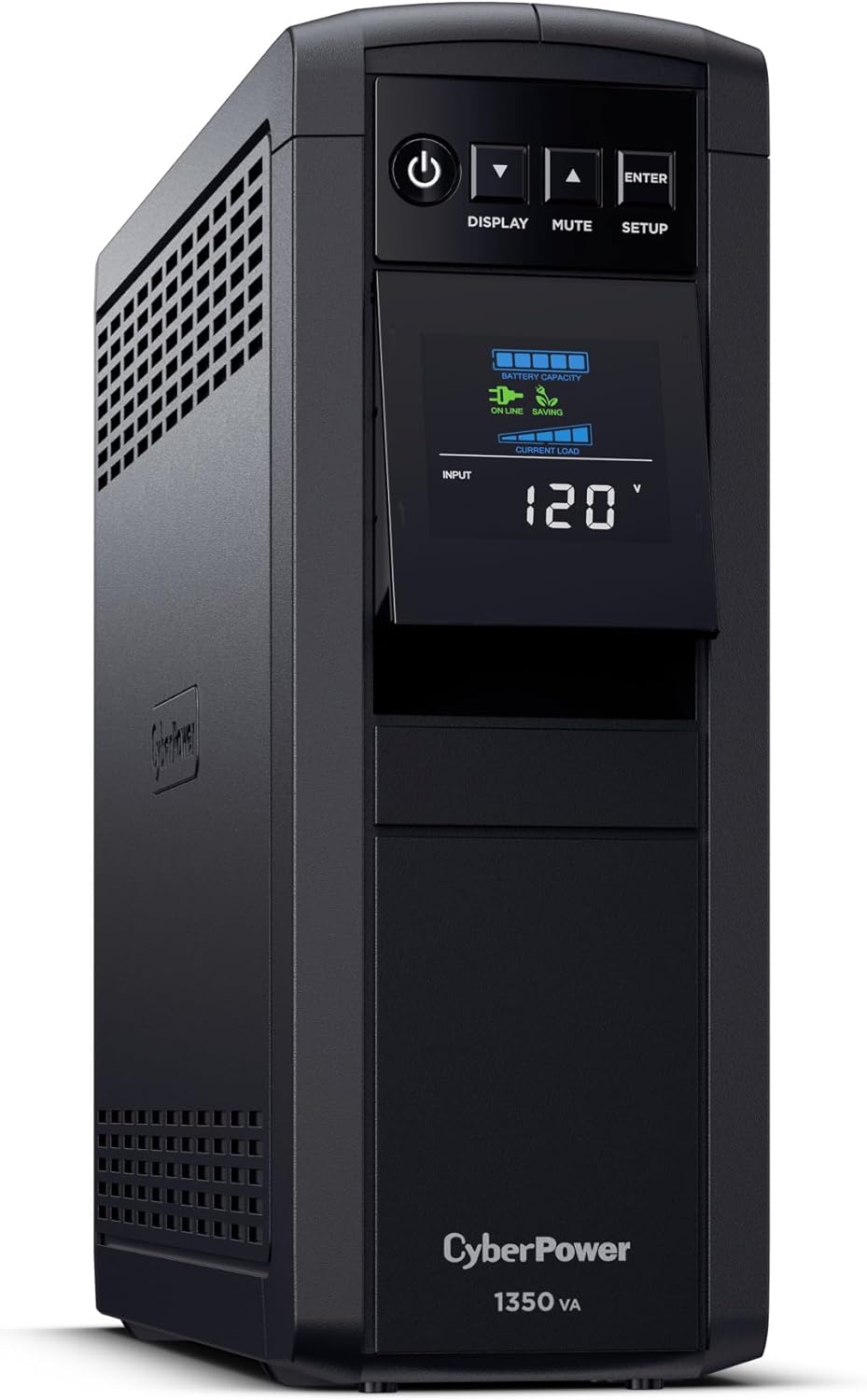
The CyberPower CP1350PFCLCD delivers the same pure sine wave, line-interactive topology as our top-ranked CP1500PFCLCD in a slightly smaller 1350VA/880W package — and typically at a meaningfully lower price. For home offices whose total connected load sits comfortably below 700W, this is the smarter buy: you get identical waveform quality, AVR regulation, and a full 12-outlet configuration without paying for headroom you will never use. It earns the #3 spot in our rankings not because it falls short, but because it trades a modest capacity ceiling for a better value-to-need fit for most home setups.
How We Scored It
Category Deep-Dives
Power Protection
8.0 / 10 30% weightingThe line-interactive topology with automatic voltage regulation (AVR) handles the broad class of power problems beyond complete outages: brownouts, momentary voltage sags from HVAC cycling, and the low-level fluctuations that degrade sensitive electronics over time. Rather than switching to battery every time voltage dips, the CP1350PFCLCD’s AVR circuitry actively corrects incoming voltage within its operating input range, delivering regulated AC output without touching the battery. This is meaningfully different from a basic standby UPS, which simply sits idle until power drops completely — and which depletes its battery unnecessarily during brownouts. For home offices in areas with variable power quality, AVR regulation is not a marketing checkbox but a daily functional advantage.
The $425,000 Connected Equipment Guarantee covers connected equipment damaged by a power event while properly attached to the CP1350PFCLCD. This figure is lower than the $500,000 CEG on the flagship CP1500PFCLCD, but remains substantial coverage for a home office environment. Note that it applies to all 12 outlets — battery backup and surge-only alike — and the unit’s EMI/RFI filtering provides an additional layer of protection against the high-frequency noise that can corrupt sensitive electronics even without a dramatic surge event. The one honest deduction from a perfect protection score: the slightly lower watt ceiling (880W vs. 1000W) means users with heavier equipment loads have a tighter margin before approaching or exceeding the unit’s capacity, which is relevant to reliability under real-world peak draws.
Bottom line on power protection: Line-interactive AVR and a $425,000 Connected Equipment Guarantee — a strong package, a step below the CP1500PFCLCD’s wider correction window and larger guarantee.
Power Quality
9.0 / 10 20% weightingThe CP1350PFCLCD’s protection story begins with its pure sine wave output — the same waveform quality that earns the CP1500PFCLCD our top spot. Active PFC (Power Factor Corrected) power supplies, standard equipment in modern desktops, high-end workstations, and many gaming rigs, are specifically engineered to run on a clean sinusoidal waveform. When powered by the stepped approximation waveform of a simulated sine wave UPS, these supplies can draw excess current, run hot, and fail unpredictably during the exact power events the UPS is supposed to protect against. The CP1350PFCLCD produces a genuine smooth sine wave that active PFC supplies see as indistinguishable from clean utility power — the correct foundation for any serious home office power protection setup.
Bottom line on power quality: The same pure sine wave output as the flagship CP1500PFCLCD — active PFC equipment is fully supported.
Usability & Features
8.0 / 10 20% weightingThe CP1350PFCLCD’s 12-outlet configuration — six battery-backup with surge protection, six surge-only — matches the outlet count of the more expensive CP1500PFCLCD and is a genuine competitive advantage in this product class. A fully equipped home office (desktop, two monitors, NAS, network switch, router, external drive, desk lamp, and one or two peripheral devices) can easily consume 10 outlets. The battery-backup outlets protect computing equipment requiring orderly shutdown; the surge-only outlets handle peripherals that tolerate abrupt power cuts. Physical outlet spacing accommodates transformer-block adapters without blocking adjacent receptacles — a detail that matters in practice when three or four wall-wart adapters need to coexist on the same strip.
The color LCD display provides real-time readout of input voltage, output voltage, battery charge percentage, estimated runtime remaining, and load in both watts and VA. This is the correct instrumentation for managing a home office UPS — numeric precision rather than LED bar graphs that indicate approximate ranges. Knowing that you are drawing 380W at 43% capacity with 14 minutes of estimated runtime is actionable information; a three-segment LED bar is not. One honest note on features relative to the CP1500PFCLCD: the 1350 ships with two USB-A charging ports sharing 1A total, with no USB-C port. The flagship model includes a USB-C port among its charging options; users who rely on USB-C charging for a phone or tablet will need to supply their own adapter for use with the CP1350PFCLCD.
The included USB data connection for PowerPanel software enables automated graceful OS shutdown — the feature that transforms a UPS from passive battery backup into an active data-protection tool. When remaining runtime drops below a configured threshold, PowerPanel sends OS-level shutdown commands that close open applications, commit open documents, and power down cleanly before the battery is exhausted. For any home office with an unattended workstation, NAS, or small server, this capability is not optional — it is the mechanism that prevents file system corruption and data loss during overnight or work-hours outages where no one is present to manually shut down.
CyberPower’s PowerPanel Personal software (free download, Windows and macOS) connects to the CP1350PFCLCD via the included USB cable and provides the functionality that makes a UPS an active power management tool rather than a passive battery. The core capability is automated graceful OS shutdown: when battery runtime drops below a configured threshold, PowerPanel sends OS-level commands to close applications, save documents, and power down cleanly — preventing file system corruption and data loss in unattended outages. PowerPanel also logs power events with timestamps, providing a record of surges, brownouts, sags, and outages that is useful both for understanding local power quality and for documenting events if connected equipment is ever damaged.
The PowerPanel Personal edition included with the 1350PFCLCD covers the full set of home office monitoring needs: real-time battery status, input/output voltage, load wattage, estimated runtime, configurable alarm thresholds, and scheduled battery self-tests. It runs on Windows and macOS without requiring a paid subscription or cloud account. The step up to the CP1500PFCLCD’s PowerPanel Business edition primarily adds multi-computer management capabilities — useful for home offices with more than one computer drawing from the same UPS. For a single-computer setup, the distinction is largely irrelevant.
Bottom line on usability and features: 12 outlets, a numerical color LCD, USB charging, and PowerPanel OS-shutdown automation are a complete home office feature set. The absence of USB-C charging is the one differentiator versus the CP1500PFCLCD; for most users it is a minor inconvenience rather than a deal-breaker.
Battery & Longevity
7.5 / 10 15% weightingAt 1350VA / 880W, the CP1350PFCLCD covers the majority of home office setups without requiring careful capacity management. A typical home office drawing 400–600W — a mid-range desktop (300–450W under load), one or two monitors (40–80W combined), a router and networking gear (25–50W), and peripherals — sits comfortably within this unit’s ceiling at CyberPower’s recommended 80% load maximum (704W). Where the 1350 model begins to feel constrained is in more demanding configurations: a high-performance workstation with a 650W+ power supply drawing 500W under sustained load, two large monitors, a NAS, and a powered speaker system can push the 880W ceiling uncomfortably close. For those users, the CP1500PFCLCD’s 1000W ceiling provides meaningful headroom that the 1350 cannot match.
The manufacturer-rated runtime of approximately 2 minutes at full 880W load and 8 minutes at half load (440W) is a conservative spec that, again, rarely reflects real-world conditions. At a representative home office load of 400W — roughly 45% of capacity — runtime extends to around 12–15 minutes, more than sufficient for a controlled shutdown. At 250W (a workstation in light use with one monitor active), runtime approaches 25–30 minutes. The key caveat is that the CP1350PFCLCD ships with a single internal battery, and its runtime curve reflects that. Replacement batteries are user-accessible and widely available through CyberPower and third-party suppliers, keeping total cost of ownership reasonable over the unit’s 3–5 year battery lifespan.
Compared directly to the APC BR1500MS2 at rank #2, the CP1350PFCLCD has a lower rated watt ceiling (880W vs. 900W) and shorter absolute runtime at full load. Both differences are narrow, but in a scoring system where runtime and capacity carry 25% weight, those honest differences matter. The 7.5 in this category reflects the CP1350PFCLCD’s real strength — excellent runtime at typical home office loads — while acknowledging that the 120W lower ceiling is a genuine constraint for heavier setups.
Bottom line on battery and longevity: Fully adequate for home offices drawing under 700W at peak — which covers the majority of setups. Plan around your equipment’s actual draw, not the unit’s ceiling. Users with demanding workstations or heavy peripheral loads should step up to the CP1500PFCLCD for greater headroom.
Value
8.5 / 10 10% weightingThe CP1350PFCLCD’s value case is straightforward: it delivers the same pure sine wave line-interactive topology as CyberPower’s flagship CP1500PFCLCD at a lower price, trading 150VA (120W) of headroom and USB-C charging for meaningfully lower upfront cost. For home offices whose peak draw falls below 700W — the realistic ceiling for confident operation within the 80% load rule — this is a rational trade. You are not getting a lesser product; you are getting the right-sized product for a more typical home office load profile at the price that reflects that sizing.
The three-year warranty including battery coverage matches the flagship exactly — CyberPower does not reduce warranty scope at the lower capacity tier. This is significant for total cost of ownership: UPS batteries typically require replacement every 3–5 years, and warranty coverage for battery replacement during the first three years eliminates the most predictable maintenance cost. When the warranty expires, replacement batteries for the CP1350PFCLCD are widely stocked through third-party suppliers at competitive prices, with user-accessible replacement requiring no tools and no service call. The cost differential between the 1350 and 1500 models, combined with matched warranty coverage, makes the CP1350PFCLCD an excellent value for appropriately sized workloads.
Bottom line on value: A strong value proposition for typical home office loads — full pure sine wave protection and a complete feature set at a lower price than the 1500VA model. The value score reflects the genuine savings against the CP1500PFCLCD for users who do not need the extra capacity headroom.
Physical Design
8.0 / 10 5% weightingThe CP1350PFCLCD shares its mini-tower chassis and construction approach with the larger CP1500PFCLCD — solid ABS construction with no notable flex, firmly seated outlet receptacles with consistent resistance, and clear rear-panel labeling that separates battery-backup outlets from surge-only outlets. The LCD panel is a straightforward fixed-angle display (unlike the tilting panel on the 1500PFCLCD), which is worth noting for installations where the unit sits on the floor or low shelf — you may need to position it deliberately for comfortable viewing. The audible alarm for overload and low battery conditions functions correctly, ensuring you are alerted during power events even without actively monitoring the display.
The unit includes CyberPower’s GreenPower UPS Bypass technology, a patented design that routes utility power around the UPS transformer when AC power is stable, reducing standby energy consumption, heat generation, and acoustic noise during normal operation. This is a genuine efficiency benefit for a device that runs 24/7 in a home office environment — lower heat output extends component lifespan, and reduced noise matters in a quiet workspace. The auto-restart function returns equipment to service automatically after utility power is restored, avoiding the scenario where a NAS or unattended workstation stays offline until someone manually powers it back on. An input circuit breaker trips under severe overload, protecting the unit without requiring fuse replacement.
Bottom line on physical design: Competently engineered hardware with practical details — GreenPower bypass, auto-restart, resettable circuit breaker, and logical outlet labeling. The fixed-angle LCD is a minor step down from the flagship’s tilting panel; everything else is comparable construction.
About the Manufacturer
Power
CyberPower Systems was founded in 1997 in Taiwan and has grown into one of the world’s largest UPS manufacturers. The PFC Sinewave product line — which includes both the CP1350PFCLCD and the flagship CP1500PFCLCD — represents CyberPower’s value-premium segment: genuine pure sine wave, line-interactive protection at prices that challenge APC’s long-standing dominance in that tier. The company operates a dedicated US-based warranty and support organization and maintains an active replacement parts program, including readily available user-replaceable batteries for the full PFC Sinewave lineup. For a full profile of CyberPower’s history, distribution, and Connected Equipment Guarantee program, see our CP1500PFCLCD review.