E3
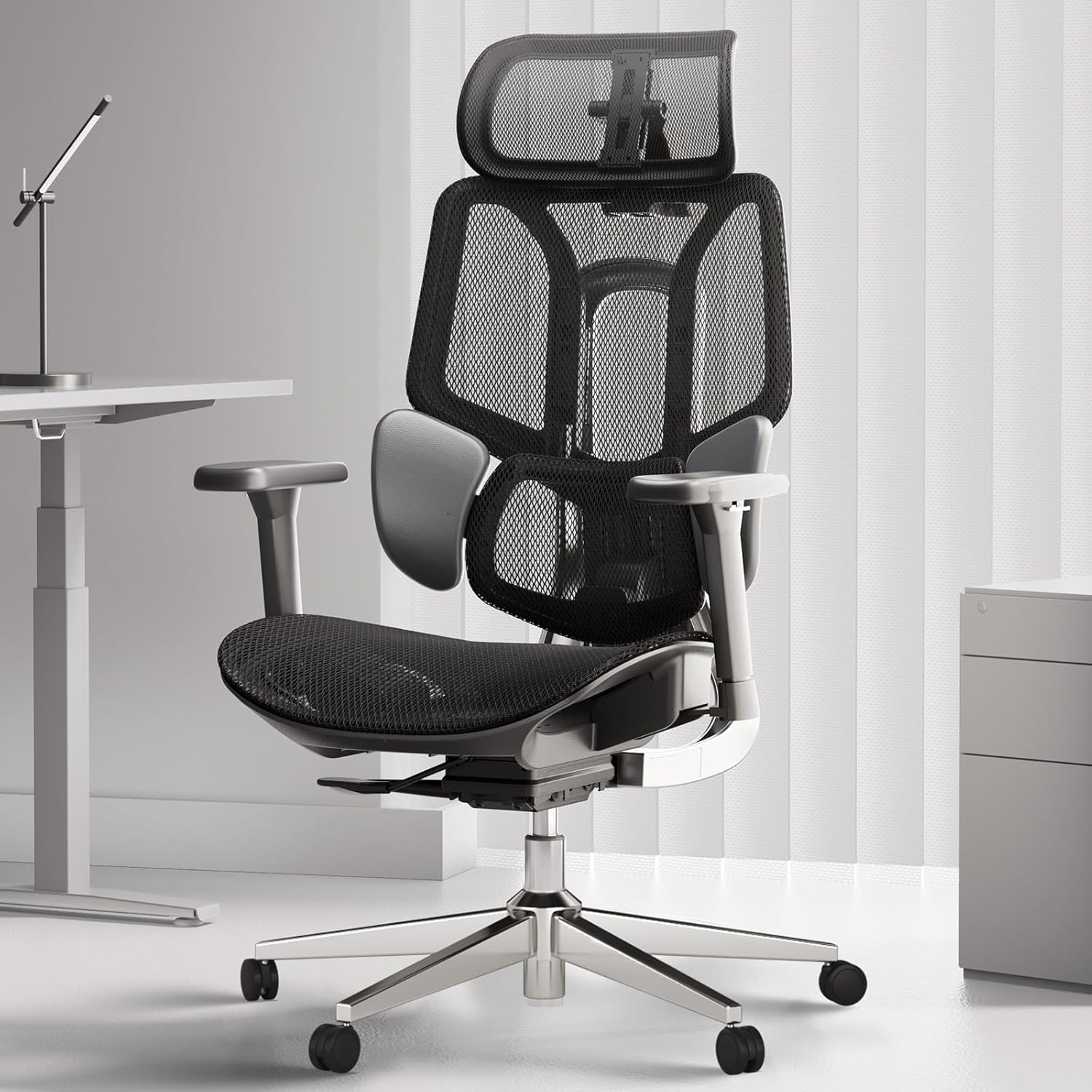
The Hbada E3 is listed at a high MSRP and perpetually discounted to well under half that. At its real street price, it competes against better-built alternatives — notably the HON Ignition 2.0, which offers a lifetime structural warranty and a commercial durability record the E3 cannot match. The 3-zone lumbar and 6D arms are genuine feature differentiators, but independent reviews document lumbar and tilt mechanisms that fail to hold set positions under dynamic load — a significant functional failure for a chair marketed on ergonomic adjustability. The spec sheet is the E3’s strongest asset; real-world reliability is not.
How We Scored It
Category Deep-Dives
Ergonomics & Support
6.5 / 10 30% weightingThe Hbada E3’s lumbar system is described as 3-zone adjustable, covering height, depth, and angle — a specification that, on paper, approaches the lumbar sophistication of chairs twice its street price. The practical problem, documented in independent long-form reviews, is that the lumbar and tilt mechanisms fail to reliably hold set positions under dynamic load. A lumbar adjustment that drifts when the user leans or shifts postures is not delivering the ergonomic benefit the adjustment range implies. This failure mode is the primary reason the E3 ranks last in this guide despite a competitive-looking specification.
When the mechanisms do hold position, the 3-zone lumbar provides a meaningful range of fit across different lumbar curves. Seat depth adjustment is present and is the most reliably functional fit feature on the chair — it allows the seat pan to be extended or retracted to position the backrest contact correctly for the user’s leg length, which is absent from most chairs at this price range. That is a genuine ergonomic advantage that should be acknowledged even given the broader mechanism concerns.
The backrest is mesh and provides passive support. There is no synchro-tilt mechanism linking seat and back angle during recline, which is standard at this price point.
Bottom line on ergonomics: The 3-zone lumbar and functional seat-depth adjustment are real strengths on paper, but lumbar and tilt mechanisms that drift under dynamic load undercut the benefit — the reason the E3 ranks last despite a competitive-looking spec sheet.
Comfort & Materials
7.0 / 10 25% weightingThe mesh back provides adequate breathability and performs well in its primary function when the chair is in a stable adjusted position. The seat pan uses a cushioned surface appropriate for the price tier. The 6D armrests have PU-padded pads; comfort is adequate but durability concerns in independent reviews suggest the arm mechanisms and their padded caps wear faster than mid-range alternatives.
Initial comfort impressions of the E3 are broadly positive — the chair feels comfortable to sit in, the adjustment mechanisms feel responsive on first contact, and the headrest provides useful neck support for taller users. Owner feedback diverges at the 6–12 month mark, where adjustment drift, loosening mechanisms, and armrest wobble become more commonly reported. The comfort score reflects the chair’s performance when new; long-term comfort is less predictable than the initial impression suggests.
Bottom line on comfort: Comfortable and responsive when new, with a useful headrest, but owner feedback diverges at 6–12 months as mechanisms loosen and arms wobble — the score reflects the chair when new more than over time.
Value for Money
5.5 / 10 20% weightingThe Hbada E3’s value case is complicated by one structural problem: its MSRP is listed high and has never meaningfully sold at that price. The chair is almost perpetually discounted to well under half of it, which creates a false impression of discount value. Buyers who evaluate it against that inflated reference point are comparing to an anchor that does not reflect the chair’s actual market position. Evaluated at its real (much lower) street price, the value calculus changes substantially.
At its street price, the E3 competes directly against the HON Ignition 2.0 (ranked #9 in this guide), which offers a lifetime structural warranty, synchro-tilt, and a decades-long commercial durability track record. It competes against the Branch Ergonomic Chair Pro (ranked #8), which offers 5D arms, dual-axis lumbar, and a 5-year warranty from a direct-to-consumer brand with documented owner satisfaction. The E3’s spec sheet is more aggressive on paper — 6D arms, 3-zone lumbar — but spec sheet aggressiveness does not compensate for mechanism reliability gaps at this price tier.
For buyers whose primary decision criterion is the feature list and who will not be sitting in the chair for more than 3–4 hours daily, the E3 offers more adjustability axes than its competitors at the same price. For full-time home office workers, the value proposition is weak relative to what the same money can buy elsewhere in this guide.
Bottom line on value: The inflated MSRP creates a false discount frame; judged at its real street price, the E3 is outclassed by the better-built, better-warrantied HON Ignition 2.0 and Branch Ergonomic Chair Pro. Defensible only for light-use buyers who prioritize the feature list.
Build Quality & Longevity
6.0 / 10 15% weightingThe E3 carries a 3-year warranty, which matches the SIHOO M57 and is the standard coverage for this price segment. Structurally, the chair passes basic rigidity standards and there are no widespread reports of catastrophic failure. The concern is mechanism quality, not frame integrity. The adjustment mechanisms — particularly the lumbar system and tilt lock — are the components that draw the most consistent negative feedback over time, with drift and loosening reported under regular dynamic use.
The 6D arm mechanisms are the other durability concern cited in independent reviews. The additional movement axes require additional pivot points, and at this price tier those pivots use lower-durometer plastics that develop play earlier than equivalent mechanisms on pricier chairs. The armrest wobble reported by owners is a symptom of this; it does not affect structural safety but reduces the functional precision the 6D specification is meant to deliver.
SIHOO’s mesh density is specifically called out in comparative reviews as better than similarly priced competitors; no equivalent commendation appears for the Hbada E3’s materials. Build quality is appropriate for a 2–3 year budget chair; not appropriate for the price anchor the MSRP implies.
Bottom line on build: Frame integrity is fine; the concern is mechanism quality — the lumbar, tilt lock, and 6D arm pivots draw the most consistent drift-and-wobble feedback over time. Appropriate for a 2–3 year budget chair, not the price the MSRP implies.
Adjustability Range
7.0 / 10 7% weightingOn paper, the E3’s adjustment set is the most extensive of any chair ranked in the budget section of this guide. Seat depth adjustment (present), 6D armrests (height, width, pivot, forward/back, and diagonal), 3-zone lumbar, headrest adjustment, recline with tilt tension — the list covers every primary fit variable. For users who can find stable mechanism positions and who sit within the chair’s target size range, this adjustability range is a genuine strength.
The practical caveat is that adjustability range and adjustability reliability are different things. The score here reflects the range of adjustment available; the ergonomics score reflects what that adjustment actually delivers when the mechanisms behave as specified under sustained use. For users who spend significant time dialing in their setup and whose mechanisms hold position, the E3’s range is the best available at this price. For users who need their settings to stay put without regular re-adjustment, the reliability concerns documented in extended owner feedback are a real risk.
Bottom line on adjustability: On paper the widest adjustment set in this guide’s budget tier — seat depth, 6D arms, 3-zone lumbar. The caveat is reliability: the range is excellent, but the mechanisms don’t always hold position under sustained use.
Aesthetics & Footprint
7.0 / 10 3% weightingThe Hbada E3 presents as a modern, feature-forward mesh task chair. Its visual identity leans contemporary — a high mesh back, an adjustable headrest, and the prominent multi-axis armrests give it a more elaborate, gadget-forward look than minimalist budget chairs. Whether that reads as purposeful or busy is a matter of taste; the many adjustment mechanisms are visible parts of the design rather than hidden away.
The footprint is standard for a high-back ergonomic chair, with a conventional five-star base and no unusual space requirements. It fits a typical home office without dominating the room, and the finish and proportions are presentable in a visible workspace, consistent with its mid-budget street positioning.
Bottom line on aesthetics: A modern, feature-forward mesh chair with a fuller high-back silhouette — presentable in a home office, with the busier look that comes from its many visible adjustment mechanisms.
About the Manufacturer
Hbada is a Chinese ergonomic furniture brand sold primarily through Amazon. The brand markets aggressively on specification count and on deep discounts from elevated MSRPs — a positioning strategy worth evaluating carefully, because the chair’s value should be assessed against its actual selling price rather than the inflated list price.
Hbada does not have a commercial or B2B support infrastructure comparable to HON or Steelcase, and warranty service has received mixed feedback in owner reports. As an online-first brand, it is best evaluated on the strength of the product at its real street price rather than on long-term service expectations.