Fern
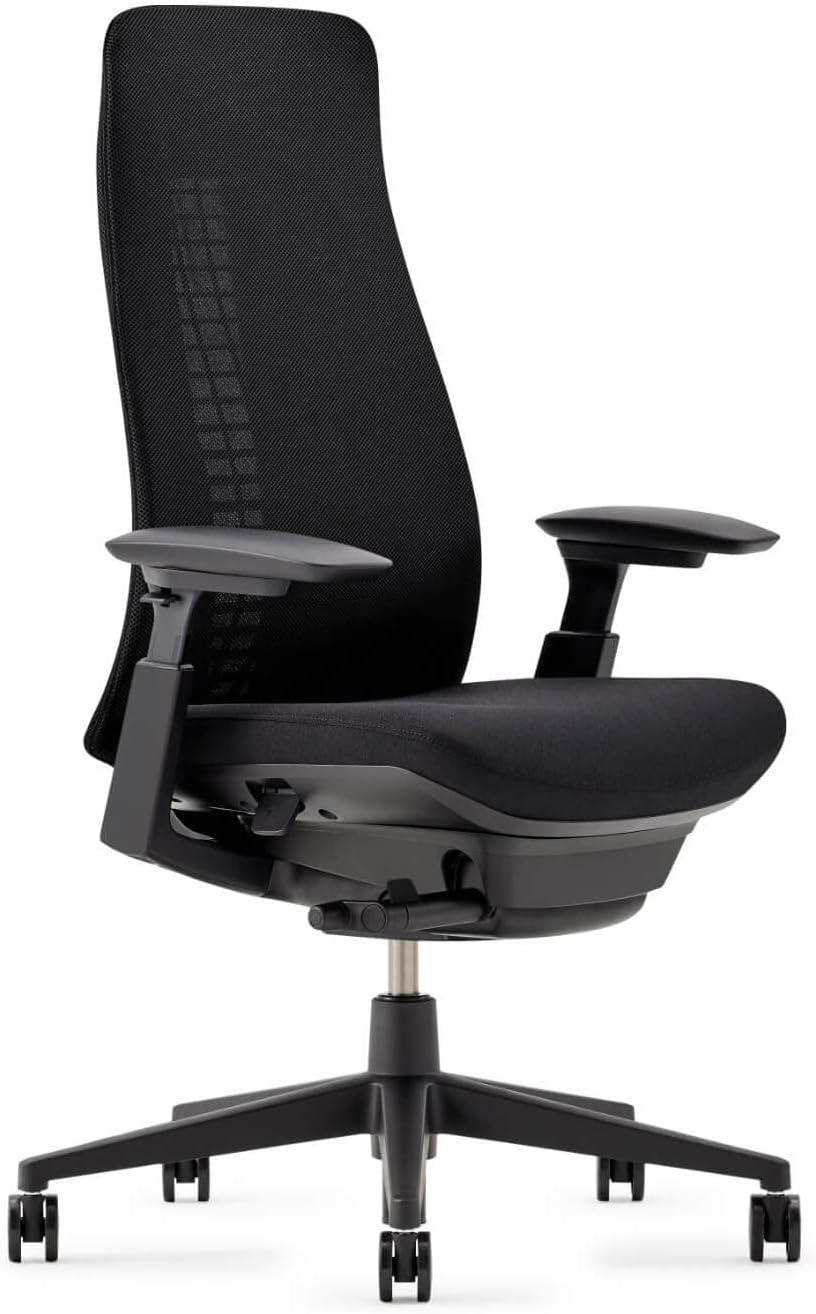
The Haworth Fern holds our #2 position through the most genuinely adaptive back mechanism in our guide: the Wave Suspension System automatically conforms to the user’s full lumbar and thoracic curve with zero manual configuration required. For users who prioritize effortless ergonomic support and superior breathability in a design-forward package, it is the most complete recommendation we can make at this tier.
How We Scored It
Category Deep-Dives
Ergonomics & Support
9.0 / 10 30% weightingThe Fern’s Wave Suspension System consists of overlapping polymer fronds that flex independently to conform to the user’s spine shape and movement — automatically, with zero manual adjustment. Where every other chair in our guide requires the user to set a lumbar pad height or tension dial, the Wave Suspension distributes support across the full lumbar and thoracic curve continuously as the user shifts position. This is the most genuinely adaptive back mechanism in our guide.
The distinction matters in practice. Users who alternate between upright keyboard postures, reclined reading postures, and angled postures during calls receive continuous, shape-matched support throughout each transition without having to pause and re-set a lumbar control. The frond architecture means the contact area adjusts with the spine’s curvature rather than pressing a fixed point against a moving target.
The 9.0 versus the Gesture’s 9.2 reflects a meaningful distinction in design philosophy: Steelcase’s Core Equalizer actively guides and coaches recline posture through its mechanism, whereas the Wave Suspension adapts without actively guiding. Neither is objectively superior, but for users who want the chair to simply respond rather than guide, the Fern’s approach is the more transparent and effortless of the two.
Bottom line on ergonomics: The most automatically adaptive back support in our guide. Exceptional for users who want genuine ergonomic responsiveness with no setup — and no reminder to adjust anything.
Comfort & Materials
8.8 / 10 25% weightingThe Wave Suspension mesh is the most open, most breathable back of any chair we’ve reviewed — more so than the Aeron’s denser mesh, and dramatically more so than the Gesture’s foam back. For warm-environment users or those who run hot, the Fern is the clearest recommendation in our chair guide on this dimension alone. The frond structure allows air to circulate freely across the entire dorsal surface, with no fabric barrier between the user and the airflow.
The seat uses a cushioned pan with a waterfall front edge that reduces pressure behind the knees during extended sessions. It is comfortable across long workdays — long-term owner reviews consistently report strong comfort across six- to eight-hour sessions. The initial sit is marginally less plush than the Gesture’s foam seat, which provides a softer first impression; the Fern’s cushion performs well through duration rather than first contact.
The combination of the highly breathable back and a well-engineered seat cushion produces a comfort profile that is particularly well-suited to extended work sessions in variable temperature environments. This is a real differentiation from the Gesture, not merely a spec-sheet distinction.
Bottom line on comfort: Best-in-guide breathability — not a close race. The clearest recommendation for users in warm spaces or those who run hot. Seat comfort is strong across long sessions.
Value for Money
7.5 / 10 20% weightingThe Fern commands the highest new-retail price in our office chair guide. The value case requires accepting the Wave Suspension’s automatic ergonomic proposition as worth the premium over alternatives — if zero-configuration lumbar adaptability is meaningful to your workflow, the price is defensible on a cost-per-year basis across the 12-year warranty period. The question is whether automatic adaptation justifies the additional cost over the Gesture and Leap V2, both of which deliver strong ergonomics with manual lumbar controls.
The more significant value consideration is the refurbished market. Steelcase’s refurbished ecosystem — through dealers like Crandall Office Furniture — is well-developed, mature, and meaningfully reduces the cost-of-entry for the Gesture and Leap V2 while preserving full warranty coverage. The Fern’s refurbished market is smaller, less mature, and offers fewer options at this time. This limits the cost-reduction path that substantially improves value for competing chairs in our guide, and it is the primary reason the 7.5 is lower than the Fern’s scores in other categories.
If you’re comfortable manually adjusting lumbar support, the Gesture and Leap V2 deliver competitive ergonomics at meaningfully lower cost, particularly through the certified refurb channel. The Fern earns its premium if the automatic-support proposition resonates with your working style.
Bottom line on value: The highest-cost chair in our guide at new retail, with a less developed refurbished market than Steelcase. Evaluate on the specific merits of automatic Wave Suspension support relative to alternatives.
Build Quality & Longevity
9.0 / 10 15% weightingHaworth has manufactured commercial furniture since 1948 and built the Fern to 24/7-rated commercial standards — the same durability threshold used for institutional environments where chairs operate around the clock under heavy-use conditions. BIFMA Level 3 certification covers both performance testing and the environmental and social standards of the manufacturing process; it is one of the more rigorous certifications in commercial furniture.
The Wave Suspension fronds are engineered for long-cycle fatigue resistance. Haworth tests the polymer frond materials through simulated lifespan use conditions — the frond flexion mechanism that makes the Wave Suspension adaptive is also the component most relevant to long-term durability, and it has been validated accordingly. Long-term owner community reports are consistent with this engineering commitment.
The 12-year warranty covers all mechanical components and is honored through Haworth’s dealer network. Parts availability is documented in owner communities. The 9.0 — versus Steelcase’s 9.5 — reflects Steelcase’s more extensively documented long-term durability track record across a larger and longer-established consumer community. Both manufacturers produce genuinely excellent, commercial-grade furniture; the gap is a matter of documented history, not a deficiency in Haworth’s engineering.
Bottom line on build: Commercial-grade construction with a 12-year warranty and institutional durability standards. The Wave Suspension frond system is specifically engineered and tested for long-cycle use.
Adjustability Range
8.5 / 10 7% weightingThe 5D arm system — adjustable for height, width, depth, rotation, and pivot — is excellent, placing the Fern second only to the Gesture’s unique full 360° continuous rotation system in our guide. For the overwhelming majority of users, the 5D arms will cover every arm position needed across a standard workday. Standard seat height and depth adjustment, recline tension control, and recline lock are all included.
The notable omission relative to most chairs in our guide is manual lumbar adjustment — and this is by design. The Wave Suspension is built to eliminate the need for explicit lumbar control entirely. For users who prefer automatic adaptation, this is not an omission at all; it is the core proposition. For users who prefer to dial in lumbar support to a specific height or pressure — or who have a particular lumbar condition they manage with precise positioning — the automatic system may feel less satisfying than a manually tunable lumbar pad.
The 8.5 reflects both the strength of the 5D arm system and the legitimate narrowing of explicit adjustment options compared to the Gesture’s broader inventory. Users who have never found manual lumbar controls useful will not experience this as a limitation.
Bottom line on adjustability: Excellent 5D arms and full standard adjustments. The automatic lumbar is the defining characteristic — a feature or a constraint depending on the user’s preference for explicit control.
Aesthetics & Footprint
9.5 / 10 3% weightingThe Fern is the most visually distinctive chair in our guide. The frond-inspired back is immediately recognizable and genuinely attractive — design-intentional in a way that the Gesture and Leap V2 are not. Where most task chairs present as capable but undistinguished professional equipment, the Fern reads as a considered design object. It integrates meaningfully into design-conscious home office environments where visual identity matters alongside ergonomic function.
Multiple colorways are available. The overall footprint is comparable to peers in this tier — not unusually large, though worth measuring against your workspace. The 9.5 reflects the Fern’s genuine distinction in a category where almost every competing chair scores in the mid-range for reasons of deliberate understatement.
Bottom line on aesthetics: The most design-forward chair in our guide. A real differentiator if workspace aesthetics matter to you — and not a reason to avoid it if they don’t.
About the Manufacturer
worth
Haworth was founded in 1948 in Holland, Michigan and remains privately held — one of the three largest commercial office furniture manufacturers globally, with products sold in over 150 countries. Its scale and commercial orientation are directly relevant to the Fern: the chair is built to institutional durability standards, not a consumer-market specification.
The Fern was developed in collaboration with biomechanics researchers as Haworth’s flagship ergonomic application — the chair that most directly embodies the company’s research investment in how the human spine moves during seated work. The Wave Suspension System is the commercial result of that research program: a back architecture designed to eliminate the gap between what a chair can sense and what it can adjust to.
BIFMA Level 3 certification covers Haworth’s manufacturing practices across environmental impact, social responsibility, and product performance — it is one of the more rigorous sustainability certifications in the commercial furniture sector. The 12-year warranty is honored through Haworth’s dealer network, and parts availability is documented in long-term owner communities. Haworth’s commercial orientation means institutional durability standards apply: the Fern is 24-hour rated for around-the-clock use, not merely specified for standard office workdays.