Dual Monitor Arm
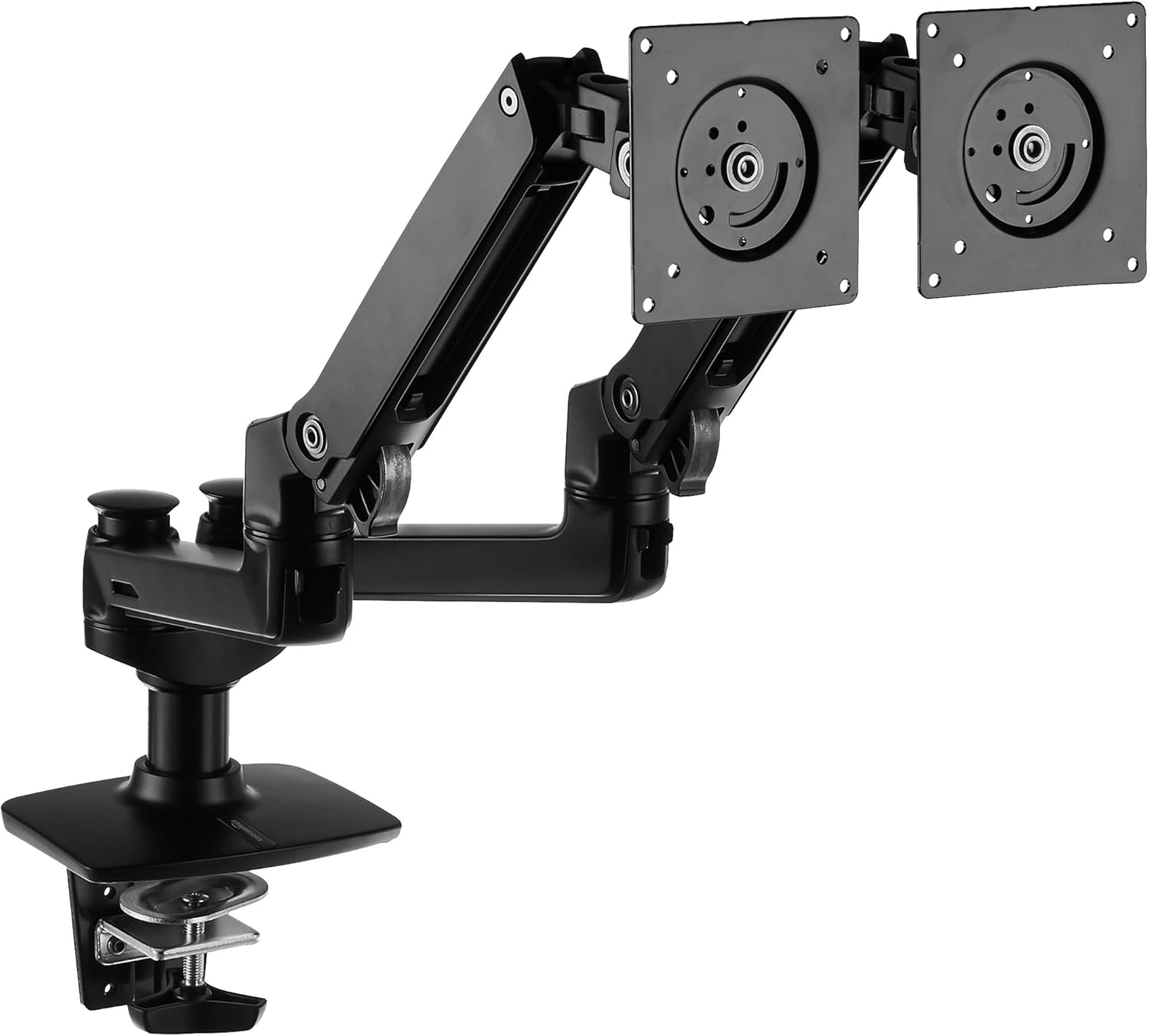
The Amazon Basics Dual Monitor Arm is the two-screen version of the value story that runs through this whole category: it’s built by Ergotron on the same Constant-Force “Lift Engine” mechanism as the LX Dual, and it sells for noticeably less. Better still, it’s rated higher than the Ergotron-badged version — 25 lb and up to 32″ per arm, versus the LX Dual’s 20 lb and 27″ — so the value pick is also the more capable one on paper. It ties the LX Dual at 8.4 overall; the only thing it gives up is the warranty, about one year against Ergotron’s ten. That single factor hands the LX Dual the “Best Dual” title and leaves this one as Best Value Dual right behind it, at #6 overall.
How We Scored It
Category Deep-Dives
Stability & Build
8.0 / 10 25% weightingMechanically, this is an Ergotron dual arm: the same Constant-Force lift in each arm, the same aluminum construction, the same drift-free hold that keeps two screens parked where you set them. In day-to-day rigidity it behaves like the LX Dual it’s based on, because under the badge it largely is the LX Dual. For a two-monitor setup that’s exactly what you want — no slow sag on either screen.
The 8.0, a half-step under the LX Dual’s 9.0, is entirely about warranty and support: Amazon covers this for roughly one year, against Ergotron’s ten. On a dual arm — more joints, two springs, more that can eventually wear — that shorter coverage carries a little more weight than it does on a single arm, which is why the deduction here is a touch larger than on the Amazon Basics single. It’s not a comment on how the arm performs out of the box, where it’s genuinely Ergotron-grade; it’s about how protected you are if something fails in year three.
Bottom line on stability: Ergotron-built dual hardware that holds like the LX Dual — the gap is the ~1-year warranty versus Ergotron’s 10, weighted a little more heavily on a dual’s extra moving parts.
Adjustability & Range of Motion
9.0 / 10 20% weightingThe motion is Ergotron’s, so it earns the same 9.0 as the LX Dual. Both arms move fully independently, each with around 13″ of height lift, 25″ of extension, 70° of tilt, and full portrait rotation — so you can set one screen ahead and angle the other inward, raise one and drop the other, or flip a display vertical for documents, all without disturbing its neighbor. That independence is the whole reason to choose a proper dual arm over a shared-pivot stand.
The Constant-Force mechanism makes each adjustment the same smooth, single-finger motion that holds its place. As with any side-by-side dual, the two arms are a little more constrained moving on one shared base than a single arm in open space — the reason it’s a 9.0 rather than higher — but for positioning two monitors exactly where you want them, it gives up nothing to its Ergotron-badged twin.
Bottom line on motion: The LX Dual’s full independent-arm range, carried over intact — each screen positions freely with smooth Constant-Force motion.
Capacity & Size Support
8.5 / 10 20% weightingThis is where the Amazon Basics Dual quietly out-specs the arm it’s based on. Each arm is rated for up to 25 pounds and a 32″ display — meaningfully more than the LX Dual’s 20 lb and 27″ — on standard 75×75 or 100×100 mm VESA. That extra headroom is genuinely useful: it comfortably covers two 27″ monitors with room to spare, and unlike the LX Dual it can credibly handle a pair of 32″ screens, which are increasingly common on a dual desk.
It earns an 8.5 — the highest capacity score among the dual arms in our lineup — and the only reason it isn’t higher is the same one that limits every dual: per-arm ratings step down from what a single arm of the same family manages, because the shared base carries two cantilevered loads at once. For the overwhelming majority of dual setups, this arm has more capacity than you’ll use.
Bottom line on capacity: 25 lb and 32″ per arm — more than the LX Dual, and enough for two 32″ screens. The most capable dual in our rankings on paper.
Installation & Mounting Versatility
8.0 / 10 15% weightingThe Dual ships with both a C-clamp and a grommet mount, and the single shared base means one desk attachment point holds both screens at a matched height — the same practical advantage the LX Dual offers over running two separate single arms. Assembly follows the familiar Ergotron pattern, tensioned with a hex key.
It scores 8.0 for reasons inherent to dual arms plus one spec to check: like the Amazon Basics single, the clamp is rated for desks up to about 2.4″ thick, a bit less than Ergotron’s retail arms, so an unusually thick top is the case to measure first or use the grommet. And as always with a dual setup, building and balancing two arms is more work than a single, and easier with a second pair of hands. Make sure your desk can take the cantilevered weight of two screens at full extension on one mounting point.
Bottom line on installation: One desk attachment for two aligned screens, clamp and grommet included — just confirm desk thickness (clamp to ~2.4″) and expect more assembly than a single arm.
Cable Management
8.0 / 10 10% weightingCable management uses the same integrated clips and channels as the rest of the Lift-Engine line, applied to both arms — which matters on a dual setup, where you’re taming two sets of power and video cables and keeping them from tangling as each screen moves on its own. It keeps a two-monitor desk looking tidy.
We score it a solid 8.0 — a hair under the LX Dual’s 8.5. The routing itself is the same effective clip-and-channel approach, but Amazon Basics’ packages tend to be a touch more pared-back than Ergotron’s retail kit, and it’s a managed rather than fully enclosed system. The practical result on the desk is much the same: cables controlled and out of the way, just not hidden.
Bottom line on cables: The Lift-Engine integrated routing on both arms — effective for a dual desk’s doubled cabling, essentially on par with the LX Dual.
Value
9.0 / 10 10% weightingThis is the arm’s headline, and it earns a 9.0. You’re getting Ergotron’s Constant-Force dual hardware — with a higher per-arm rating than the Ergotron-badged LX Dual — for a lower price. It’s the same dynamic as the single-arm rankings, but if anything stronger: here the value pick doesn’t just match the benchmark, it out-specs it on capacity, and only concedes the warranty. For a buyer outfitting a two-monitor desk who cares more about how the arms perform than how long they’re guaranteed, that’s a compelling case.
The honest accounting against its twin: versus the LX Dual (our #5 and “Best Dual”) you save real money and gain capacity, and you give up the 10-year warranty for roughly one. That trade is exactly why the two tie at 8.4 — the LX Dual’s warranty edge in our heaviest category exactly offsets this arm’s advantages in capacity and value. Choose the LX Dual if a decade of coverage and Ergotron’s direct support matter to you; choose this one to bank the savings on the same engineering and pick up a little more capacity in the bargain. Either way, it’s Ergotron hardware underneath.
Bottom line on value: Ergotron dual hardware with more capacity than the LX Dual, for less — the smartest-spending dual arm in the lineup, if you don’t need the 10-year warranty.
About the Manufacturer
Basics
Amazon Basics is Amazon’s private-label line, built to undercut name brands by selling direct. Quality varies by category, but its premium monitor arms are the standout exception: they’re manufactured by Ergotron — a connection widely reported by reviewers and reflected in Amazon’s own “Lift Engine Arm Mount” branding, “Lift Engine” being Ergotron’s name for the mechanism — the category’s engineering benchmark, using the same patented Constant-Force “Lift Engine” that powers the Ergotron LX and LX Dual.
The Dual Monitor Arm (sold under the “Lift Engine Arm Mount” name) is the two-screen model in that line, sitting alongside the single arm we rank at #2 and a wall-mount version. Notably, Amazon’s published ratings for this dual — 25 lb and 32″ per arm — actually exceed the figures Ergotron lists for the LX Dual, making it the rare case where the store-brand spec sheet reads better than the original’s.
The trade is consistent across the Amazon Basics arms: you get Ergotron’s mechanism and build, backed by Amazon’s shorter warranty — roughly a year — rather than Ergotron’s 10-year term. For a dual setup, the takeaway is simple: choose this to maximize capacity-per-dollar, or step up to the Ergotron LX Dual for the long warranty and direct manufacturer support on what is, underneath, the same arm.