Jarvis Standing Desk
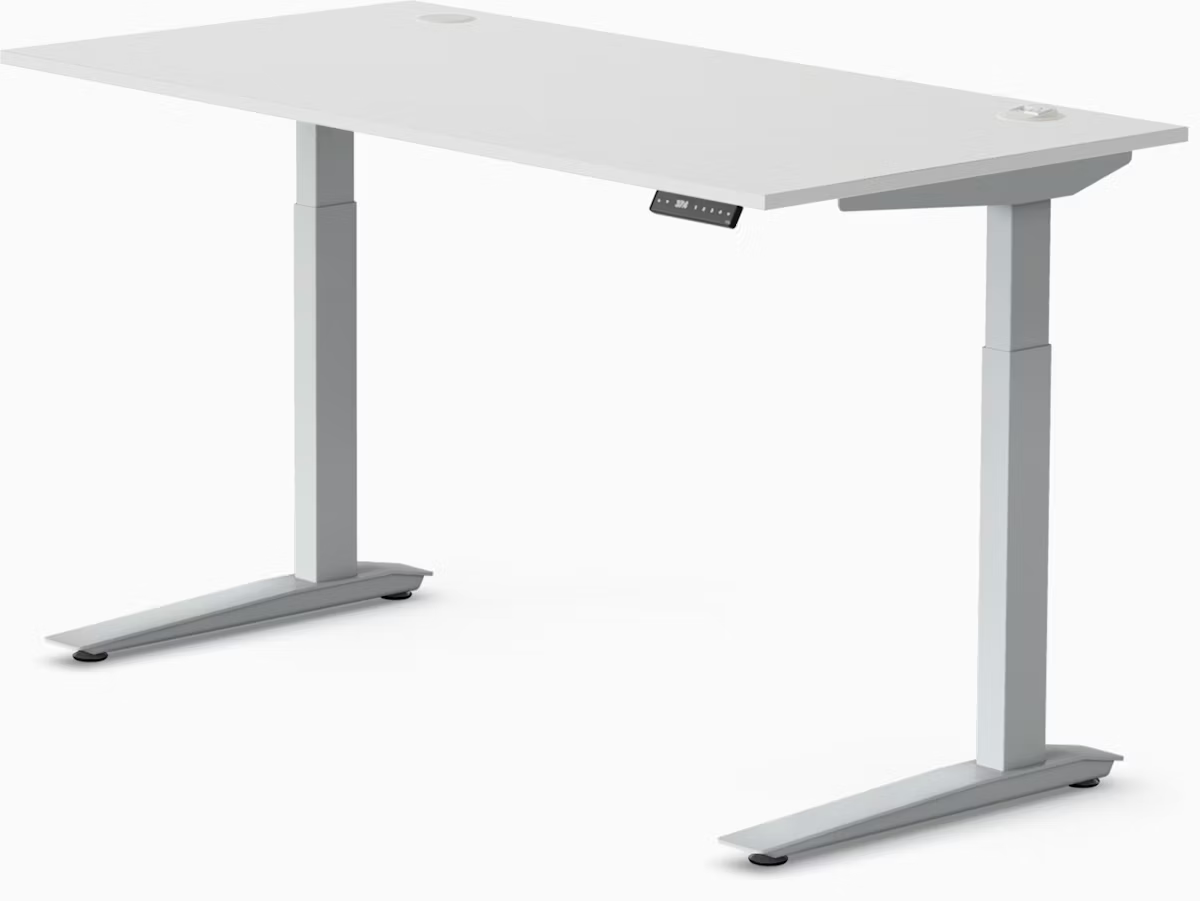
The Jarvis — formerly the Fully Jarvis, and since 2023 a Herman Miller product — has earned a long-standing reputation in the standing desk category for ergonomic range, dual-motor build, and lifting capacity. It is available in 2-stage or 3-stage frames, includes accelerometer-based anti-collision detection on its programmable handset, carries a 350 lb capacity, and is backed by a 7-year warranty that covers the motors and electronics as well as the frame — a genuinely strong package. The one thing that has changed for the worse since our original review is price: Fully’s direct storefront has closed, the desk is now sold only through Herman Miller and Design Within Reach, and a base laminate configuration now lists at roughly double its Fully-era price. That increase is the main thing holding its score back; the desk itself is better than its old reputation for bargain value implied.
How We Scored It
Category Deep-Dives
Structural Stability
8.0 / 10 30% weightingThe Jarvis is offered in both 2-stage and 3-stage frames, with the 3-stage configuration as the standard option — the same three-piece-leg design used by the FlexiSpot E7 and UPLIFT V3. The 3-stage frame’s greater section overlap gives it better rigidity at full extension than the older 2-stage version, and the Jarvis’s column diameter and steel quality produce a frame that performs creditably in independent stability tests. (A 2-stage frame remains available for buyers who specifically prefer it, at a slightly higher minimum height.)
The included crossbar provides lateral stability that is adequate for typical use, though it is a less substantial design than the UPLIFT V3’s I-beam implementation. BIFMA certification — present on the Jarvis — independently validates that the frame meets published stability and durability standards, which is meaningful given that the Jarvis has been on the market long enough for BIFMA performance to be compared against real-world owner experience. Field reports from a large installed base are broadly consistent with the certification claims: the desk is stable at typical working heights, with wobble more apparent at or near maximum extension.
One structural note relevant to setup: the Jarvis crossbar is not adjustable for width, which constrains the available desktop sizes and means the frame is optimized for specific width configurations rather than fully flexible. Buyers selecting a non-standard desktop width should confirm crossbar compatibility before purchase. Within a compatible configuration, the structural package is solid — particularly for users who keep the desk at moderate rather than maximum heights.
Bottom line on structural stability: An 8.0 reflects a desk that performs competently at standard working heights, with BIFMA validation and a 3-stage frame as standard. It is stable and well-built, without quite matching the UPLIFT V3’s I-beam crossbar rigidity at maximum height — more than solid enough for the large majority of users.
Ergonomic Range
8.0 / 10 25% weightingThe Jarvis’s standard 3-stage frame has a height range of approximately 25.6″–51.1″ (about 26.6″–52.1″ at the work surface with a 1″ top), among the widest in our guide and comfortably spanning the BIFMA G1 ergonomic targets for the 5th through 95th percentile of adult users. Buyers who need a lower seated minimum can choose the 3-Stage Low frame (23″–43.5″), and a 2-stage frame (30″–49.5″) is also offered — frame-height configurability that most competitors do not match. The ~51″ maximum is adequate for users up to roughly 6’4″ standing.
Lifting capacity of 350 lbs provides substantial headroom for any realistic home office setup. Even a heavy configuration — a dense solid wood top, multiple monitors, and a desktop computer — rarely exceeds 150 lbs; at 350 lb capacity, the Jarvis motors operate well within their envelope under any normal load. This is comparable to the UPLIFT V3’s 355 lb rating and better than the E7’s 275 lb capacity, making it one of the stronger capacity specifications in our guide.
The 8.0 ergonomic range score — versus the 9.5 the V3 earns in this category — reflects two differences: the V3’s slightly wider range and vastly greater desktop configurability. The Jarvis offers a good range, but the V3’s 24.0″–50.1″ frame span and the ability to specify custom desktop dimensions give it a meaningful edge for users at either end of the ergonomic spectrum. For most buyers in the 5th–95th percentile range with standard desktop size requirements, the Jarvis’s ergonomic range is fully adequate.
Bottom line on ergonomic range: The Jarvis’s height range (25.6″–51.1″ on the standard 3-stage frame, with 3-Stage Low and 2-stage options) and 350 lb capacity are genuine strengths, with more frame-height configurability than most competitors. The gap to higher-scoring competitors reflects desktop-size configurability rather than a practical deficiency for most buyers.
Motor & Controls
8.5 / 10 20% weightingThe Jarvis uses a dual-motor design — a separate motor driving each leg — which is the configuration buyers should want and the same approach used by the UPLIFT V3 and FlexiSpot E7. Dual motors lift more evenly under uneven loads, avoid the drift-prone coupling of single-motor desks, and keep operation reasonably quiet: the Jarvis is rated under 50 dB at a 1.5 in/sec lift speed. BTOD’s teardown found the JieCang motor units to be well-built, with the gear and worm drive internalized in later revisions to reduce noise and contamination.
The Jarvis handset comes in two forms — a simple up/down toggle, or an upgraded OLED programmable controller with four memory presets and a height display. The programmable handset adds accelerometer-based anti-collision detection: if the moving desktop meets resistance (around 15 lb), it stops, pauses, and reverses about an inch, and the sensitivity is user-adjustable. That is a genuine safety feature for homes with children, pets, or a dense cable run — and it corrects a long-standing misconception that the Jarvis lacks collision protection. Buyers who want it should select the programmable handset rather than the basic up/down version.
With dual motors, four presets, and adjustable anti-collision on the programmable handset, the Jarvis’s motor-and-controls package is strong — competitive with the dual-motor V3 and E7. The modest gap to the very top of the category reflects motor refinement and the noise-under-load edge the best desks hold, not any missing feature. The one thing to get right at checkout is choosing the programmable handset, since the basic toggle forgoes both presets and anti-collision.
Bottom line on motor and controls: Dual motors plus adjustable anti-collision detection (on the programmable handset) make this a genuinely strong, safe motor package — a clear improvement over how this desk has often been characterized, and the reason this category rises to 8.5. No meaningful feature gaps for home office use.
Warranty & Longevity
8.5 / 10 15% weightingThe current Herman Miller warranty on the Jarvis is 7 years covering the frame, mechanical parts, motors, and electrical components, plus 5 years on the tabletop and 1 year on power grommets and surge protectors. Crucially, the motors and electronics — the parts with a realistic failure window — are covered for the full 7 years, not a short separate term. This corrects the single biggest knock in our original review, which cited a 2-year motor warranty that does not reflect the product as currently sold by Herman Miller.
For context: the UPLIFT V3’s 15-year comprehensive warranty remains the benchmark, roughly twice the Jarvis’s term. But the Jarvis’s 7-year comprehensive coverage is better than the FlexiSpot E7’s 5 years, and well ahead of most competitors — placing the Jarvis comfortably in the upper-middle of the top tier rather than at the bottom of it, as our original 2-year-motor assessment implied.
Since Fully’s acquisition by Herman Miller in 2023, the Fully.com storefront has been shut down, and the Jarvis is now sold only through Herman Miller and Design Within Reach — in fewer configurations than Fully once offered. Warranty service now runs through Herman Miller / MillerKnoll, a long-established furniture company with strong support infrastructure. The remaining open question is long-term parts availability and continued platform investment, but the headline coverage itself is now both confirmed and competitive.
Bottom line on warranty and longevity: A 7-year warranty that includes the motors and electronics is genuinely competitive — better than most rivals and second only to the UPLIFT V3’s 15-year term. This corrects our earlier 2-year-motor assessment and is the main reason this category now scores 8.5 rather than 7.0.
Value
6.0 / 10 5% weightingUnder Fully, the Jarvis was a strong value — a laminate configuration undercut the UPLIFT V3 while matching much of its specification. That is no longer the case. At Herman Miller a base laminate Jarvis now lists at roughly double that, with larger and upgraded configurations higher — placing it at or above the V3 rather than below it. The desk is better-equipped than our original review credited (dual motors, anti-collision, a 7-year comprehensive warranty), but at the new price those strengths are what you would expect at this tier rather than a value advantage.
The 7-year comprehensive warranty actually improves the long-term picture relative to our original review — out-of-warranty motor risk in years 3–4 is no longer a concern. But that does not rescue the value score, because the issue now is simply the up-front price: at roughly double its former cost, the Jarvis is a premium purchase. Shoppers optimizing on value will find the FlexiSpot E7 delivers a comparable feature set — dual motors, anti-collision, 3-stage frame — at a meaningfully lower price.
Bottom line on value: The Value score drops from 9.0 to 6.0 to reflect the substantial Herman Miller price increase — the desk now costs roughly double its Fully-era price. It remains a well-built, well-warrantied desk that earns its overall ranking on merit, but it is no longer the value standout it once was; the FlexiSpot E7 is the stronger pick for buyers optimizing on price.
Assembly & Usability
8.0 / 10 5% weightingThe Fully Jarvis has a generally positive assembly reputation in the owner community. The frame arrives in pre-assembled leg units with minimal field assembly required beyond connecting the crossbar, attaching the desktop brackets, and routing the control cable. Most reviewers report assembly times of 45–90 minutes for a single person, with Fully providing printed instructions and online video resources. The component quality feels consistent — fasteners fit correctly, the cable management channel routes the motor cable cleanly, and the frame tolerance is good enough that the assembly process is not frustrating. Two-person assembly is recommended for the desktop attachment step, where holding the frame level while securing brackets is easier with a helper.
Initial calibration is handled via a reset sequence documented in the manual, and the keypad’s four presets are straightforward to program and recall. The Jarvis keypad interface is slightly simpler than the UPLIFT Advanced Keypad but covers the essential sit-stand workflow without friction. Fully’s customer support was historically rated well in owner communities; post-acquisition, support and fulfillment now run through Herman Miller, whose operational consistency for the Jarvis line is not yet fully established. Buyers should note that the Jarvis is now sold direct through Herman Miller and Design Within Reach rather than the former Fully site, so the purchasing and service experience differs from Amazon-available alternatives.
Bottom line on assembly and usability: Assembly is manageable and well-documented. The keypad is functional. The Fully website purchasing experience is clean and direct. Post-acquisition support continuity under Herman Miller is an open question, though there are no current reports of service degradation. A solid 8.0 across the board for this category.
About the Manufacturer
HM
Fully was founded in 2014 as a direct-to-consumer ergonomic office furniture company headquartered in Portland, Oregon. The company built its reputation primarily around the Jarvis standing desk line and a curated selection of ergonomic chairs and accessories, positioning itself as a thoughtful alternative to both big-box office furniture and the premium commercial contract market. The Jarvis became one of the most widely owned and reviewed standing desks in the direct-to-consumer category, earning broad recognition for its ergonomic range and value proposition.
Fully was acquired by Knoll in 2019; Herman Miller and Knoll then merged to form MillerKnoll in 2021. In 2023, the standalone Fully.com storefront was retired and the Jarvis was folded into the Herman Miller catalog as the Herman Miller Jarvis — now sold through the Herman Miller Store and Design Within Reach, in a narrower set of configurations (laminate or bamboo) and at notably higher prices than during the Fully era. The Jarvis’s product track record is well-established; what is newer is its move fully into the Herman Miller catalog and the higher price position that comes with it.
For buyers considering the Jarvis, the acquisition is a relevant context item for two reasons. First, the service and warranty infrastructure backing the 7-year frame warranty is now part of a larger corporate organization, which may improve or complicate resolution of warranty claims depending on how Herman Miller integrates Fully’s operations. Second, the future of the Jarvis product line — whether it will continue to receive investment and updates, or whether it will be gradually de-emphasized in favor of Herman Miller’s own product lines — is uncertain. The Jarvis’s track record is well-established; its ownership continuity is newer and less certain.