BX1500M Back-UPS
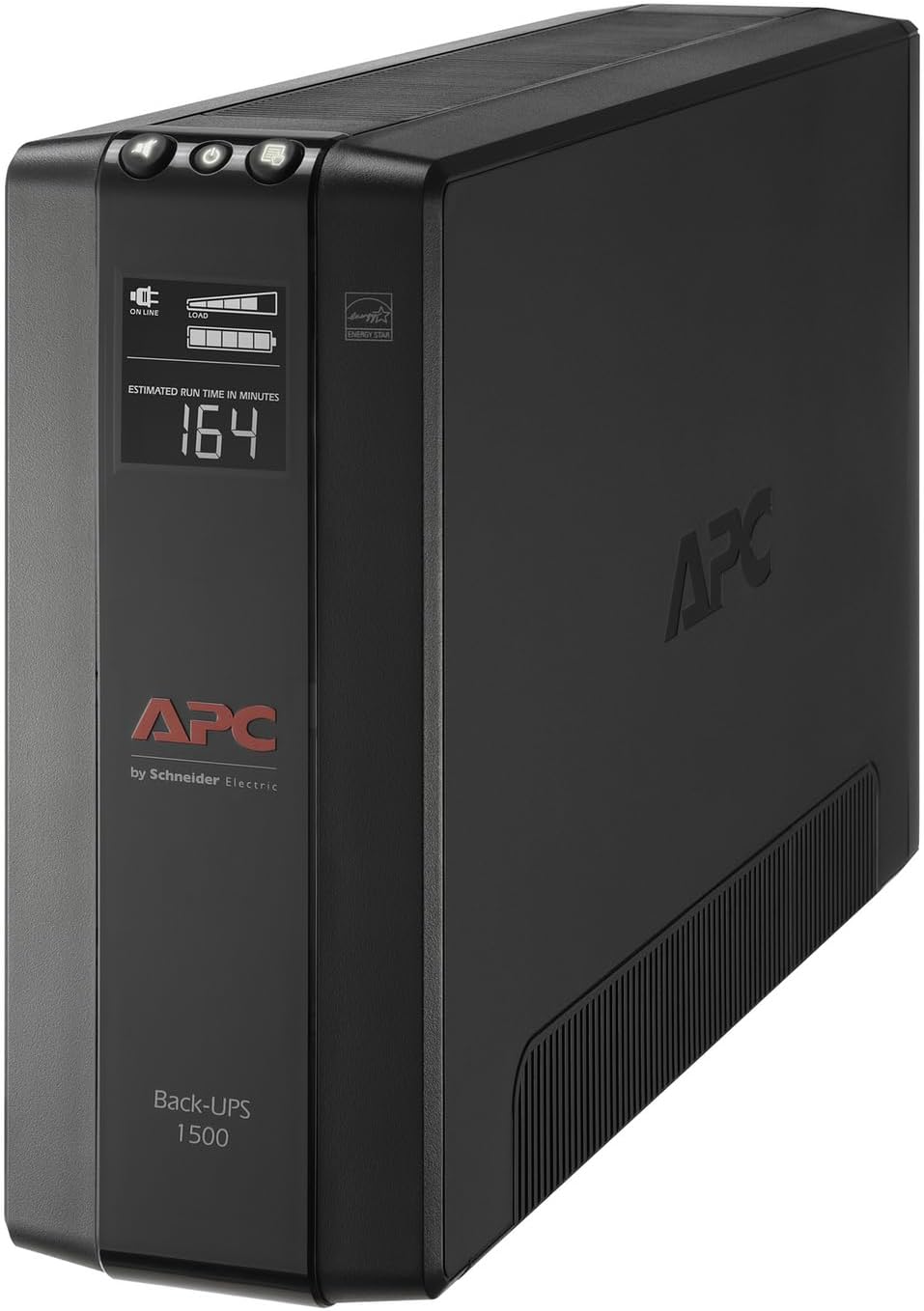
The APC BX1500M delivers 1500VA of line-interactive UPS protection at one of the lowest prices in our guide — making it an appealing high-capacity option for routers, NAS devices, monitors, and non-critical home office peripherals. Its defining limitation is equally clear: the BX1500M outputs a simulated (stepped) sine wave on battery, which is incompatible with the active PFC power supplies found in virtually all modern desktop computers and many laptops. If your workstation has a modern power supply, this is not your UPS. For the equipment it does suit, it represents strong value at 1500VA capacity.
How We Scored It
Category Deep-Dives
Power Protection
9.0 / 10 30% weightingThe BX1500M’s line-interactive topology with automatic voltage regulation is the unit’s strongest attribute, and the 9.0 score in this category reflects that the underlying protection architecture is genuinely capable. Line-interactive with AVR means the unit actively boosts or trims incoming voltage in response to brownouts and over-voltage events without engaging the battery — protecting connected equipment from the most common power anomalies in residential environments while preserving battery runtime for actual outages. This is the correct topology for home office use: standby UPS designs, which dominate the very low end of the market, switch to battery on every voltage event, burning unnecessary battery cycles on fluctuations that don’t require battery power.
The BX1500M’s 1500VA / 900W capacity is generous for the price tier. At 1500VA, the unit handles substantial connected loads — an entire network rack, a NAS device with multiple drives, a full complement of networking equipment, and several monitors simultaneously — without approaching its load ceiling. The practical significance of adequate VA headroom is that the UPS operates within its efficiency band and manages battery draw correctly; underpowered UPS units can shut down under surge conditions precisely when protection is most needed. At 1500VA, the BX1500M has meaningful overhead for realistic home office non-PC loads.
The 789 Joules of surge suppression across the battery-backed outlets provides protection against the transient surges that follow lightning strikes or utility switching events. The built-in circuit breaker provides overload protection without requiring fuse replacement. Five battery-backed outlets handle the primary protected load; five surge-only outlets cover non-critical peripherals that can tolerate an abrupt power cut. Together, the topology, AVR, and surge protection deliver the complete line-interactive protection stack — competent and well-specified for equipment that doesn’t require pure sine wave output.
Bottom line on power protection: Line-interactive topology with AVR, 1500VA capacity, and 789 Joules of surge suppression deliver a genuinely capable protection architecture. The score reflects what the unit does well — this section’s strong performance pulls the total score well above what the Power Quality penalty alone would suggest.
Power Quality
5.5 / 10 20% weightingThis is the BX1500M’s defining limitation, and it must be understood clearly before purchase. The BX1500M produces a simulated (stepped) sine wave on battery — a blocky, stepped approximation of the smooth sine wave that comes from the wall outlet. On utility power, the UPS passes through clean sine wave power normally. The problem arises during a power outage, when the unit switches to battery: the equipment then runs on simulated sine wave output rather than the clean sine wave it expects.
The critical incompatibility is with Active PFC (Power Factor Corrected) power supplies, which are standard equipment in virtually all desktop computers manufactured in the last decade and in many laptops. Active PFC power supplies are required for 80 Plus certification (Gold, Platinum, Titanium) and are designed specifically to consume clean sine wave power efficiently. When operated on a stepped waveform, active PFC power supplies can experience: audible buzzing from the power supply fan and transformer, reduced operating efficiency (generating more heat), intermittent shutdowns as the power supply’s protection circuitry triggers on the non-sinusoidal input, or in worst cases, accelerated component wear from sustained operation under non-ideal input conditions. Some active PFC units will refuse to operate on simulated sine wave at all, shutting down immediately when the UPS switches to battery — meaning the UPS provides zero protection for the connected computer during an actual outage.
To be concrete about compatible versus incompatible equipment: equipment that works correctly with simulated sine wave includes most routers and managed switches, NAS devices with standard power bricks or internal power supplies (verify your specific model — some NAS units also use active PFC), monitors and displays, printers, non-critical peripherals, and older computers built before active PFC became standard (roughly pre-2010 for budget units, though this varied). Equipment that requires pure sine wave includes modern desktop workstations with 80 Plus certified power supplies, most gaming PCs, high-performance laptops (particularly those with large batteries that use active PFC charging circuitry), and any equipment where the manufacturer specifies pure sine wave input.
Critical buyer caveat: Do not purchase the BX1500M to protect a modern desktop PC or workstation. The APC BR1500MS2 (Rank #2) provides the same 1500VA capacity with genuine pure sine wave output and is the correct choice for active PFC equipment. The BX1500M’s 5.5 score in this category reflects that simulated sine wave is a significant, use-case-limiting limitation — not a minor technical footnote.
Usability & Features
7.0 / 10 20% weightingThe BX1500M provides 10 NEMA 5-15R outlets in a five-and-five split: five with full battery backup and surge protection, five with surge protection only. For home networking setups — the primary use case this unit suits — five battery-backed outlets cover a router, a managed switch, a NAS, a cable modem, and one additional device simultaneously, which is a reasonable complement of protected networking gear. The five surge-only outlets handle monitors, printers, phone chargers, and desk lamps that can tolerate an abrupt power cut. The outlet count is adequate for its intended use case without being generous.
Where the BX1500M falls short of the higher-ranked APC BR1500MS2 is in status visibility and software depth. The BX1500M uses LED status indicators rather than an LCD display — you see basic status (on utility, on battery, battery low, overload) but not real-time input voltage, output load percentage, or estimated runtime remaining. For a router closet or network equipment rack where the UPS is not actively monitored, LED indicators are sufficient. For a monitored home office environment where you want to understand load and runtime, the absence of an LCD is a real operational gap.
The BX1500M includes a USB data port for PowerChute Personal Edition, enabling automated graceful shutdown of a connected computer when battery runtime drops below a configured minimum. APC’s PowerChute software is functional and well-maintained — it handles the core shutdown automation use case competently on both Windows and macOS. There are no USB charging ports on the unit, unlike the BR1500MS2, so device charging occupies an outlet rather than a dedicated charge port. The unit also lacks the phone/data line surge protection jacks present on higher-end APC units, leaving coaxial and telephone surge pathways unprotected.
Bottom line on usability and features: Ten outlets with a practical backup/surge split and USB connectivity for PowerChute shutdown automation cover the functional requirements for networking and peripheral protection. The LED-only status display is the meaningful step-down from APC’s higher-tier units and limits real-time monitoring capability.
Battery & Longevity
7.5 / 10 15% weightingThe BX1500M is rated at approximately 2.8 minutes of runtime at its full 900W load — the lowest full-load runtime in our guide at this capacity tier, reflecting the unit’s battery specification. In practice, most protected equipment (routers, NAS, managed switches, monitors) draws well below the 900W ceiling. At a more realistic mixed load of 200–300W, runtime extends to 15–25 minutes — sufficient time to survive most residential outages and complete automated shutdown procedures initiated by PowerChute. The 2.8-minute full-load figure is relevant primarily as a floor: users who push close to the 900W load limit should not expect meaningful runtime on battery, and the unit would function primarily as a ride-through during brief outages rather than an extended backup source.
The battery is user-replaceable via APC’s APCRBC124 replacement battery cartridge, available from APC directly and through third-party suppliers. Replacement is a tool-free process: the front panel slides open to reveal the battery compartment, and the cartridge slides out and reinstalls without tools. Battery replacement intervals of every 3–5 years (depending on usage, temperature, and discharge frequency) are typical for sealed lead-acid batteries of this class. APC’s battery recycling program provides a prepaid return label for spent batteries through the BackUPS Battery Recycle program, addressing the disposal dimension of battery ownership.
APC does not document a continuous-operation (hot-swap) battery procedure for the BX1500M, so the conservative approach is to schedule a brief maintenance window — transfer or power down the connected load, then swap the cartridge — every few years. By contrast, APC explicitly documents hot-swap battery replacement for the higher-tier BR1500MS2. For home networking gear that needs to remain continuously online, that documented capability matters: users running always-on services who want to maintain uptime through a battery change should consider the BR1500MS2 specifically. For most home office environments, a planned battery swap every few years is a manageable, infrequent event rather than a meaningful operational constraint.
Bottom line on battery and longevity: User-replaceable battery with readily available replacement cartridges provides reasonable long-term serviceability. The 2.8-minute full-load runtime is adequate for ride-through and ordered shutdown at realistic loads; users requiring extended runtime should ensure their actual connected load is well below the 900W ceiling.
Value
9.0 / 10 10% weightingFor compatible equipment, the BX1500M delivers an exceptional value proposition: 1500VA of line-interactive UPS protection at a significantly lower cost than any pure sine wave unit at this capacity. The APC BR1500MS2, which provides the same 1500VA/900W capacity with pure sine wave output, typically costs substantially more. If your protected equipment is genuinely compatible with simulated sine wave output — routers, managed switches, NAS devices, monitors, printers — the BX1500M provides equivalent topology, capacity, and outlet count at a meaningful price discount. The value score of 9.0 reflects exactly this: for the right use case, the dollar-per-VA efficiency is among the best in the guide.
APC includes a $250,000 Lifetime Connected Equipment Guarantee with the BX1500M — substantial coverage that comfortably exceeds the connected-equipment value of typical home networking gear. The 3-year warranty on electronics is among the longer terms in the category. Replacement battery cost (APCRBC124) adds a recurring maintenance cost of roughly every 3–5 years, which is consistent across all UPS units in this guide regardless of brand or tier. APC’s connected equipment guarantee and warranty infrastructure provide a baseline of post-purchase support commensurate with the unit’s position in the line.
The honest framing on value is conditional: the BX1500M’s 9.0 value score applies only to buyers for whom the simulated sine wave limitation is a non-issue because their protected equipment doesn’t require pure sine wave. If your use case requires pure sine wave output — protecting a PC workstation — the BX1500M represents zero value regardless of price, because it will not reliably protect that equipment. Value must be evaluated against the specific protection requirement; a cheap UPS that cannot protect your hardware is not a value, it is a liability.
Bottom line on value: Best-in-class price per VA for compatible, non-active-PFC equipment. The 9.0 score is accurate for its intended use case — networking gear, NAS, peripherals — and does not apply to buyers who need to protect active PFC equipment, where any pure sine wave unit is the correct choice regardless of cost difference.
Physical Design
7.5 / 10 5% weightingThe BX1500M uses a tower form factor consistent with APC’s Back-UPS line — a rectangular chassis designed for floor or shelf placement alongside networking equipment or under a desk. The unit’s footprint is compact enough for a network closet, and its tower orientation allows it to occupy a shelf position that a horizontal rackmount unit cannot. The chassis construction is standard APC quality for the consumer tier: solid plastic housing with consistently mounted outlets and a clean front panel layout. The LED status indicators are visible from a normal operating distance and provide the essential status signals without requiring a display interface.
The audible alarm system provides distinct tones for on-battery operation, low battery, and overload — the passive alerting mechanism that ensures you are notified during a power event even if the UPS is out of sight. Alarm volume is sufficient to be audible from an adjacent room. The alarm can be temporarily silenced via a front-panel button, useful during intentional maintenance. The five battery-backed outlets are clustered together and clearly differentiated from the five surge-only outlets by panel labeling — an important usability detail for initial setup that prevents accidentally connecting a critical device to a surge-only outlet.
At approximately 22 lbs, the BX1500M is heavier than a similarly-sized surge protector but manageable for one person to position. The weight is expected for a lead-acid battery at this capacity. The unit does not include rack-mount hardware — it is a consumer tower form factor and is not designed for equipment rack installation. Users who need rack-mounted UPS protection at this capacity should look to APC’s Smart-UPS line or alternative rack-format units outside this guide.
Bottom line on physical design: Functional tower form factor with clear outlet labeling and a serviceable LED status display. No meaningful design differentiators — the unit is well-built for its price tier but does not offer the front-panel LCD or USB charging convenience of higher-tier APC units.
About the Manufacturer
APC (American Power Conversion) was founded in 1981 in West Kingston, Rhode Island, and built the consumer UPS market through the 1980s and 1990s with the Back-UPS and Smart-UPS product lines. Acquired by Schneider Electric in 2007, APC continues as the APC by Schneider Electric brand, producing UPS systems, power distribution units, and cooling infrastructure under Schneider’s global manufacturing and distribution network.
The Back-UPS line — the family to which the BX1500M belongs — is APC’s mainstream consumer and small-business tier, positioned below the premium Back-UPS Pro series (which includes pure sine wave output) and above APC’s entry-level surge strip offerings. The BX line specifically targets users who need UPS protection at high capacity without the premium cost of pure sine wave circuitry — making compatibility with the connected equipment the central purchase decision. APC’s brand recognition, global support infrastructure, and widely available replacement battery program (the same RBC battery cartridge system covers multiple product generations) give the BX1500M a long-term serviceability advantage over lesser-known brands at similar price points.
APC products are sold through Amazon, Best Buy, Staples, CDW, and enterprise distributors globally. The company’s warranty service operates across more than 100 countries, and APC’s battery recycling program provides prepaid return shipping for spent batteries. Schneider Electric’s backing ensures manufacturing consistency and long-term parts availability — relevant for a device category where buyers expect a product lifespan of five years or more between full replacements.