SmartDesk Pro
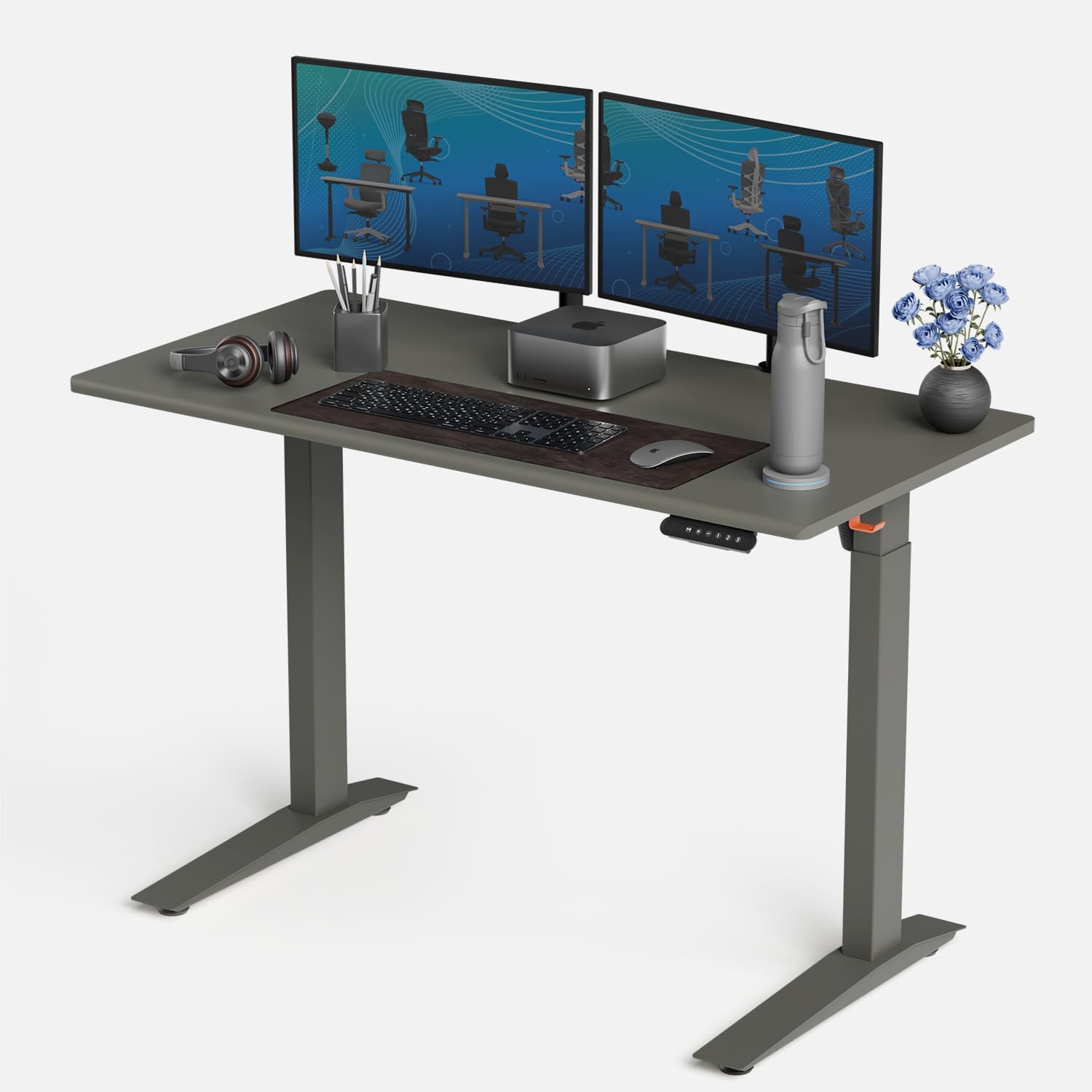
The Autonomous SmartDesk Pro is a 2-stage dual-motor desk with one genuine standout specification: motor noise rated under 45 dB, which is among the quietest in our guide. Anti-collision detection, four memory presets, and a 310-pound lifting capacity round out a capable control package. The desk’s limitations are structural — 2-stage legs deliver meaningfully less rigidity than the 3-stage designs used by top-ranked competitors, and a 7-year warranty falls short of the 10- to 15-year coverage offered by the desks ranked above it. Buyers who prioritize a quiet motor and are less concerned with long-term stability or warranty depth will find the SmartDesk Pro acceptable at rank #9.
How We Scored It
Category Deep-Dives
Structural Stability
6.0 / 10 30% weightingThe SmartDesk Pro uses 2-stage dual-motor lifting columns — each leg has two telescoping sections that extend from a fixed base. The dual-motor configuration, with an independent motor in each column, provides synchronized lifting and eliminates the torque imbalances associated with single-motor drive-shaft designs. That is a meaningful structural advantage over single-motor desks. The limitation is the 2-stage leg architecture itself: two-section columns must extend each section over a longer travel range than a 3-stage design would at equivalent heights, which means there is greater cantilevered leverage working against lateral rigidity at full standing height.
In practical terms, 2-stage desks at maximum extension exhibit measurably more wobble than 3-stage alternatives when the desk surface is deflected laterally — as happens when a user leans on the edge, repositions a monitor arm, or simply touches the desk during a video call. The SmartDesk Pro includes a stability crossbar connecting the two leg columns, which reduces this lateral sway and is the right design choice for a 2-stage frame. Even so, the crossbar cannot fully compensate for the geometric disadvantage of a 2-stage leg at full height relative to a 3-stage competitor. With a 310-pound lifting capacity, the frame is comfortably rated for any reasonable home office load — this is not a concern in practice, but it does not elevate the structural score beyond what the leg design warrants.
For home office users whose work surface height in standing mode falls below 45 inches — which covers the majority of users at or below average height — the 2-stage limitation is less pronounced, as sway amplifies with extension length. Taller users who stand at or near the SmartDesk Pro’s maximum will notice the structural difference more acutely.
Bottom line on structural stability: Dual motors and a crossbar give the SmartDesk Pro a reasonable foundation, but 2-stage legs are the structural ceiling. At full standing height, rigidity is below what 3-stage competitors deliver at the same or similar price points. This is the score category that drives the SmartDesk Pro’s overall ranking, and 6.0 reflects a desk that is adequate but not competitive at the top.
Ergonomic Range
6.5 / 10 25% weightingThe SmartDesk Pro’s height range of 26.2″ to 52.0″ (measured at the work surface with a standard desktop included) spans 25.8 inches of total travel — a reasonable range for the category. The upper bound of 52.0 inches is excellent for taller users, covering ergonomic standing positions for users up to roughly 6’5″. The more significant limitation is at the low end: a 26.2-inch minimum work surface height is higher than BIFMA’s G1 ergonomic guideline recommends for the 5th percentile of users, which maps to approximately 24–25 inches depending on the target population. Shorter users — broadly, anyone under 5’4″ — may find that the SmartDesk Pro’s lowest sitting position is above what a neutral elbow angle requires, forcing a compromise in seated ergonomics.
The 310-pound lifting capacity provides adequate headroom for virtually any home office configuration. Even a demanding setup — a heavy desktop, dual monitor arms, a desktop computer, and a full accessory array — would typically fall below 130 pounds of total load. Operating at well under half the rated capacity is the condition motors run coolest and longest under, and the SmartDesk Pro’s capacity figure does not create any practical constraints.
Desktop size options — available in 53″, 60″, and 70″ widths — cover the most common home office configurations from compact single-monitor to wide dual-monitor setups. The lack of deeper 30-inch or 32-inch depth options may limit users who need a large working surface, but the three width offerings are sufficient for most use cases.
Bottom line on ergonomic range: The 26.2″ minimum height is the primary ergonomic constraint — it excludes shorter users from achieving an optimal seated position. The 52.0″ maximum is genuinely useful for taller users, and the 310-pound capacity is not a practical limitation. A 6.5 reflects a desk that covers most users well but has a meaningful low-end gap compared to desks with lower minimums.
Motor & Controls
8.0 / 10 20% weightingMotor noise is the SmartDesk Pro’s strongest specification. At under 45 dB during height adjustment, it is among the quietest desks in our guide — only FlexiSpot’s E7 matches it at this threshold among the desks we evaluated. For context, 45 dB is roughly equivalent to a quiet library; most standing desks in this category operate in the 48–55 dB range during adjustment. In a home office shared with others, or where video calls are frequently in progress, the difference between a 45 dB motor and a 55 dB one is audible and meaningful. This is a specification the SmartDesk Pro delivers on where many competitors do not.
The dual-motor system drives each lifting column independently, electronically synchronized to maintain a level work surface across the full travel range. This synchronization prevents the gradual drift that can appear in single-motor designs over time, particularly under asymmetric loads. The keypad panel offers four programmable height memory presets — the practical minimum for a desk used daily by a person who transitions between sitting and standing positions. One-press recall to a saved position removes the friction that causes users to default to a fixed height; without presets, height-adjustable desks frequently stop being used as such. Anti-collision detection stops and reverses the motors when resistance is sensed during descent, an important safety feature in environments with chairs, cables, or pets underneath the desk surface.
The keypad itself is functional and straightforward — a display showing current height in inches, preset buttons, and up/down controls. It does not have the premium feel of the top-ranked desks in our guide, but the interface is intuitive and covers the features that matter for daily use.
Bottom line on motor and controls: The sub-45 dB motor noise rating is the SmartDesk Pro’s most differentiated feature and the reason this category score is the only green bar in the review. Dual motors, four memory presets, and anti-collision detection complete a control package that outperforms the desk’s structural and warranty scores. If a quiet adjustment cycle is the primary decision factor, the SmartDesk Pro earns consideration here.
Warranty & Longevity
6.0 / 10 15% weightingThe Autonomous SmartDesk Pro carries a 7-year warranty covering both frame and motor. A unified warranty term — the same coverage period for structural components and drive electronics — is the right approach, as it avoids the misleading “15-year frame / 3-year motor” splits that make some competitors’ headline warranties less meaningful than they appear. Seven years is a real commitment on a motorized product. The practical limitation is context: several desks in our guide offer longer coverage. UPLIFT and FlexiSpot warranty their motors for 15 years, and the IKEA IDÅSEN for 10. The Jarvis matches the SmartDesk Pro at 7 years, while the Branch Duo trails at 3. Against this peer group, 7 years is solid but not a differentiated position.
Autonomous has been in the direct-to-consumer standing desk market since 2015. The company has made multiple product generations of the SmartDesk, which suggests the platform has been refined over time and that replacement parts are more likely to be available than for newer entrants to the category. The brand’s warranty service track record is mixed in owner communities — positive experiences are reported alongside friction in the claims process — which is relevant context for buyers weighing the 7-year term against competitors with better-documented service reputations.
For a desk purchased as a multi-year investment, the 7-year motor warranty means buyers face a meaningful out-of-warranty period if the desk remains in use for a decade or more. Motor replacement costs on 2-stage dual-motor frames are non-trivial relative to the original purchase price of a mid-tier standing desk.
Bottom line on warranty and longevity: Seven years is an adequate warranty, but not a competitive one when every desk ranked above the SmartDesk Pro in this guide offers 10–15 years on the same components. For buyers who plan to keep their desk for a decade, this gap is worth factoring into the total-cost-of-ownership calculation.
Value
5.0 / 10 5% weightingThe SmartDesk Pro is positioned as a mid-range standing desk, positioned in the mid-range depending on desktop size and configuration. At that price point, buyers are paying for a 2-stage frame with a 7-year warranty and a notably quiet motor. The quiet motor (<45 dB) is a genuine differentiator that adds real value for the right buyer. The trade-off is that the structural and warranty gaps to competitors are not compensated by a meaningful price discount. Desks ranked higher in our guide — including the FlexiSpot E7, which offers 3-stage legs and a 15-year warranty — are frequently available at comparable or lower prices during promotional periods, narrowing the SmartDesk Pro's value case.
The value score also reflects that the SmartDesk Pro’s most important weakness — 2-stage legs — is a structural limitation, not a feature trade-off. Buyers who are choosing a standing desk for long-term daily use are making a decision that will affect their workspace for years. A structural compromise that delivers less rigidity at the height where the desk is most used (standing height) is not easily remediated by accessories or upgrades after purchase. Against this backdrop, a mid-market price for a 2-stage product with a shorter warranty positions the SmartDesk Pro as a desk that does not maximize value by any of the metrics this guide scores.
Bottom line on value: The sub-45 dB motor is the SmartDesk Pro’s strongest argument for its price. Beyond that, buyers at this price range can find 3-stage frames and longer warranties in competing products, which limits how favorably the SmartDesk Pro scores on value relative to its peer set.
Assembly & Usability
6.0 / 10 5% weightingThe SmartDesk Pro ships in multiple boxes containing the frame components, crossbar, hardware, keypad, and desktop surface. Assembly requires connecting the leg columns to the crossbeam structure, routing and securing the motor wiring, attaching the keypad cable, and mounting the desktop. Most users complete assembly in 60–90 minutes working alone, with the initial height calibration — a one-time button-press sequence that sets the motor reference points — adding a few minutes at the end. Autonomous provides printed instructions and supplemental video content; the process is comparable in complexity to other desks in this category.
Common owner feedback identifies the wiring management step as the most time-consuming part of the process — the motor cables run inside the legs and must be routed and connected correctly before final tightening. Hardware is labeled, though some users have noted that the instruction diagrams could be more detailed for this step. The crossbar installation is straightforward once the leg-to-crossbar bolt alignment is clear. Overall assembly difficulty is mid-range for the category: more involved than the simplest flat-pack designs, but not significantly more complex than comparable desks.
Bottom line on assembly and usability: Assembly is adequate and manageable for most users within 60–90 minutes. The process is not exceptional in either direction — functional documentation, standard tooling, one step (wiring) that benefits from patience. The keypad interface is intuitive and covers all necessary functions without unnecessary complexity.
About the Manufacturer
NOMOUS
Autonomous is a direct-to-consumer office furniture company founded in 2015 and headquartered in New York. The company launched with the SmartDesk as its flagship product and has expanded into office chairs, monitor arms, accessories, and a broader smart office ecosystem. Autonomous sells primarily through its own website (autonomous.ai) and through Amazon, with a particular emphasis on the home office and remote work market segment.
The SmartDesk product line spans several configurations — the SmartDesk Core (single motor, entry-level), SmartDesk Pro (dual motor, mid-range), and SmartDesk Corner (L-shaped configuration). The Pro has gone through multiple hardware revisions since its introduction, incorporating refinements to motor noise, controller reliability, and frame tolerances. The brand has a substantial owner community and maintains a standing desk-focused FAQ and support resource on its website.
Autonomous’s 7-year warranty covers frame and motor components. The company’s service track record in owner communities is mixed — many users report straightforward warranty experiences, while others describe friction in the claims and parts sourcing process. Prospective buyers researching the brand’s long-term service reputation will find a range of experiences in owner forums, which is worth factoring into a purchase decision for a product expected to remain in service for many years.