APC BE650G1 Back-UPS 650VA
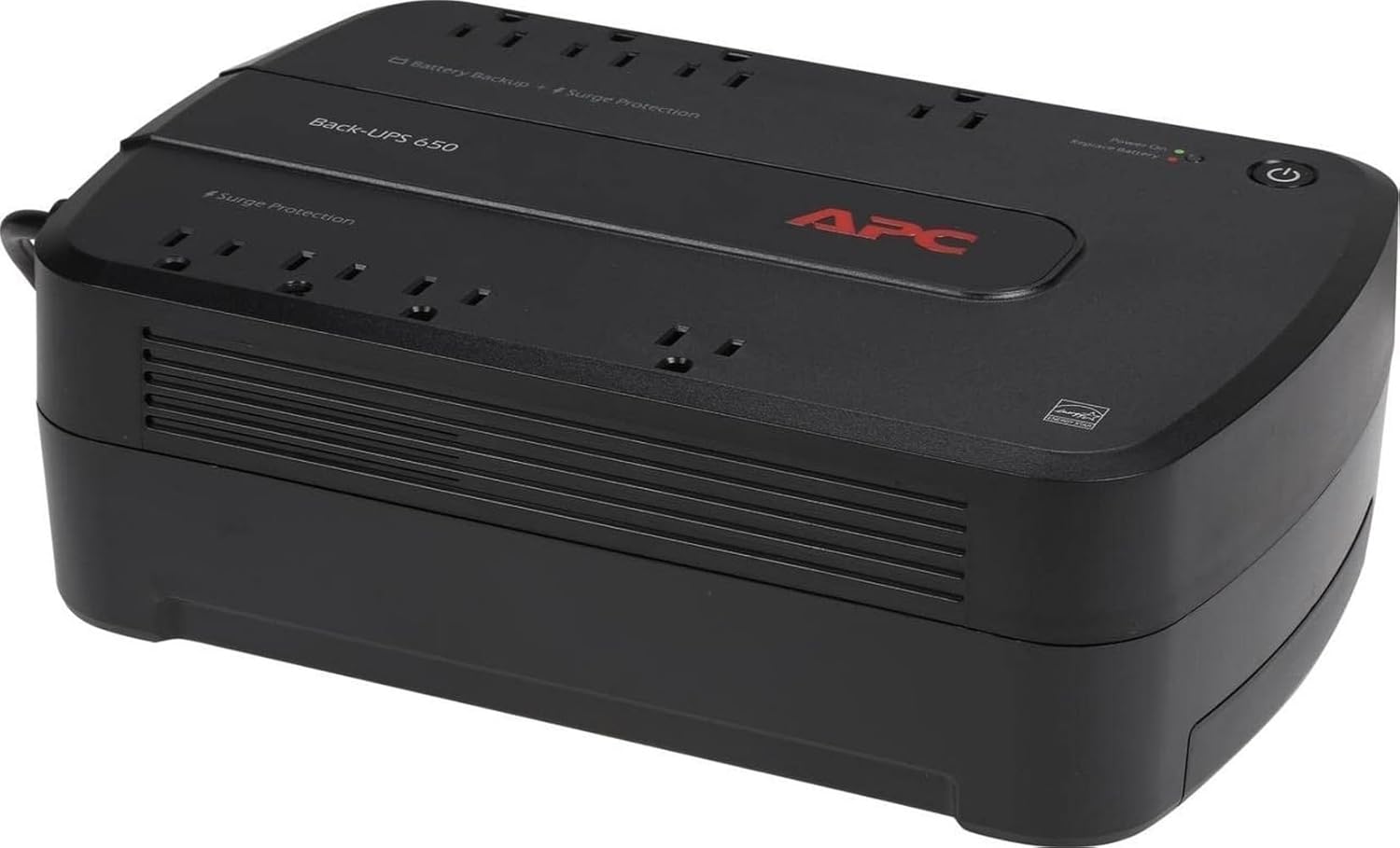
The APC BE650G1 is a 650VA standby UPS with no AVR, simulated sine wave output, and just 390W of usable capacity — enough for a router and a modem, but not a workstation. Its standby topology means the unit does nothing during brownouts or voltage sags, switching to battery only during a complete power failure. APC’s brand prestige does not translate to better protection at this product tier, and the price-to-capability ratio is poor compared to the line-interactive options ranked above it.
How We Scored It
Category Deep-Dives
Power Protection
2.0 / 10 30% weightingThe BE650G1’s most significant limitation is its standby (offline) topology. A standby UPS does exactly what the name implies: it stands by, doing nothing, until utility power completely fails. During a brownout — a voltage sag where power drops below safe operating levels — a standby UPS stays passive. During a voltage spike that stays within the unit’s surge suppressor range, it stays passive. The unit’s battery inverter only activates during a complete outage, and the brief switchover delay (typically 8–10 milliseconds) is long enough to cause momentary disruption in some sensitive equipment. Modern computers generally tolerate this delay, but it is a meaningful limitation compared to a line-interactive UPS, which actively regulates voltage without battery switching.
The absence of Automatic Voltage Regulation (AVR) is the defining weakness at this score level. In a real home office environment, complete outages are actually rare — voltage sags, brownouts, and over-voltage events caused by heavy loads switching on the same circuit are far more common. A UPS without AVR simply passes these problems through to connected equipment, providing no correction whatsoever. The battery depletes only during true outages, not during the voltage instability that accounts for the majority of real-world power quality events. If you live in an area with frequent brownouts or an older electrical system prone to sags, the BE650G1 provides no meaningful protection for that class of problem.
Bottom line on power protection: Standby topology with no AVR leaves the two most common power quality events — brownouts and sags — completely unaddressed.
Power Quality
2.5 / 10 20% weightingThe simulated sine wave output adds another layer of concern for equipment with active PFC power supplies, which are standard in modern desktop computers. When a simulated (stepped approximation) sine wave is fed to an active PFC supply during a switchover, the power supply can behave erratically. This is generally not an issue for routers, modems, and basic networking equipment — the BE650G1’s realistic use case — but eliminates the unit from consideration for workstation protection.
Bottom line on power quality: Simulated sine wave output compounds the topology problem for active PFC equipment — modern desktops should not rely on it.
Usability & Features
3.5 / 10 20% weightingThe BE650G1 offers 8 outlets total — 4 battery-backup and 4 surge-only — which is generous for its rated capacity. Running more than 4 devices on battery backup at 390W total means the unit’s watt ceiling limits you to low-draw devices anyway, so the outlet count is not a meaningful constraint in practice. The 4 surge-only outlets handle non-critical items like a printer or charger. There are no USB charging ports, no LCD display (LED indicators only), and no power monitoring instrumentation beyond basic status lights indicating online, on-battery, and fault conditions.
The Ethernet (RJ45) dataline surge protection is a small positive. It protects networking equipment against surge events delivered through a wired network connection — a commonly overlooked pathway for surge damage that the unit’s surge-only outlets do not cover. For a unit positioned as a networking UPS, this is a relevant feature. The USB data port connects to a computer running APC’s PowerChute Personal Edition software, enabling automated graceful OS shutdown when battery runtime is low. This is meaningfully useful for a computer connected to the unit, but the 390W capacity ceiling means a computer-plus-monitor setup is at risk of overloading the unit before shutdown automation becomes relevant.
There is no LCD display and no real-time power monitoring instrumentation on the unit itself. LED indicators tell you whether the unit is running on utility power, on battery, or experiencing a fault — nothing more. To know remaining battery charge, load percentage, or estimated runtime, you must use PowerChute software on a connected computer. This is a material limitation for a unit that might be protecting networking equipment where no computer is directly connected to read the software.
APC’s PowerChute Personal Edition (free download, Windows and macOS) connects to the BE650G1 via the included USB cable. The software provides automated graceful OS shutdown when battery runtime drops below a configured threshold — the core function that separates a UPS from a surge strip for unattended workstations. PowerChute’s implementation is solid and reliable; APC’s software quality is not the issue here. The low software score reflects a scoring framework reality: the software cannot rescue the fundamental limitations of 390W capacity, standby topology, and no AVR. PowerChute is a good solution to a set of problems that the BE650G1 mostly avoids creating.
PowerChute Personal Edition also logs power events, displays battery status, and reports load and voltage information — a functional monitoring suite for the price tier. The software does not provide the granular real-time instrumentation of CyberPower’s PowerPanel Business, and it lacks network SNMP management capabilities, but neither of those gaps is relevant at this product tier. The meaningful gap is that the BE650G1’s LED-only front panel means software is the only way to access any power monitoring data — a limitation for networking deployments where no computer may be running PowerChute.
Bottom line on usability and features: Eight outlets, Ethernet dataline protection, and PowerChute USB connectivity are adequate for the capacity tier. The absence of a display or power monitoring instrumentation limits visibility into the unit’s state, particularly in networking-only deployments where no computer is running PowerChute.
Battery & Longevity
3.0 / 10 15% weightingAt 650VA / 390W, the BE650G1 is the smallest-capacity unit in our UPS guide. The 390W ceiling is sufficient to run a home router (typically 10–20W), a cable modem (5–10W), and perhaps a small network switch (5–15W) — in other words, it is a networking equipment UPS, not a workstation UPS. A desktop computer with a modest discrete GPU draws 150–300W under load; add a monitor at 30–60W and the BE650G1 is already at or beyond its rated capacity before accounting for any other devices. Attempting to run a workstation on this unit risks overloading it and triggering the circuit protection — or worse, running it near 100% capacity, which accelerates battery wear and reduces actual runtime below the already-short specification.
The manufacturer-rated ~2.0 minutes of runtime at full 390W load is among the shortest in our guide. In practice, a router and modem drawing 30W total would run for considerably longer — perhaps 30–40 minutes — but that use case does not require a UPS in most home office contexts where internet downtime, while inconvenient, does not cause data loss. For any use case involving a computer, a screen, and peripherals, the runtime is inadequate. By comparison, the CyberPower CP1500PFCLCD ranked #1 provides 1000W of capacity with genuine line-interactive protection and AVR at a price point that makes the BE650G1’s value proposition difficult to defend.
Bottom line on battery and longevity: 650VA / 390W is networking-tier capacity, not workstation capacity. The ~2.0 minute full-load runtime means the unit’s primary function is preventing a forced restart during a momentary outage, not enabling a graceful shutdown of meaningful computing work. If protecting networking equipment is the specific goal, there are better-value options at this capacity tier.
Value
2.5 / 10 10% weightingThe BE650G1’s value score reflects a difficult reality: APC brand recognition commands a price premium that the product’s specifications do not justify. The Amazon Basics Standby UPS 800VA — ranked #12 with a score of 3.5 — offers 23% more VA capacity (800VA vs. 650VA) and 28% more watt capacity at a price point that is generally equal to or below the BE650G1, with the same fundamental topology limitations. When a generic brand’s entry-level offering outperforms a branded product on pure capacity per dollar, the value case for the branded unit collapses.
Looking further up the ranking table, the gap widens further. The APC BX1500M at rank #7 — still an APC product — offers 1500VA, AVR, and genuine line-interactive features at roughly twice the price. The cost-per-watt comparison across these two APC products illustrates that the BE650G1’s value proposition does not hold even within APC’s own lineup. The 3-year warranty is a minor positive versus Amazon Basics Standby’s 1-year coverage, but warranty duration alone does not rescue the fundamental capacity and topology limitations. For buyers specifically seeking the APC brand with a constrained budget, the BX1500M represents materially better value at a modest price step-up.
Bottom line on value: The BE650G1’s pricing reflects APC brand premium without delivering APC’s better engineering. The Amazon Basics Standby 800VA offers more capacity at a lower price point with the same topology, and APC’s own BX1500M offers genuine line-interactive protection at a modest step up. There is no price point at which the BE650G1 represents the optimal purchase in this category.
Physical Design
5.5 / 10 5% weightingThe BE650G1’s most defensible attribute is its physical construction quality. APC by Schneider Electric has been manufacturing UPS hardware since 1981, and that manufacturing experience shows in the BE650G1’s fit and finish. The chassis is solid, the outlet receptacles have consistent, well-calibrated insertion resistance, and the unit feels appropriately dense and substantial for its size. The LED status indicators are clearly legible, and the audible alarm for on-battery and low-battery conditions is properly calibrated — loud enough to hear from across a room without being painfully loud.
The tower form factor sits stably on a desk or floor without risk of tipping, and the unit is quiet during normal operation. APC’s manufacturing quality at the hardware level is genuine — this is not a cheaply assembled device, and it will likely last through multiple battery replacement cycles without mechanical failure. The battery is user-replaceable with the RBC17 cartridge, following APC’s standard cartridge system. APC’s replacement battery ecosystem is extensive, with cartridges available from APC directly and through third-party suppliers at competitive prices.
The 5.5 build quality score reflects a meaningful distinction: the hardware is well-assembled, but hardware quality alone does not overcome the product’s fundamental specification limitations. A well-built device in the wrong product category is still in the wrong product category. APC’s better products — the BR1500MS2 at rank #2, for instance — demonstrate what APC’s engineering quality looks like when applied to genuinely appropriate specifications. The BE650G1’s build quality is the one area where APC’s brand advantage delivers tangible results.
Bottom line on physical design: APC’s manufacturing heritage produces hardware that is well-assembled and durable. Solid chassis construction, quality outlet receptacles, and a proven battery cartridge system are genuine strengths. The 5.5 score reflects that build quality is the BE650G1’s only above-average attribute — and it is not sufficient to rescue the product’s overall standing.
About the Manufacturer
APC (American Power Conversion) was founded in 1981 in West Kingston, Rhode Island, and is one of the world’s most recognized UPS manufacturers. The company was acquired by Schneider Electric in 2007 and continues to operate as a major brand within Schneider’s Energy Management division. APC’s product portfolio spans from entry-level home UPS units through enterprise three-phase systems powering large data centers, with the Back-UPS series representing their consumer and small-business tier.
APC’s brand recognition is well-earned at the mid-to-high end of their product lineup. The BR1500MS2 Back-UPS Pro (ranked #2 in our guide) is a genuinely excellent pure sine wave line-interactive UPS that reflects APC’s engineering quality at its best. The BE650G1 belongs to the entry-level Back-UPS series — a product family designed for price accessibility rather than performance leadership. Understanding this distinction is important when evaluating APC products: the brand’s reputation should not be assumed to apply uniformly across a product line that spans from exceptional to merely adequate.
APC’s service infrastructure is a genuine advantage: replacement battery cartridges (including the RBC17 for the BE650G1) are widely stocked by third-party suppliers and directly from APC. The cartridge-based replacement system is user-friendly and requires no special tools or service calls. APC’s warranty support and US-based customer service channels are well-regarded, and the 3-year standard warranty on the BE650G1 exceeds the 1-year coverage offered by some competing brands at this tier.