BR1000MS Back-UPS Pro
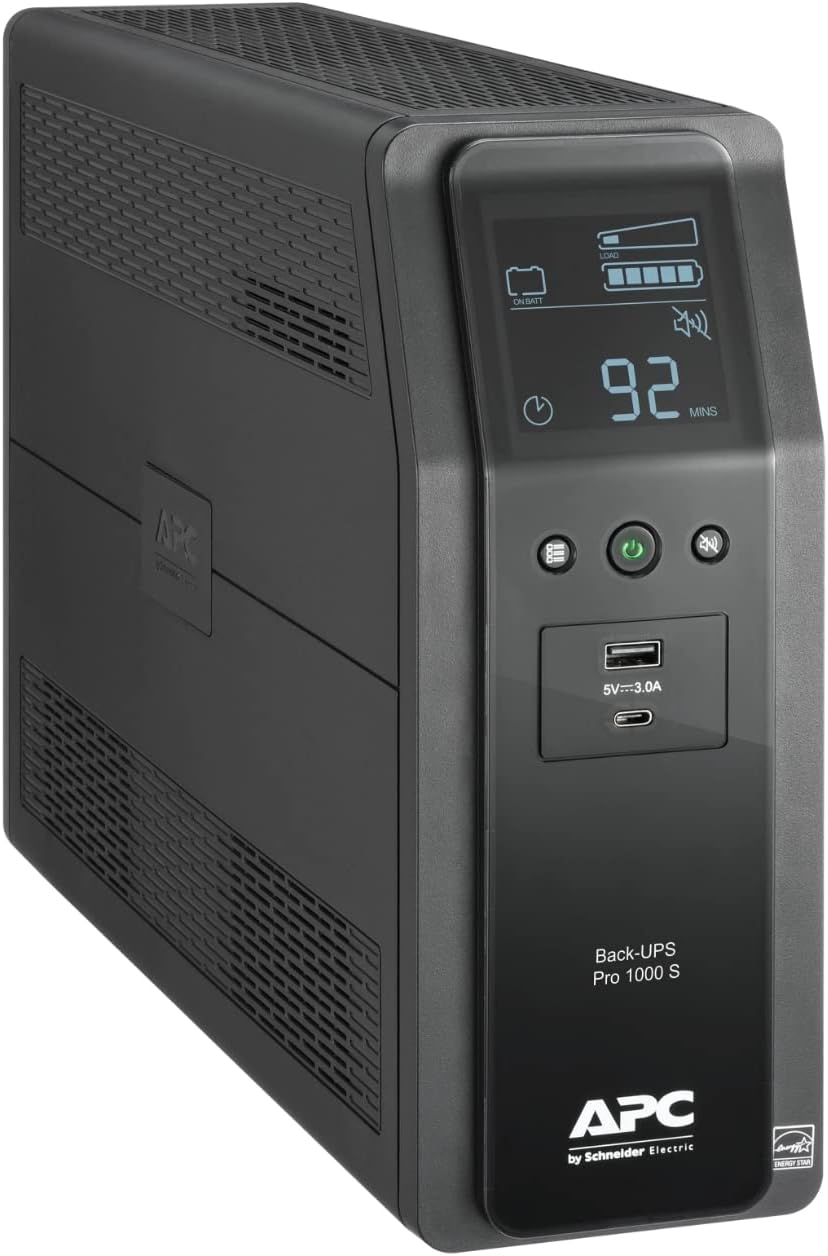
The APC BR1000MS is the right-sized APC pure sine option for a single-workstation home office that doesn’t need the full 1500VA of the BR1500MS2. Its 1000VA / 600W ceiling pairs cleanly with a mid-range desktop and one or two monitors, delivering the same pure sine wave protection and APC software ecosystem as its bigger sibling at a meaningfully lower cost — with the trade-off being a tighter watt budget and a standard (not hot-swap) user-replaceable battery.
How We Scored It
Category Deep-Dives
Power Protection
7.5 / 10 30% weightingThe line-interactive topology with Automatic Voltage Regulation (AVR) handles brownouts, sags, and voltage spikes by boosting or trimming the incoming line voltage directly, without pulling the battery into service. This is the correct architecture for home office environments where voltage fluctuations are more common than full outages: a standby UPS wastes battery cycles responding to every brownout, while the BR1000MS’s AVR circuitry corrects minor fluctuations silently and reserves battery runtime for actual power loss. The 1,080 Joules of surge suppression across all 10 outlets matches the rating on the BR1500MS2 and covers both computing equipment and connected data lines, with a built-in resettable circuit breaker protecting against overload.
The transfer time to battery — the gap between utility power loss and the UPS engaging its battery — falls within the same 6–10ms window as the BR1500MS2. For the vast majority of home office equipment, this transition is invisible: the capacitors inside a quality ATX power supply bridge the brief gap without the system detecting any interruption. Users running particularly sensitive audio interfaces, certain network switches, or specialized instruments should verify transfer time tolerance, as with any line-interactive UPS. The score of 7.5 rather than the BR1500MS2’s 9.0 reflects the lower absolute watt ceiling — 600W versus 900W — which constrains what loads the BR1000MS can protect effectively; the protection quality of the circuitry itself is equivalent between models.
Bottom line on power protection: The same line-interactive AVR circuitry and 1,080 Joules as the BR1500MS2; the lower 600W ceiling is what constrains the loads it can protect.
Power Quality
9.0 / 10 20% weightingThe BR1000MS delivers pure sine wave output across all six of its battery-backed outlets — and that fact matters more than the unit’s VA rating when assessing protection quality. Modern desktop power supplies certified to 80 Plus Gold, Platinum, or Titanium all use active power factor correction (active PFC), which requires a clean sine wave input to operate correctly. A simulated sine wave (stepped approximation) from a cheaper UPS can cause an active PFC supply to malfunction, overheat, or shut down entirely at the worst possible moment. The BR1000MS eliminates that risk, matching the protection quality of the higher-capacity BR1500MS2 on this crucial dimension. The 1000VA capacity does not diminish the quality of the sine wave output — it simply limits how much load that output can sustain.
Bottom line on power quality: Pure sine wave output matching the BR1500MS2 — safe for active PFC power supplies.
Usability & Features
7.0 / 10 20% weightingThe BR1000MS provides 10 NEMA 5-15R outlets: six with battery backup and surge protection, and four with surge protection only. That outlet count matches the higher-capacity BR1500MS2, which means the step down to the 1000VA model involves no compromise on port availability. The six battery-backed positions handle all computing equipment that requires an orderly shutdown — desktop, monitor, NAS, external drive — while the four surge-only outlets serve printers, phone chargers, desk lamps, and other loads that can tolerate an abrupt cut without consequence. For a compact single-workstation setup, 10 outlets is typically more than sufficient. Users with two desktop systems or a heavily peripheral-dense configuration will want to count carefully before purchasing.
The front-panel LCD is the same display interface found on the BR1500MS2, showing real-time battery charge level, input voltage, output voltage, load percentage, and estimated runtime remaining. This is genuinely useful day-to-day information that simpler UPS units (those with only LED indicator arrays) do not provide — particularly the load percentage readout, which is the most direct way to verify that your actual system draw is safely below the 600W ceiling. USB-A and USB-C charging ports (15W total shared) on the front panel serve as a convenient device-charging station without consuming an outlet, and their front placement keeps charging cables accessible. A front-accessible resettable 15A circuit breaker on the rear panel provides overload protection without requiring fuse replacement after a trip.
A USB-B data port connects the BR1000MS to a host computer for software integration via APC’s PowerChute Personal Edition — enabling automated graceful shutdown when battery runtime falls below a configurable threshold, real-time monitoring, and scheduled battery self-tests. The unit also includes RJ-11/RJ-45 data line protection jacks for phone and Ethernet surge suppression, covering the secondary surge ingress pathways that outlet protection alone does not address. The score of 7.0 versus the BR1500MS2’s 8.0 reflects the absence of the hot-swap battery design and the tighter load headroom — the physical connectivity and display features are equivalent, but the operational flexibility ceiling is lower.
The BR1000MS ships with the same software stack as the BR1500MS2: PowerChute Personal Edition (free, Windows and macOS) handles the core home office management use case — automated OS shutdown when battery runtime drops below a configurable minimum, real-time monitoring of input voltage, output load percentage, battery charge level, and estimated runtime, power event logging, and scheduled self-test configuration. PowerChute Personal Edition has been refined through many product generations and is one of the more polished pieces of UPS management software available at the consumer level. The setup process is straightforward, and the monitoring dashboard surfaces the load percentage readout that is particularly important for the BR1000MS given the tighter 600W ceiling — seeing a real-time load number is the most direct way to confirm safe operating headroom.
APC’s broader software ecosystem compatibility — VMware vSphere, Synology NAS management, Nutanix, and enterprise monitoring platforms via PowerChute Business Edition — extends to the BR1000MS through its USB-B data connection. For home offices running a NAS or multi-host environment where the UPS protects more than a single workstation, this third-party integration depth remains the software differentiator over CyberPower’s PowerPanel. The software experience is effectively identical between the two APC models — the BR1000MS carries no software penalty relative to its larger sibling.
Bottom line on usability and features: 10 outlets matching the BR1500MS2, front-panel LCD, USB charging, data line surge protection, and full PowerChute software support cover all standard single-workstation home office needs. The non-hot-swap battery and 600W ceiling are the meaningful feature-tier downgrades from the larger model.
Battery & Longevity
7.5 / 10 15% weightingThe BR1000MS is rated at 1000VA / 600W, with a manufacturer-specified runtime of approximately 3.7 minutes at full 600W load, around 12 minutes at a 300W load, and more than an hour at a light 50W draw. These figures are honest benchmarks for a home office workstation that draws 150–300W at the wall during normal operation: the BR1000MS provides several minutes of runtime to save work and initiate a graceful shutdown without data loss — which is exactly the use case it is designed for. It is not designed to run a heavily loaded workstation for extended periods during long outages, and users seeking that capability should look at the BR1500MS2 or our top-ranked CyberPower CP1500PFCLCD.
The 600W watt ceiling is the single most important spec to verify against your specific setup. A typical home office configuration — a mid-range desktop, one 27-inch monitor, a USB hub, and a few peripherals — draws somewhere in the 150–300W range, well within the BR1000MS’s comfort zone. Add a second large monitor, a high-powered workstation CPU, and a dedicated GPU under sustained load, and that ceiling can be approached or exceeded. APC recommends not loading the unit above 80% of its watt rating (480W effectively) for sustained use; buyers with a power-hungry system should calculate their actual load before committing to the 1000VA model rather than stepping up to the 1500VA BR1500MS2. The difference in rated capacity between the two models — 300W — is not trivial at the high end of home office hardware.
Unlike the BR1500MS2, the BR1000MS has a standard (non-hot-swappable) user-replaceable battery. The battery — model RBC17, a 12V 9Ah sealed lead-acid unit — can be replaced without tools and without contacting APC, but the unit and connected equipment must be powered down during the swap. For most home office users replacing a battery every 3–5 years, this is a minor inconvenience rather than a real operational problem. The ~16-hour recharge time after a significant discharge event is the same as the BR1500MS2 and reflects APC’s deliberate trade-off of charging rate for battery longevity — faster charging produces more heat and reduces overall battery lifespan.
Bottom line on battery and longevity: The 600W ceiling is the dominant spec to evaluate — verify your actual system load before choosing the BR1000MS over the BR1500MS2. Within its designed use case of a single mid-range workstation, runtime figures are appropriate for graceful shutdown scenarios. The non-hot-swap battery is a step down from the BR1500MS2 but acceptable for most home office environments.
Value
7.0 / 10 10% weightingThe BR1000MS is priced below the BR1500MS2, which is expected given the lower capacity. The value challenge it faces comes primarily from the CyberPower CP1500PFCLCD at rank #1: the CyberPower offers 50% more watt capacity (1000W versus 600W), two more outlets (12 versus 10), and a higher surge rating, all typically at a similar or lower price point than the BR1000MS. For a buyer focused strictly on protection per dollar, the CyberPower’s 1000VA model in its lineup or the CP1500PFCLCD directly represents a more efficient purchase than the BR1000MS. The BR1000MS makes a rational value proposition only for buyers with a genuine reason to stay within the APC ecosystem — software integration with existing APC infrastructure, familiarity with APC’s support organization, or a load light enough that the 600W ceiling is not a constraint.
APC backs the BR1000MS with a 3-year warranty on electronics and the company’s Connected Equipment Guarantee, which provides manufacturer-covered replacement protection for equipment damaged by a surge or power event while connected to the UPS. Battery replacement (model RBC17) is available through APC directly, Amazon, and multiple third-party suppliers, with APC’s battery recycling program providing a prepaid return pathway for spent cells. APC’s replacement battery availability and pricing have historically been reliable, which has real long-term value for a device expected to serve a home office for 5–10 years across two or more battery cycles.
The honest framing on value is that the BR1000MS sits in an awkward market position. It does not offer the full capacity or hot-swap battery that justifies the premium paid for the BR1500MS2, and it does not offer the watt-per-dollar efficiency of the CyberPower alternatives. Its natural buyer is someone who specifically wants pure sine APC protection for a single workstation at the lowest possible entry point in the Back-UPS Pro line — a legitimate use case, but a narrower one than either APC model bracketing it.
Bottom line on value: A sound choice if you specifically want APC’s ecosystem and brand assurance for a light-to-medium single-workstation setup. Buyers optimizing for protection per dollar should evaluate the CyberPower CP1500PFCLCD first; buyers who need more watt headroom within APC’s lineup should step up to the BR1500MS2.
Physical Design
7.0 / 10 5% weightingThe BR1000MS uses the same tower form factor as the BR1500MS2, though it is slightly smaller and lighter given the lower-capacity internal battery — a physical size that works comfortably under a desk or alongside a tower desktop without consuming disproportionate floor space. APC’s manufacturing quality is consistent across the Back-UPS Pro line: outlet receptacles are solidly mounted, the chassis does not flex under reasonable handling, and the LCD panel integrates cleanly into the front face. The battery compartment is accessible from the front without tools — the panel opens to allow the RBC17 battery to slide out — though unlike the BR1500MS2, the swap requires powering down connected equipment rather than performing a hot exchange while the unit continues conditioning from wall power.
The audible alarm system provides the same distinct tone pattern as the BR1500MS2: intermittent beeping on battery, rapid beeping at low battery, and a distinct alarm for overload conditions. The alarm volume is sufficient for detection from an adjacent room — important for a device that typically sits under a desk, out of direct line of sight. APC includes a front-panel mute button for temporary alarm suppression during planned maintenance. Automatic periodic battery self-test runs without user intervention and is configurable in frequency via PowerChute software, providing proactive health monitoring over the battery’s multi-year service life.
Bottom line on physical design: Solid, consistent APC construction with user-accessible battery replacement and a clear alarm system. The step down from hot-swap to standard-swap battery design is the one build-quality differentiation from the BR1500MS2 — meaningful only if battery-swap downtime is a concern for your specific setup.
About the Manufacturer
APC (American Power Conversion) has been producing consumer and business UPS systems since 1981 and operates today as a division of Schneider Electric following a 2007 acquisition. For a full overview of APC’s history, market position, warranty infrastructure, and software ecosystem, see our APC BR1500MS2 review, which covers the manufacturer in detail. The BR1000MS belongs to the same Back-UPS Pro product line as the BR1500MS2 and is manufactured to the same build standards and backed by the same support infrastructure.