Flint 2 (GL-MT6000)
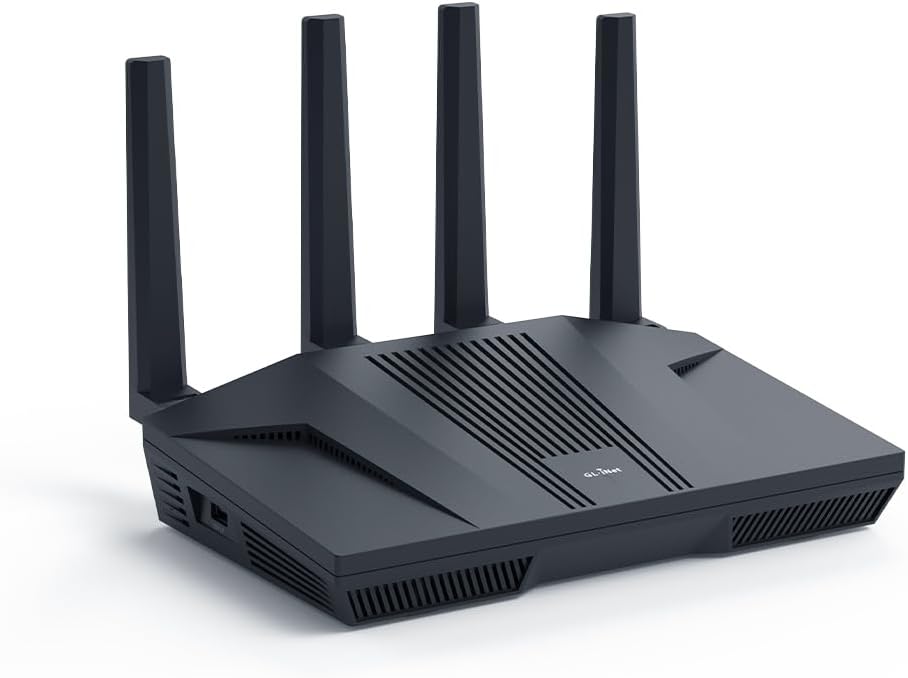
The GL.iNet Flint 2 is the specialist in our router rankings — and within its specialty, it is untouchable. Roughly 900 Mbps of WireGuard throughput, ~880 Mbps over OpenVPN, built-in Tailscale and AdGuard Home, multi-WAN failover, and the full configurability of OpenWrt, all with zero subscriptions at a price that undercuts every flagship here. If router-level VPN is central to your remote work, this is the pick, full stop. Its overall rank reflects the rest of the spec sheet honestly: dual-band Wi-Fi 6 with no 6 GHz band and single-unit coverage make it a modest wireless performer in a lineup full of Wi-Fi 7 mesh systems.
How We Scored It
Category Deep-Dives
Coverage & Range
6.0 / 10 20% weightingThis is the Flint 2’s weakest category, and there is no point dressing it up. It is a single dual-band router rated for roughly 2,500 sq ft — solid reach for one unit, helped by strong 4×4 radios and external antennas, but with no 6 GHz band and no turnkey mesh ecosystem to grow into. In an apartment, condo, or single-level home with the router reasonably central, it covers a home office without complaint. In a large multi-story house, it is the wrong tool.
The qualifications matter, though. OpenWrt supports 802.11s mesh, WDS, and wired access points, so a technical owner can absolutely extend a Flint 2 network — GL.iNet even sells companion hardware that pairs cleanly. But that is a project, not a product: there is no TrueMesh- or AiMesh-style managed experience, and we score the out-of-box reality. Within its intended footprint, signal quality is strong and stable; past it, you are engineering your own solution.
Bottom line on coverage: Fine for apartments and small-to-mid single-level homes; not built for whole-home coverage in larger spaces. If you need mesh reach and VPN throughput, wire a Flint 2 behind a mesh system — or accept the trade.
Reliability & Stability
8.0 / 10 20% weightingThe Flint 2’s reliability case rests on unglamorous fundamentals. The MediaTek MT7986A quad-core processor with 1 GB of DDR4 and 8 GB of eMMC storage is enormous headroom for a router at this price — it is why the VPN numbers are what they are, and why the router stays responsive under load that would stagger lighter hardware. The firmware is built on OpenWrt, the most battle-tested router operating system in existence, hardened by two decades of open-source scrutiny. Owner-reported stability is excellent: this is a router that runs for months untouched.
The deductions are structural rather than observed. GL.iNet is a much smaller company than ASUS or Amazon, so firmware QA has occasionally let a rough release through (typically fixed quickly, and easily rolled back). And the configurability that defines the product is also its risk surface — a misconfigured plugin is the most common cause of instability, which is the owner’s doing, but a category our framework still has to account for. A unique mitigant deserves mention: because the platform is open, the Flint 2 can run vanilla OpenWrt indefinitely, meaning its useful, secure life is not bounded by any vendor’s support decisions — no other router in our rankings can claim that.
Bottom line on reliability: Overbuilt hardware and a battle-tested OS deliver excellent real-world stability — with small-vendor QA and tinkering risk as the honest caveats. The open platform means this router can outlive its manufacturer’s support window.
Speed & Throughput
7.0 / 10 15% weightingThe Flint 2 is an AX6000-class Wi-Fi 6 router: 1,148 Mbps on 2.4 GHz and 4,804 Mbps on 5 GHz from 4×4 radios on both bands. There is no 6 GHz band and no Wi-Fi 7 — in a lineup where almost everything else is 802.11be, that is the gap this score records. No 320 MHz channels, no MLO, no clean spectrum for a Wi-Fi 7 laptop.
Here is the context that keeps the score respectable: on the internet plans most people actually have, none of that is felt. Wi-Fi 6 at 4×4 moves data faster than a gigabit connection at any realistic distance, the 2.5GbE WAN ingests multi-gig plans up to its port speed, and real-world throughput at range is strong for the class — those big radios earn their keep at distance, not just up close. As we say throughout this guide, Wi-Fi 7’s gains show up on multi-gig fiber, in device-dense homes, and as future headroom. The Flint 2 concedes the future headroom and keeps the today.
Bottom line on speed: Fast enough that gigabit-and-under households will never feel the difference — but no 6 GHz band and no Wi-Fi 7 means less headroom for multi-gig fiber and the device-dense future. Know which buyer you are.
Call & VPN Performance
9.5 / 10 15% weightingThis is why the Flint 2 exists, and nothing else in our rankings comes close. Router-level VPN throughput of roughly 900 Mbps over WireGuard and 880 Mbps over OpenVPN (with DCO) is not an incremental edge — it is several times what mainstream flagships sustain with encryption running, and it means a Flint 2 can put your entire network behind an always-on VPN without throttling a fast connection. Site-to-site tunnels between a home office and a main office run at speeds that make remote file access feel local.
The toolkit around the raw speed is just as strong: Tailscale and ZeroTier are built into the stock firmware — the modern, zero-config way to reach your home network securely from anywhere, and a feature no mainstream consumer router ships natively. VPN policies route specific devices or destinations through (or around) the tunnel. The USB port handles 4G/5G modem tethering for failover, and multi-WAN failover is supported in firmware — a continuity stack that rivals business gear.
For calls, OpenWrt’s SQM (Smart Queue Management) is the gold standard for bufferbloat control — properly tuned, it produces flatter latency under load than the auto-QoS on any mainstream router here. The honest caveat: tuned is the operative word. SQM works brilliantly once configured; eero does a very good approximation with zero effort. We score the ceiling, and note the floor.
Bottom line on calls & VPN: The undisputed VPN champion of our rankings — class-leading WireGuard and OpenVPN throughput, native Tailscale, multi-WAN failover, and best-in-class bufferbloat control for those willing to tune it.
Security & Management
8.5 / 10 15% weightingEverything is free, and much of it is auditable. AdGuard Home — network-wide ad and tracker blocking — ships in the stock firmware at no cost, where eero charges a subscription for the equivalent. WPA3, guest networks, and VLAN-capable network segmentation cover the home office security fundamentals, and the open-source firmware base means the code securing your network is publicly inspected rather than taken on faith — a genuine, if philosophical, security advantage. There is no subscription tier because there is nothing held back to sell you later; our subscription-gated-security penalty has nothing to attach to.
What the Flint 2 lacks is the commercial threat-intelligence layer: no Trend Micro-style malicious-site database, intrusion prevention, or one-tap “quarantine infected device” feature like ASUS’s AiProtection Pro. The building blocks to assemble equivalents exist in the plugin ecosystem, but assembled is the operative word.
Management is honest about its audience. The GL.iNet admin panel is genuinely clean — VPN, AdGuard, and guest networks are point-and-click easy, more approachable than ASUS’s web UI for those tasks. Beneath it sits LuCI, the full OpenWrt interface, where the depth is effectively unlimited and the responsibility is entirely yours. There is a functional mobile app, but this is a router managed from a browser by someone comfortable in one.
Bottom line on security: Subscription-free, open-source, and segmentation-capable, with AdGuard Home included where competitors charge. Docked for the missing commercial threat-protection layer and a management experience that rewards — and expects — technical comfort.
Connectivity & Value
9.0 / 10 15% weightingThe port array covers the realistic home office: two 2.5GbE ports (configurable WAN/LAN) plus four gigabit LAN ports and a USB 3.0 port for storage or cellular tethering. Wire the work machine to one 2.5G port, take a multi-gig plan in on the other, and the six total ports mean no immediate need for a switch — a quietly practical advantage over the two-port eero. No 10G is the ceiling here, and at this price, a fair one.
Value is where the Flint 2 embarrasses the field. It sells for a fraction of what the flagship mesh systems in this guide command, while delivering VPN throughput none of them can match, hardware (quad-core, 1 GB RAM, 8 GB storage) that outguns routers costing twice as much, and a feature set — Tailscale, AdGuard, multi-WAN — with no subscription attached to any of it. Five-year total cost of ownership is simply the purchase price. For the technically comfortable buyer whose needs it fits, this is the best price-to-capability ratio in our entire router lineup.
Bottom line on connectivity & value: Six usable ports including dual 2.5GbE, USB failover, and the strongest price-to-capability ratio in our rankings. The savings versus a flagship mesh fund a lot of coffee — or a second unit for the office.
About the Manufacturer
Net
GL.iNet, founded in 2014, built its reputation on something unusual in consumer networking: shipping routers with open-source OpenWrt firmware as the foundation rather than a locked-down proprietary OS. The company first won a following among travelers and security-conscious users with pocket-sized VPN routers like the Slate and Beryl lines, then moved into full-size home hardware with the Flint series and Brume security gateways.
The Flint 2 (GL-MT6000), released in late 2023, is the company’s home-router flagship and its broadest mainstream success — widely recommended in networking communities for pairing serious hardware with OpenWrt flexibility at an aggressive price. Its successor tier (the Wi-Fi 7 Flint 3) continues the line, but the Flint 2 remains the value sweet spot.
For home office buyers, GL.iNet’s appeal is self-reliance: open firmware you can audit, extend, or replace entirely, no subscriptions, and a feature set aimed at people who treat their network as infrastructure they own — not a service they rent.