BR1500MS2 Back-UPS Pro
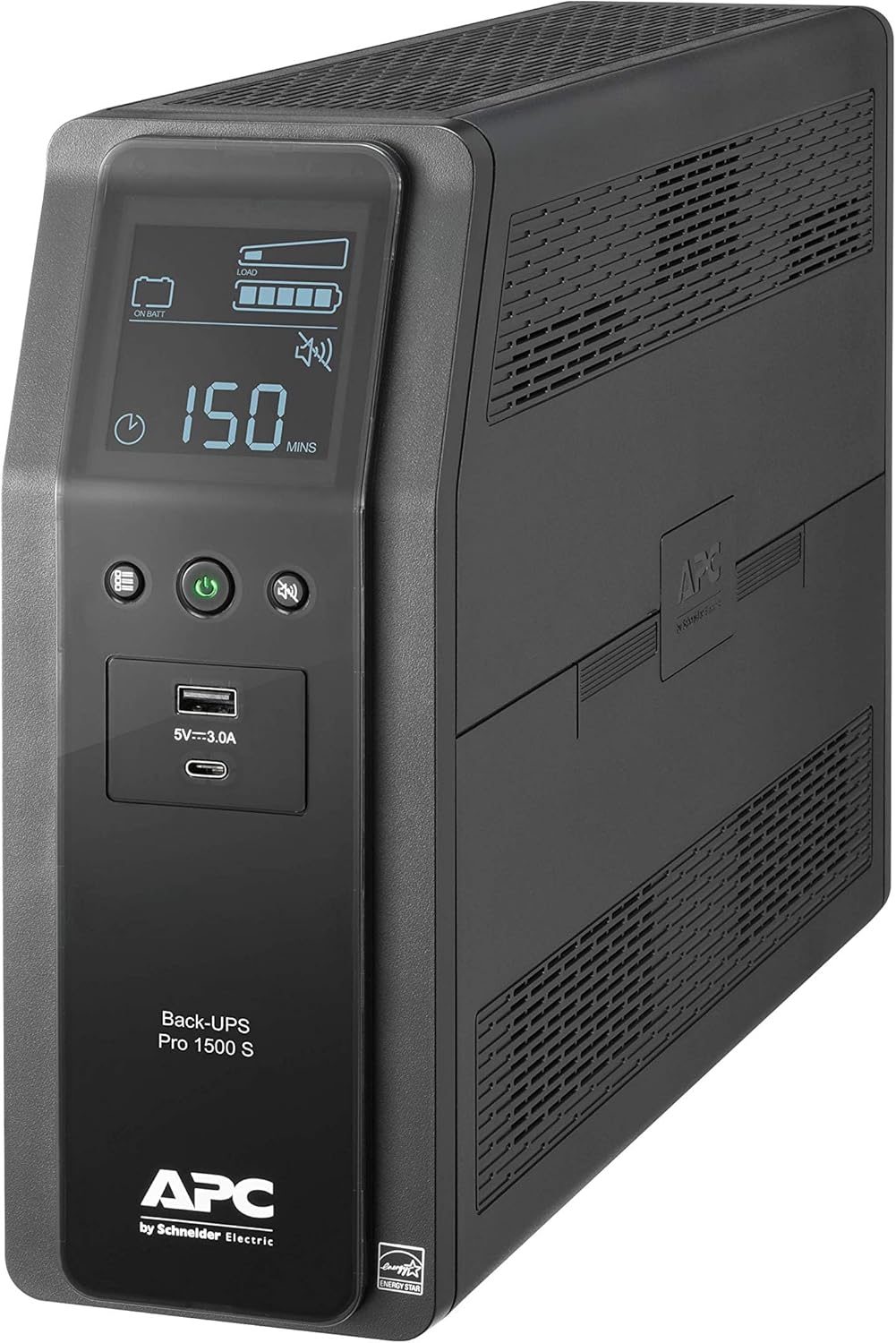
The APC BR1500MS2 is the pure sine wave UPS for users who prioritize brand pedigree, a user-hot-swappable battery, and APC’s deep ecosystem of network management software. At 1500VA/900W with line-interactive AVR, 10 outlets, and a front-panel LCD, it delivers the same core protection tier as our top-ranked CyberPower at a higher price — justified in part by APC’s stronger enterprise software integration, its reputation for long-term reliability, and the hot-swap battery design that allows replacement without powering down connected equipment.
How We Scored It
Category Deep-Dives
Power Protection
9.0 / 10 30% weightingThe line-interactive topology with AVR addresses voltage fluctuations — brownouts, sags, and surges — by boosting or trimming the incoming voltage in place, without engaging the battery. This is the correct topology for home office environments where power instability is intermittent rather than constant: a standby UPS switches to battery on every fluctuation, accelerating battery wear and consuming runtime on events that don’t require battery power at all. The BR1500MS2’s AVR circuitry handles minor deviations silently, reserving battery power for actual outages. The integrated 1,080 Joules of surge suppression across all outlets and the built-in resettable 15A circuit breaker provide protection at both the surge and overload extremes.
The 6–10ms transfer time to battery is the one specification worth noting carefully. Most desktop computers with active PFC power supplies operate without issue at this transfer time, as the capacitors in the power supply bridge the brief gap between utility power loss and battery engagement. Some particularly sensitive equipment — certain network switches, specific audio interfaces, and laboratory instruments — may detect the transition. For the vast majority of home office hardware, 6–10ms is imperceptible and causes no operational interruption. If your setup includes unusually sensitive equipment, the CyberPower CP1500PFCLCD at rank #1 shares a similar transfer time specification, and true zero-transfer-time protection requires an online double-conversion UPS at significantly higher cost.
Bottom line on power protection: Line-interactive AVR and 1,080 Joules of surge protection, with a 6–10ms transfer window that quality ATX supplies bridge without interruption.
Power Quality
9.0 / 10 20% weightingThe BR1500MS2 delivers pure sine wave output across all six battery-backed outlets, making it fully compatible with active PFC power supplies found in modern desktop computers, workstations, and higher-end laptops. The significance of pure sine wave output in this context is not merely technical: active PFC power supplies — which are mandatory for 80 Plus Gold, Platinum, and Titanium certified units — can malfunction, overheat, or fail outright when operated on the stepped approximation waveform produced by simulated sine wave UPS units. APC’s Back-UPS Pro series has been shipping pure sine wave output for the active PFC era specifically because the engineering consequences of a mismatch are severe. The BR1500MS2 eliminates that risk entirely.
Bottom line on power quality: Pure sine wave output across all battery-backed outlets — fully compatible with active PFC power supplies.
Usability & Features
8.0 / 10 20% weightingThe BR1500MS2 provides 10 NEMA 5-15R outlets: six with battery backup and surge protection, four with surge protection only. For most home offices, 10 outlets covers the full equipment load without compromise. Users with particularly equipment-dense setups — two desktops, multiple monitors, NAS, external drives, networking gear, and charging stations — may find 10 outlets limiting and should consider the CyberPower CP1500PFCLCD’s 12-outlet configuration. The six battery-backed outlets are sufficient for all computing equipment that requires orderly shutdown; the four surge-only outlets handle non-critical loads like printers, phone chargers, and desk lamps that can tolerate abrupt power cuts.
The front-panel LCD provides real-time display of battery charge level, input voltage, output voltage, load percentage, and estimated runtime remaining. The display interface is a consistent element across APC’s Back-UPS Pro line and is well-regarded for clarity and readability. The USB-A and USB-C charging ports (3A shared) on the front panel allow convenient device charging without occupying an outlet, and their front placement — as opposed to rear outlet banks — makes them more accessible in typical desk configurations. The unit also includes a built-in resettable 15A circuit breaker accessible from the rear panel, providing overload protection without requiring fuse replacement after a trip event.
APC provides a USB data port for software connection, enabling PowerChute Personal Edition (for home users) and PowerChute Business Edition (for small office environments) to automate graceful OS shutdown when battery runtime reaches a configured minimum. The DataChute capability additionally allows remote network management via a connected computer — useful for home server environments where the UPS owner may not be physically present during a power event. Phone/data line surge protection jacks are included for coaxial, telephone, and Ethernet lines, covering the alternative surge pathways that wall outlet protection alone does not address.
APC’s PowerChute Personal Edition (free, Windows and macOS) provides the core home office UPS management experience: graceful OS shutdown automation when battery runtime drops below a configured threshold, real-time monitoring of input voltage, output load, battery charge, and estimated runtime, power event logging with timestamps, and scheduled battery self-test configuration. For home office users, PowerChute Personal Edition covers every meaningful use case without requiring the more complex Business Edition licensing. The interface is straightforward and has been refined through many product generations — it is one of the more polished pieces of UPS management software available at the consumer level.
For users managing a home server or small-office environment, APC’s Network Management Card ecosystem represents a step-up integration that the BR1500MS2’s USB connectivity supports as a foundation. The DataChute feature in PowerChute Business Edition allows centralized shutdown management for multiple networked computers from a single UPS connection, a capability relevant to home offices running a NAS, media server, and primary workstation as separately managed hosts. APC’s software ecosystem has broader third-party integration support than CyberPower’s PowerPanel — compatible with VMware vSphere, Nutanix, Synology NAS management, and enterprise monitoring platforms — which is meaningful for technically sophisticated home office environments where the UPS connects to systems beyond a standard desktop.
Bottom line on usability and features: 10 outlets with a sensible battery-backup/surge-only split, front-panel LCD, USB charging, and a complete software ecosystem cover all standard home office needs. Two fewer outlets than the CyberPower CP1500PFCLCD is a real constraint for equipment-dense setups.
Battery & Longevity
8.5 / 10 15% weightingThe BR1500MS2 is rated at 1500VA / 900W, with a manufacturer-specified runtime of approximately 4.2 minutes at full 900W load — meaningfully better than the CyberPower CP1500PFCLCD’s 2.5-minute full-load rating, though the CyberPower’s 1000W ceiling is 11% higher. The real-world comparison depends on your connected load: at typical home office loads well below 500W, both units provide comparable runtime. The VA rating of 1500 handles any home office equipment combination without concern, but the 900W watt ceiling is a modest constraint compared to the CyberPower’s 1000W. Users with a very power-hungry workstation (say, a high-end gaming PC with a 700W power draw) would want to verify load against the 900W ceiling, as the 80% loading rule leaves only 720W of recommended capacity before the BR1500MS2 begins operating outside its efficiency band.
The standout capacity feature is the user-replaceable, hot-swappable battery design. Most home office UPS units, including the CyberPower CP1500PFCLCD, require the unit to be powered down and all connected equipment to be shut off before the battery can be replaced. The BR1500MS2 allows battery replacement while connected equipment remains powered — the UPS continues to provide surge protection and AVR conditioning from wall power during the swap, with the new battery installed and online without a service interruption. For a home office NAS or always-on workstation where downtime is disruptive, hot-swap capability has genuine operational value. Battery replacement intervals of every 3–5 years means this feature is used infrequently, but when a battery dies at an inconvenient time, the ability to swap it without a full shutdown is a meaningful practical advantage.
The 16-hour typical recharge time is notably longer than the charging rate of some competing units and is worth flagging for home offices that experience multiple power events in quick succession. If a first outage discharges the battery substantially and a second event follows within 12–14 hours, the battery may not be fully recovered. In most residential environments this scenario is uncommon, but users in areas with frequent power instability should be aware of the recharge ceiling. APC’s recharge time is a function of the charging circuit design; faster chargers reduce battery longevity by increasing heat during charging, so APC’s conservative rate reflects a deliberate engineering trade-off favoring battery lifespan over rapid recovery.
Bottom line on battery and longevity: The hot-swappable battery is a genuine differentiated feature with real operational value, and the 4.2-minute full-load runtime is strong. The 900W watt ceiling and 16-hour recharge time are the two specifications to verify against your specific setup and power environment.
Value
7.5 / 10 10% weightingThe BR1500MS2 is typically priced above the CyberPower CP1500PFCLCD, while providing a lower watt ceiling (900W vs. 1000W) and two fewer outlets (10 vs. 12). On a pure specs-per-dollar basis, the CyberPower delivers more measurable unit for the money. The APC’s premium reflects factors that are real but less directly quantifiable: APC’s brand reputation for consistent reliability across product generations, the hot-swappable battery design, a more established enterprise software ecosystem, and Schneider Electric’s global support and service infrastructure. For users who place significant weight on brand stability and long-term support availability — particularly for an infrastructure device that may run continuously for 5–10 years — the APC premium has a rational basis.
APC offers a $150,000 Connected Equipment Guarantee with the BR1500MS2 — meaningful protection, though notably lower than CyberPower’s $500,000 commitment on the CP1500PFCLCD. For a home office with $3,000–5,000 of connected equipment, either guarantee level provides coverage multiples above the likely connected equipment value. The unit comes with APC’s standard 3-year warranty on the electronics; battery warranty coverage terms vary by region and purchasing channel. Replacement batteries (model APCRBC163) are widely available from APC directly and through third-party suppliers, and APC’s battery recycling program provides a free-return pathway for spent batteries.
The honest framing on value is that the BR1500MS2 is a premium product within its tier, not an overpriced one. If the hot-swappable battery or APC’s software ecosystem are meaningful to your use case, the price premium is justifiable. If you want the best protection per dollar for a standard home office setup, the CyberPower CP1500PFCLCD at rank #1 is the more efficient purchase.
Bottom line on value: Higher price than the CyberPower CP1500PFCLCD for a lower watt ceiling and fewer outlets. The premium is supported by APC’s brand equity, hot-swap battery design, and software ecosystem — but only partially. Best suited to buyers with specific reasons to choose APC over CyberPower rather than buyers optimizing for protection per dollar.
Physical Design
8.0 / 10 5% weightingThe BR1500MS2 uses a tower form factor with a similar footprint to the CyberPower CP1500PFCLCD — compact enough for under-desk placement or alongside a tower desktop. APC’s construction quality reflects decades of UPS manufacturing refinement: the chassis is solid, outlet receptacles are consistently mounted, and the LCD panel is integrated cleanly into the front face. The hot-swappable battery compartment, accessed from the front panel, is a genuine engineering achievement in this unit class. The door opens on a firm latch, the battery slides out on rails without requiring tools, and the electrical contacts are protected against mis-insertion. The entire swap operation takes approximately 60 seconds with a replacement battery on hand.
The audible alarm system provides distinct tones for on-battery operation (intermittent beeping), low battery (rapid beeping), and overload conditions — an important passive alerting system for a device that often sits out of sight under a desk. The alarm volume is sufficient to be audible from an adjacent room, ensuring the operator is alerted during a power event even if they are not at their desk. APC includes a front-panel mute button for temporary alarm suppression during planned power work, which prevents the unit from alarming continuously during deliberate maintenance. Automatic self-test and scheduled battery tests (configurable via PowerChute software) provide proactive battery health monitoring without requiring manual intervention.
Bottom line on physical design: Well-constructed hardware with the hot-swap battery compartment as the engineering standout. The tower form factor, clear outlet labeling, and thoughtful alarm system reflect APC’s experience building UPS units for both home and business environments.
About the Manufacturer
APC (American Power Conversion) was founded in 1981 in West Kingston, Rhode Island, and pioneered the consumer and business UPS market through the 1980s and 1990s with the Back-UPS and Smart-UPS product lines. The company was acquired by Schneider Electric in 2007 and now operates as the APC by Schneider Electric brand, continuing to produce UPS systems, power distribution units, and cooling infrastructure under the parent company’s global manufacturing and distribution network.
APC’s Back-UPS Pro line — the series to which the BR1500MS2 belongs — represents the company’s premium consumer and prosumer tier, combining pure sine wave output and line-interactive topology at a price point accessible to home office buyers. The Back-UPS Pro has been continuously updated through multiple generations to track the active PFC transition in desktop power supplies, the growing importance of USB-C charging, and increasing software integration requirements. APC’s decades of market presence and enterprise software ecosystem give it a level of third-party compatibility and institutional familiarity — with IT departments, MSPs, and network management platforms — that newer UPS brands have not yet matched.
APC products are sold through a broad channel including Amazon, Best Buy, Staples, CDW, and enterprise distributors globally. The company’s warranty and support infrastructure operates across more than 100 countries, and APC’s battery recycling program provides a prepaid return label for spent batteries, addressing the environmental handling dimension of UPS ownership. Schneider Electric backs the APC brand with manufacturing consistency and long-term parts availability commitments that are relevant for a device category where buyers expect a product lifespan of five years or more.