Line Interactive UPS 1500VA
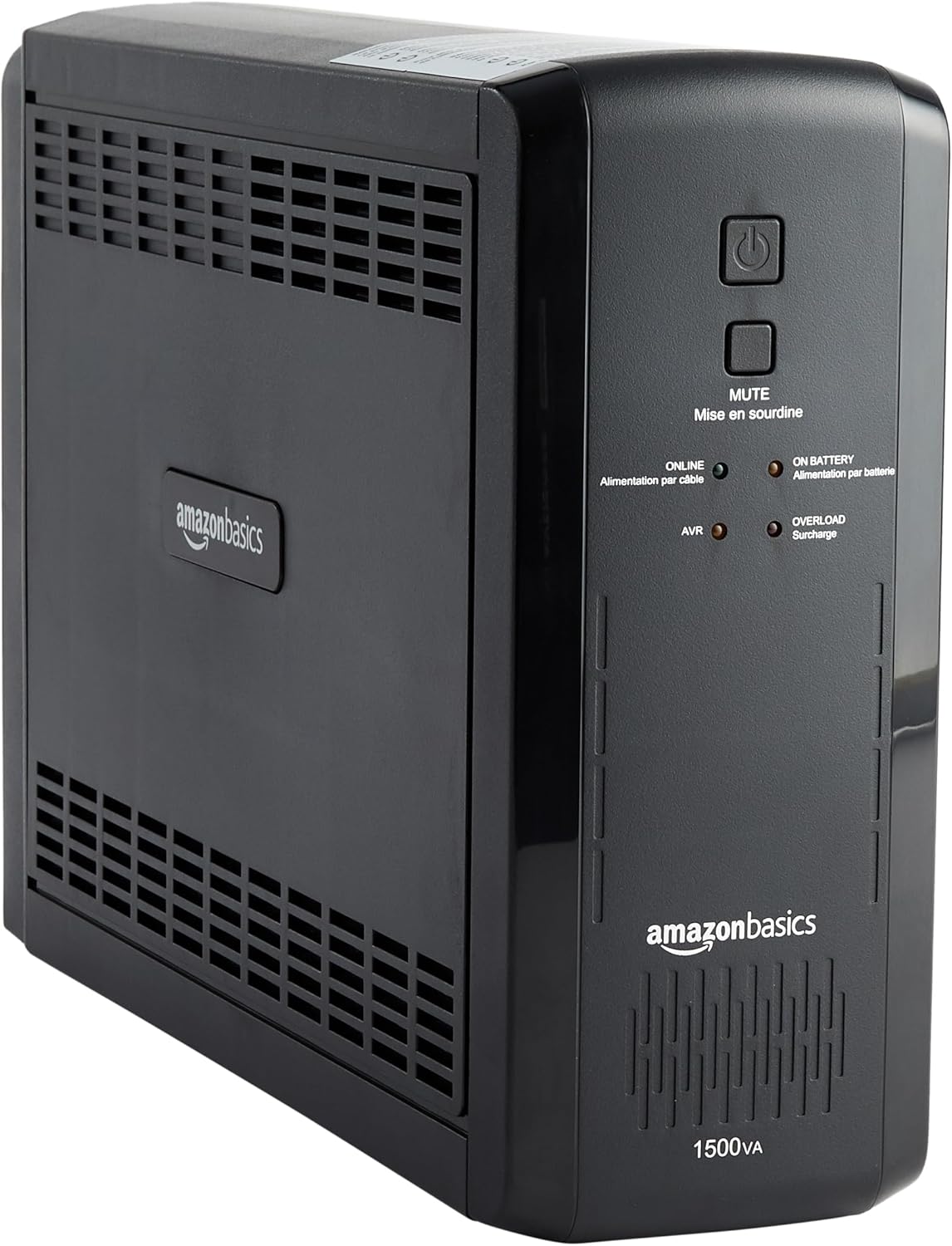
The Amazon Basics 1500VA is the lowest-cost line interactive UPS in our guide, and its value score reflects that plainly. It delivers the fundamentals — line interactive topology, automatic voltage regulation, and 1500VA capacity — at a price that consistently undercuts every named-brand competitor by a meaningful margin. The trade-off is real: simulated sine wave output limits compatibility with active PFC power supplies common in modern desktops, the outlet count is low for a 1500VA unit, and there is no management software for automated shutdown. For users protecting a basic setup where budget is the primary constraint, it earns its place. For users with a modern desktop or any equipment that benefits from pure sine wave power, the step up to a named-brand unit is worth taking.
How We Scored It
Category Deep-Dives
Power Protection
8.0 / 10 30% weightingThe Amazon Basics 1500VA uses a line interactive topology with automatic voltage regulation (AVR) — the correct foundation for a home office UPS. Line interactive means the UPS actively conditions incoming voltage through its AVR circuitry rather than simply switching to battery power when things go wrong. Voltage sags, brownouts, and momentary spikes are handled electronically, preserving battery charge for genuine outages. This places the Amazon Basics meaningfully above standby-only units that provide no protection outside of full power loss events.
Bottom line on power protection: Line interactive topology with AVR and all-outlet surge protection — the core protection hardware does its job.
Power Quality
5.5 / 10 20% weightingThe significant limitation is the simulated sine wave output. Simulated sine wave UPS units produce a stepped approximation of a sine waveform rather than the smooth, continuous sinusoidal waveform delivered by the utility grid or by pure sine wave UPS units. For equipment with standard power supplies — older desktops, monitors, networking gear, external drives — this is generally fine. The problem arises with active PFC (Power Factor Corrected) power supplies, which are standard in modern desktop computers, workstations, and many higher-end laptops. Active PFC supplies are engineered to operate on a clean sine wave; when a simulated sine wave UPS switches to battery during a power event, some active PFC power supplies will react badly — shutting down unexpectedly, drawing excess current, or failing to hold the expected load. The frequency and severity of this incompatibility varies by power supply design, but it is a known and documented issue across the UPS industry. Users with modern desktop hardware should verify their power supply’s active PFC status before relying on a simulated sine wave UPS.
For the equipment the Amazon Basics is genuinely suited to — NAS devices, networking hardware, monitors, laptops with standard power bricks, printers, and other non-PFC loads — the line interactive protection with AVR is solid and provides meaningful improvements over no UPS at all. The 5.5 power quality score reflects this honestly: the battery output is genuinely useful for compatible loads, with a waveform constraint that rules it out for modern desktop setups.
Bottom line on power quality: Simulated sine wave output limits this unit to non-PFC loads — NAS, networking gear, and standard power bricks, not modern desktop workstations.
Usability & Features
6.5 / 10 20% weightingWith 6 total outlets, the Amazon Basics 1500VA is the most constrained UPS in our guide at this capacity tier. For context: the CyberPower CP1500PFCLCD at rank #1 provides 12 outlets; the APC BR1500MS2 at rank #2 provides 10; the APC BX1500M at rank #7 provides 10. At 6 outlets, a fully equipped home office — desktop, two monitors, router, switch, and a NAS — has already used all available ports before adding a printer, phone charger, desk lamp, or external drives. Users who expect to connect the full complement of a functioning home office setup may find 6 outlets genuinely limiting, requiring either a separate surge strip for non-critical peripherals or deliberate prioritization of which equipment receives battery backup protection.
The LED indicator panel provides basic status information — power on, on battery, replace battery, and overload indicators. This is functional for a product in this class, but it stands in contrast to the numerical LCD displays on the CyberPower and APC units above it in the rankings, which provide real-time readouts of input voltage, output voltage, load percentage, and estimated runtime. With LED indicators only, users have no precise visibility into their actual load level relative to the UPS’s capacity, remaining runtime, or whether the unit is currently performing AVR regulation. For a UPS whose core purpose is protecting expensive equipment, this instrumentation gap is meaningful — you are trusting the unit without being able to verify its current operating state numerically.
There is no USB charging port, no coaxial/telephone line protection, and no USB data port for software connectivity. Each of these omissions is individually understandable at this price tier, but collectively they represent the most basic feature set of any 1500VA unit in our guide. For buyers whose primary requirement is battery backup coverage at minimum cost — and who have other means of managing outlet count and monitoring — these omissions may be acceptable trade-offs. For buyers who want more of a complete home office power management solution, the step up to ranked units above this one provides substantially more capability.
The Amazon Basics 1500VA includes no management software and no USB data port for software connectivity. There is no automated graceful shutdown capability — the single most important software function a UPS provides for unattended workstations. If the battery is depleted during an extended outage while the user is away, connected computers will lose power abruptly without a clean shutdown sequence, risking unsaved work and file system corruption on any storage device with write-cache enabled. For users who are always present when power events occur, this limitation is manageable; for users who leave computers running unattended — overnight backups, server workloads, network-attached storage — the absence of automated shutdown is a genuine operational risk.
Status monitoring is limited to the LED indicator panel on the front of the unit: power on, on battery, overload, and replace battery indicators. There is no numerical display of load level, input voltage, output voltage, or remaining runtime. Users have no means of verifying how much of the UPS’s capacity their connected load is consuming or how much battery runtime their current load level provides. This is not a disqualifying limitation for all users — a home router and NAS drawing 80W on a 900W UPS does not require real-time load monitoring — but it does mean the Amazon Basics is a passive protection device rather than an active power management platform.
Bottom line on usability and features: Six outlets is the most significant practical constraint — it is insufficient for a fully equipped home office without supplementing with an additional surge strip. No USB charging, no management software port, and LED-only status indication round out the most feature-limited configuration in our 1500VA comparison.
Battery & Longevity
7.5 / 10 15% weightingAt 1500VA / 900W, the Amazon Basics provides a meaningful capacity ceiling for home office use. The 900W watt rating is the practical limit — a typical home office setup drawing 400–600W under real conditions sits comfortably within this ceiling and allows the headroom for battery longevity recommended by UPS manufacturers (no more than 80% of rated wattage under sustained load). For a networking-focused setup — router, switch, NAS, modem, and possibly a monitor — where wattage demands are lower, the 1500VA rating is generous and provides ample headroom.
The ~1.5 minutes of runtime at full 900W load is modest but reflects an honest spec at this price point. The practical calculus is the same across all UPS units at this tier: almost no home office runs at full rated load, and runtime extends substantially as actual draw decreases. A networking stack drawing 150–200W might run 15–20 minutes or more from the same battery. The goal in most home office scenarios is not sustained operation but enough time to execute a graceful shutdown — save work, close applications cleanly, power down in an orderly sequence — which is achievable within the realistic runtime envelope at typical partial loads.
One notable difference from the named-brand competition: the Amazon Basics does not publish detailed runtime curves for intermediate load levels, and there is no runtime calculator provided by the manufacturer. Users who want precise runtime estimates for their specific load will need to rely on general UPS runtime principles (runtime scales roughly inversely with load) rather than manufacturer-supplied data. This is a documentation limitation, not necessarily a hardware one, but it reduces the precision with which buyers can forecast actual runtime for their setup.
Bottom line on battery and longevity: 1500VA / 900W provides adequate capacity for most home office loads. Full-load runtime of ~1.5 minutes is short but typical for this battery size; real-world partial-load runtime is longer. The absence of manufacturer-published runtime curves at partial loads is a documentation gap that buyers should note.
Value
9.5 / 10 10% weightingThe Amazon Basics 1500VA earns its 9.5 value score straightforwardly: it is the lowest-cost line interactive 1500VA UPS in our guide, and by a meaningful margin. Amazon Basics operates as Amazon’s in-house brand, sourcing products from established OEM manufacturers and distributing under Amazon’s own label without the brand premium, warranty program costs, or marketing overhead that contribute to the pricing of CyberPower, APC, and Tripp Lite products. The result is a line interactive UPS that provides the correct topology at a price that no named-brand competitor matches.
For buyers whose use case aligns with the product’s actual capabilities — protecting networking hardware, a NAS, monitors, and non-PFC loads where simulated sine wave output is not a concern — the Amazon Basics delivers line interactive protection at a price point that makes UPS adoption accessible. A buyer protecting a home router, network switch, NAS device, and a monitor against power disruptions gets genuine line interactive AVR coverage for substantially less than any named-brand alternative at this VA rating. That is a defensible value proposition for the right user and load profile.
The honest counterpoint: the value calculation changes if a buyer needs more than 6 outlets, needs pure sine wave output for active PFC equipment, or would benefit from management software for automated shutdown. In those scenarios, the incremental cost of moving up to the APC BX1500M (rank #7, 7.6/10) or CyberPower CP1350AVRLCD3 (rank #4, 7.8/10) buys significantly more capability per dollar spent on the upgrade. The 9.5 value score reflects the Amazon Basics on its own terms for the use case it best serves — not as a universal maximum-value recommendation.
Bottom line on value: The lowest-cost line interactive 1500VA in the guide. Exceptional value for buyers protecting networking and non-PFC loads where outlet count and software management are not requirements. Value advantage narrows substantially when the comparison includes the capability gaps versus units one tier above.
Physical Design
7.5 / 10 5% weightingThe Amazon Basics 1500VA is housed in a standard mini-tower ABS enclosure that meets the functional requirements for a home office UPS without the premium finish of the CyberPower and APC units at higher rankings. The chassis is adequately rigid, outlet receptacles are firmly mounted, and the unit includes an audible alarm for overload, on-battery operation, and low battery conditions — the essential safety alerts that ensure users are notified during a power event even without monitoring software. The form factor fits under or alongside a desk without occupying disproportionate space.
Amazon Basics sources hardware from established OEM manufacturers and the underlying UPS internals at this specification — sealed lead-acid battery and AVR buck/boost autotransformer stages — are built to industry-standard designs. There is no field data distinguishing the Amazon Basics unit’s reliability from named-brand competitors in this class, and the standard sealed lead-acid battery is user-replaceable by any competent home user when the time comes. Battery replacement availability is an important practical consideration for a UPS intended to provide protection over a multi-year service life; sealed lead-acid batteries of the standard sizes used in 1500VA units are widely available from third-party suppliers and not dependent on the manufacturer’s own supply chain.
The main build caveat is the absence of an Amazon Basics warranty program equivalent to the CyberPower or APC Connected Equipment Guarantee. Named-brand UPS manufacturers back their surge protection with liability coverage for connected equipment damaged through their units; this coverage is an implicit part of the value calculation for those products. Amazon Basics does not publish an equivalent guarantee, meaning buyers are relying on the product’s standard return policy and Amazon’s customer service rather than a dedicated equipment protection program. For buyers protecting high-value computing equipment, this is a material distinction worth noting.
Bottom line on physical design: Functional, adequately constructed hardware with audible alarms and user-replaceable battery. The absence of a Connected Equipment Guarantee equivalent to named-brand competitors is the most notable quality caveat for buyers protecting expensive equipment.
About the Manufacturer
Basic
Amazon Basics is Amazon’s in-house product label, launched in 2009 and expanded significantly through the 2010s to cover hundreds of product categories — cables, batteries, office furniture, electronics accessories, and, more recently, power protection equipment. Amazon Basics products are sourced from third-party OEM manufacturers and sold exclusively through Amazon’s retail channels, typically at prices below equivalent named-brand products by eliminating brand premium, dedicated warranty programs, and retail distribution costs.
The Amazon Basics UPS line represents the brand’s entry into a product category that has historically been dominated by established manufacturers with deep engineering histories in power protection — APC (founded 1981), CyberPower (founded 1997), and Tripp Lite (founded 1922). Amazon Basics does not publish OEM sourcing information for its UPS products, and the underlying hardware is manufactured to standard industry specifications rather than to proprietary Amazon designs. The product lineup targets buyers prioritizing price over brand support infrastructure, warranty depth, or connected equipment guarantee programs.
Amazon Basics products are sold exclusively on Amazon.com and Amazon marketplaces globally. Customer support, warranty service, and returns are handled through Amazon’s standard customer service channels rather than a dedicated manufacturer support program. Replacement batteries for standard UPS units at this capacity are widely available from third-party suppliers and are not manufacturer-specific components.