Standby UPS 800VA
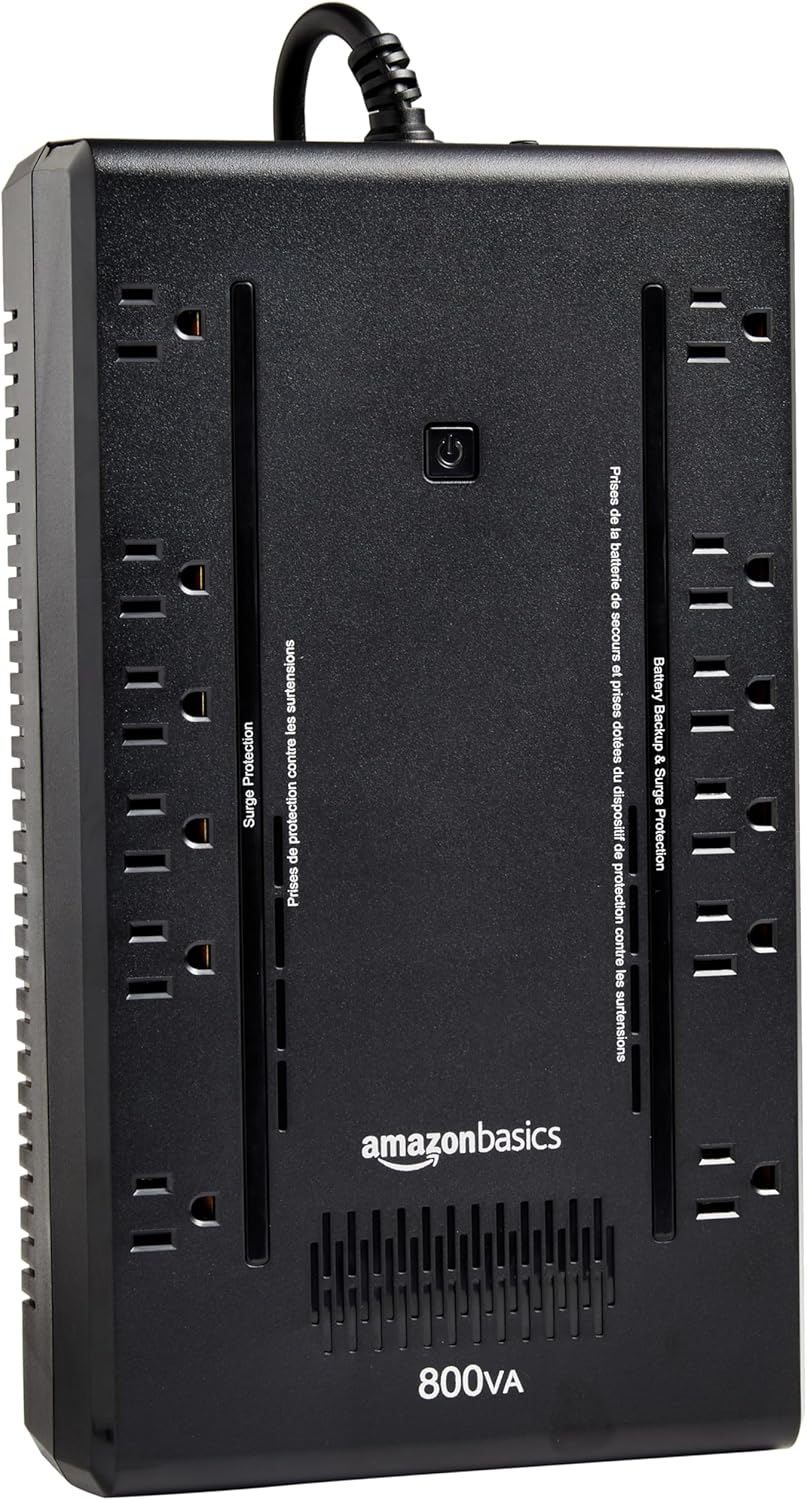
The Amazon Basics Standby UPS 800VA is a bare-minimum backup power device that protects against complete power failures but offers almost nothing else. No voltage regulation, no software, no LCD, and only 4 outlets — it sits at the bottom of our guide because that’s exactly where its feature set places it. It will keep a router and modem running through a brief outage. It will not meaningfully protect a home office workstation.
How We Scored It
Category Deep-Dives
Power Protection
3.5 / 10 30% weightingThe Amazon Basics Standby UPS 800VA uses a standby (offline) topology with no automatic voltage regulation. In normal operation, it passes utility power directly to connected equipment and does nothing — there is no line conditioning, no voltage stabilization, and no protection against the most common power quality problems that home offices actually face: brownouts, voltage sags, frequency variations, and momentary spikes. The unit only activates when it detects a complete power failure or a severe voltage event, at which point it switches to battery.
This matters because complete power failures are not the most common power quality event. Brownouts, voltage sags from heavy appliances cycling on, and neighborhood grid fluctuations are far more frequent and are what most home offices actually experience. A standby UPS offers zero protection against these — it switches to battery on complete failure and depletes that battery during every brownout instead of regulating in-line. The absence of AVR also means that connected equipment absorbs every voltage variation utility power delivers. For equipment with cheap internal power supplies, this can accelerate component wear over time.
Bottom line on power protection: Standby topology with no AVR — this unit does nothing during brownouts and voltage sags; it protects against complete outages only.
Power Quality
2.5 / 10 20% weightingThe simulated sine wave output during battery operation is an additional constraint, limiting compatibility with modern active PFC power supplies. The power quality score of 2.5 reflects what battery operation actually provides: a simulated waveform suitable only for basic electronics, with no power conditioning of any kind.
Bottom line on power quality: Simulated sine wave with no conditioning — battery output is suitable only for basic, non-PFC electronics.
Usability & Features
2.5 / 10 20% weightingFour outlets, LED status indicators, and no data line protection. That is the complete feature summary. The 4-outlet count barely covers a minimal networking setup: router, modem, switch, and one peripheral consumes all available sockets. There are no LCD readouts, no USB charging, no coaxial or RJ-45 data line protection, and no USB data port for software connectivity. The LED indicators tell you whether the unit is on battery or utility power and approximately how much battery remains — there are no numerical readouts of any kind.
This is a deliberately minimal product, and that minimalism is reflected in the score. The one thing it does reliably is provide basic battery backup — but even that comes without the software infrastructure (no PowerPanel equivalent) to trigger a graceful OS shutdown if the battery is running low during an unattended outage.
There is no software. No USB data port, no management application, no automated graceful shutdown capability. If this unit’s battery is depleted during an unattended outage, connected equipment will experience an abrupt power cut — the same as a sudden power failure with no UPS at all. For any home office with an active workstation or NAS that stores data, the absence of automated shutdown capability is a meaningful data-integrity risk during extended outages. Every CyberPower and APC unit in our guide includes software with graceful shutdown functionality; this unit does not.
Bottom line: Bare-minimum feature set. 4 outlets and LED indicators is the whole feature story.
Battery & Longevity
5.0 / 10 15% weightingAt 800VA / 450W, capacity is the least bad category here. 450W is enough to power networking equipment (router, modem, switch — typically 30–60W combined) plus a monitor and a few small peripherals. That is legitimately useful: keeping a network stack and a work monitor running through a brief outage has real value for a home office. The approximately 2 minutes of runtime at full 450W load extends considerably at lower loads — a 100W networking-only load would run significantly longer.
The honest caveat is that 800VA is the smallest capacity in our 15-unit guide and is firmly outclassed by the Amazon Basics 1500VA (#8), which provides nearly double the wattage for a small price premium. For anyone whose connected load includes a desktop computer, this unit’s capacity ceiling will be exceeded in normal operation.
Bottom line: Adequate for networking gear and light peripherals only. Not suitable for desktop workstation protection.
Value
4.0 / 10 10% weightingThe value score of 4.0 acknowledges that this unit is inexpensive, and within its very limited scope it delivers what it promises. But the Amazon Basics UPS 1500VA (#8, 7.3/10) provides nearly double the capacity, more outlets, and meaningfully better protection for a modest premium. The price gap between these two units does not justify the capability gap. For a buyer on an absolute minimum budget who only needs to keep a router alive through brief outages, the 800VA standby unit gets the job done. For anyone with a more complete home office setup, spending slightly more buys substantially better protection.
Bottom line: Inexpensive for what it is, but the Amazon Basics 1500VA (#8) is the better value by a significant margin for almost any home office scenario.
Physical Design
5.0 / 10 5% weightingThe physical hardware is adequately constructed for the product tier — ABS housing, functional outlet seating, audible alarm for low battery and overload. Battery replacement is user-accessible. The 1-year warranty is the shortest in our entire guide and is the most telling indicator of Amazon’s confidence in the product’s longevity. All other UPS units in our rankings carry at least a 2-year warranty; the 800VA standby’s single-year coverage is a notable gap.
Bottom line: Functional hardware. The 1-year warranty is the weakest in our guide and worth noting when evaluating long-term ownership cost.
About the Manufacturer
Basics
Amazon Basics is Amazon’s private-label brand, offering baseline products across a wide range of consumer electronics categories. The UPS product line covers two capacity tiers — this 800VA standby unit and the 1500VA line-interactive unit (#8 in our guide). Amazon Basics products are sold exclusively through Amazon and are manufactured by contract partners. Warranty service is handled through Amazon’s standard returns and replacement process.