Meet SE
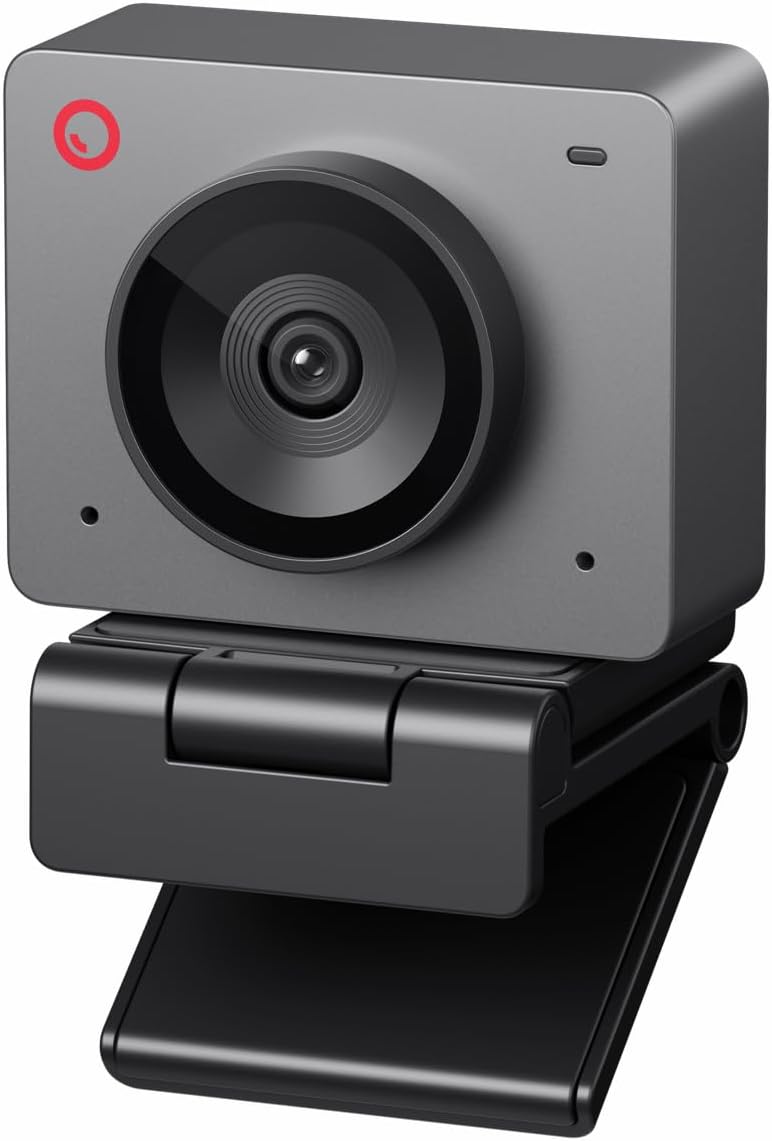
The Obsbot Meet SE is the brand’s most accessible entry point into AI auto-framing webcams — a 1080p/60fps camera with software-based AI tracking at a price where most alternatives either lack auto-framing entirely or step up to motorized-gimbal models at a significant premium. The Meet SE uses digital face detection and a real-time crop of the captured field to keep you centered in frame as you move, without any physical pan or tilt mechanism. This approach covers smaller positional changes well — leaning back, shifting slightly left or right, standing briefly — though it cannot track large lateral movements the way Obsbot’s own motorized cameras (the Meet 2, Tiny 2) can. The trade-offs relative to the guide’s higher-ranked alternatives are real: the FOV is fixed at approximately 80°, which limits room-view flexibility; the built-in microphone is basic; and there is no privacy shutter. Buyers who specifically want AI auto-framing without paying for a motorized gimbal will find the Meet SE a capable, purpose-built option. Buyers who are open to software-based framing from a camera with a stronger overall feature set should also consider the Anker PowerConf C300, which includes comparable digital auto-framing alongside adjustable FOV, a three-mic array, and 60fps for a similar price.
How We Scored It
Category Deep-Dives
Image Quality
6.5 / 10 30% weightingThe Meet SE records at 1080p and up to 60fps — a capable baseline for home office video calls. In good to moderate lighting the output is clean, exposure is stable, and 60fps delivery keeps motion smooth. The camera handles typical home office lighting transitions without significant lag or clipping artifacts. For the core use case of video conferencing, the image quality is adequate and consistently usable.
The image quality ceiling reflects the absence of a named premium sensor. Without a back-illuminated sensor like the Sony Starvis family, low-light performance is limited relative to cameras at comparable or slightly higher price points. Noise is visible in dim environments, and shadow detail is compressed. For users in well-lit home offices — good natural light or consistent artificial overhead lighting — this is rarely a practical issue. For users with challenging lighting situations, the gap against Sony Starvis alternatives becomes meaningful.
AI auto-framing introduces a specific image quality trade-off worth understanding: when the feature is active, it performs a real-time digital crop of the ~80° captured field. The crop narrows the effective sensor area used for the output image, which softens resolution relative to a camera whose full sensor is dedicated to the primary framing window. In direct comparison, a conventionally framed 1080p camera will show slightly crisper fine detail than the Meet SE operating in auto-framing mode — a characteristic inherent to any digital-crop implementation, not specific to Obsbot.
Bottom line on image quality: Solid 1080p/60fps in good lighting; limited low-light performance without a premium sensor. The digital-crop auto-framing feature softens effective resolution modestly when active. The 6.5 score reflects image quality that meets the standard call use case without distinguishing itself against the guide’s better-equipped alternatives.
Audio Performance
6.0 / 10 25% weightingThe Meet SE’s built-in microphone is a single-element unit without multi-mic beamforming or hardware noise canceling. For quiet, well-controlled home office environments — where background noise is minimal and the speaker sits within a normal desktop-to-monitor distance — the microphone captures voice intelligibly and call participants receive audio that is acceptable for standard meetings. It functions as expected for its category.
Beyond that baseline, the audio does not distinguish itself. Without beamforming, the microphone picks up sound from all directions roughly equally, which means background noise — HVAC systems, keyboard clicks, nearby conversations, traffic through a window — competes with voice in the captured signal. There is no hardware or algorithmic noise canceling in the microphone chain itself (though some operating systems and conferencing applications apply their own software processing independently). The result is below-average noise isolation compared to multi-mic webcams at similar price points, including the Anker PowerConf C300’s three-mic beamforming array and the C200’s dual-mic system.
The 6.0 audio score is the Meet SE’s lowest category result and reflects a meaningful limitation relative to the camera’s overall positioning. At its price, buyers are paying for the AI auto-framing feature; the microphone is a secondary consideration that has clearly not received equivalent investment. Users for whom call audio quality is a priority should plan to supplement the Meet SE with a dedicated USB desk microphone or a headset.
Bottom line on audio performance: Functional single microphone for quiet environments; below-average noise isolation without beamforming or hardware noise canceling. Audio is the Meet SE’s weakest scoring category — a clear secondary priority relative to the auto-framing feature. A dedicated microphone is recommended for users in noisier environments or who need consistently clean audio.
Usability & Features
7.5 / 10 20% weightingThe Meet SE’s headline feature is its AI auto-framing system, and it is a genuinely useful implementation for the right user. The camera uses face detection to identify the speaker in the frame, then applies a real-time digital crop to keep that face centered in the output — adjusting dynamically as the speaker shifts position. Leaning back from the desk, turning slightly to reach for something, standing briefly for a stretch: the auto-framing system adjusts to maintain a centered, well-composed frame for call participants without any manual camera adjustment. For users who move frequently during calls — animated speakers, people who alternate between sitting and standing, anyone who dislikes the self-consciousness of staying rigidly still — this is a practical convenience that has real call quality impact.
It is important to understand the Meet SE’s auto-framing in context. This is software-based digital crop, not the motorized pan-and-tilt tracking that Obsbot’s higher-tier cameras (Meet 2, Tiny 2) provide. The motorized models physically move the lens to follow a subject across a wide spatial range — standing and walking across a room, for example. The Meet SE’s software approach operates within the ~80° field captured by the fixed lens; subjects who move significantly outside of that field will exit the frame rather than being tracked to the boundary and beyond. Within that operational envelope, the system works reliably and responds quickly. The distinction matters primarily for users with large workspaces or who move dramatically during calls.
Beyond auto-framing, the feature set is thin by comparison. The FOV is fixed at approximately 80° — neither adjustable nor particularly wide. There is no privacy shutter, no resolution step up to 2K or 4K, and no AI noise canceling in the microphone chain. The OBSBOT WebCam application provides basic image controls and the ability to toggle and configure auto-framing behavior, including a gesture control feature that lets users start or stop the tracking system with a hand gesture without touching the computer. This is a polished convenience feature that reduces the friction of managing the camera during calls.
Bottom line on usability and features: AI auto-framing is the Meet SE’s defining feature and it works reliably within its operational range — software digital-crop tracking rather than motorized physical tracking, but genuinely useful for normal call movement. The 7.5 score reflects a camera that excels on its core feature while offering little beyond it; fixed FOV, no privacy shutter, and a basic microphone are the gaps.
Value
7.5 / 10 15% weightingThe Meet SE occupies an interesting position in the market. The price is modestly above the Anker PowerConf C300, which also includes software-based AI auto-framing alongside adjustable FOV, a three-mic array, and 1080p/60fps. For buyers who are specifically invested in the Obsbot brand ecosystem — perhaps already using Obsbot’s higher-tier motorized cameras, or planning to upgrade — the Meet SE’s familiarity with OBSBOT WebCam software and its shared gestural interface make the premium over the C300 reasonable. For buyers evaluating purely on feature-per-dollar, the comparison is tighter than Obsbot’s positioning would suggest.
The value case strengthens when the Meet SE is compared against the alternative of buying AI auto-framing via Obsbot’s own motorized cameras. The Meet 2 and Tiny 2 offer dramatically superior spatial tracking range with their physical pan-and-tilt mechanisms, but at a significantly higher price. For buyers who want AI tracking for normal-movement call scenarios — not theatrical room-spanning coverage — the Meet SE delivers a meaningful portion of the convenience at a fraction of the gimbal premium. Within the specific question of “entry-level AI tracking webcam,” the Meet SE’s value proposition is solid.
The 7.5 value score reflects a camera that delivers meaningfully on its primary feature promise at an accessible price, with the caveat that its nearest competitor (the C300) offers a broader feature set for slightly less money. Buyers whose specific priority is Obsbot’s auto-framing implementation — particularly the gesture control and OBSBOT WebCam integration — will find the value argument more compelling than those buying purely on spec-per-dollar.
Bottom line on value: Good value for buyers who specifically want Obsbot’s AI tracking implementation at the brand’s lowest price point. The 7.5 score reflects solid feature delivery at an accessible price, with the Anker PowerConf C300’s competing value case as the key benchmark to weigh before purchasing.
Physical Design
7.0 / 10 10% weightingThe Meet SE uses a compact, rounded plastic housing that is visually clean and unobtrusive on a monitor. Obsbot has maintained a consistent design language across its webcam line — smooth contours, minimal external detail, a professional appearance that avoids the gaming-peripheral aesthetic of some budget webcam competitors. The monitor clip is stable and holds position reliably on standard flat-panel displays. USB-C connection is the modern standard and appreciated at this price point. Overall build quality is solid for the price tier, without the premium material feel of metal-accented alternatives.
The notable physical design gap is the absence of a privacy shutter. With no physical cover or integrated sliding mechanism, privacy requires either a software-only solution (camera disable in the operating system or application) or a third-party lens cover. Software-only privacy solutions are dependent on application state — a camera that is software-disabled but still physically powered can still be interrogated by other processes in ways that a physically blocked lens cannot. For users in shared home spaces or anyone for whom a visible, unambiguous privacy state is important, the lack of a hardware shutter is a real gap. The C200 at a lower price point includes an integrated sliding shutter; the Meet SE at a higher price does not.
The 7.0 physical design score reflects a camera that is well-executed on form factor and build for its price, with a meaningful omission in the privacy implementation. The clean aesthetic and USB-C connection are positive; the software-only privacy solution is the main physical design limitation.
Bottom line on physical design: Clean, compact, and well-built for the price — consistent with Obsbot’s design standard across the product line. The absence of a hardware privacy shutter is the significant physical design gap at this price tier. The 7.0 score reflects a camera that earns solid marks on form and construction while leaving one meaningful feature unaddressed.
About the Manufacturer
BOT
Obsbot is a Shenzhen-based camera company that has built its brand around AI-powered tracking and framing in consumer video products. The company is best known for its motorized-gimbal webcam line — the Tiny and Meet series — which use physical pan-and-tilt mechanisms to follow subjects across a wide spatial range without any fixed camera positioning. The Meet SE is Obsbot’s entry into software-based tracking, bringing the brand’s auto-framing approach to a price point where the motorized hardware premium would otherwise be prohibitive.
Obsbot maintains the OBSBOT WebCam application for Windows and macOS, which provides camera control, framing settings, gesture recognition configuration, and firmware update delivery. The company has an established pattern of post-launch software updates that expand features and refine AI tracking behavior over product lifetimes. US warranty support is available via Obsbot’s direct customer service channels. Obsbot products are available primarily through Amazon and the Obsbot direct store; retail availability is more limited than mass-market brands such as Logitech or Anker.