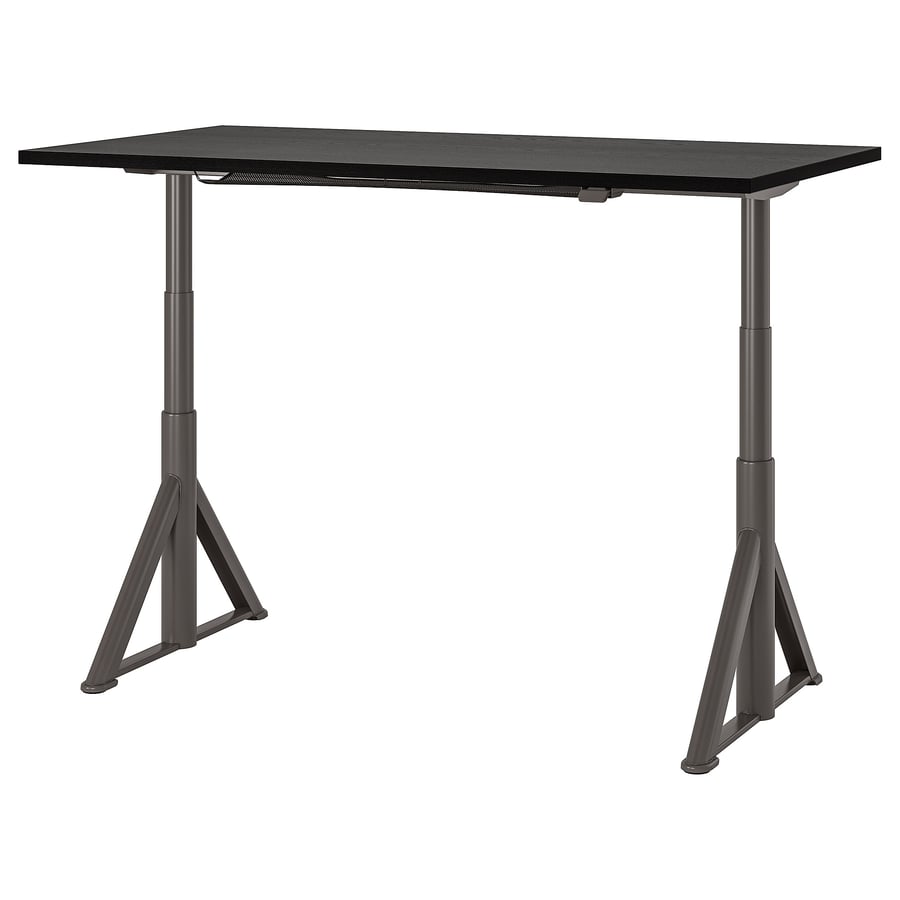
IDÅSEN Sit/Stand Desk
The IKEA IDÅSEN is the most unusual desk in our guide: it is sold exclusively through IKEA’s own stores and website, uses Linak actuators typically found in medical and industrial equipment rather than the commodity motors in most consumer standing desks, and carries a comprehensive 10-year warranty that covers the entire product without splitting frame and motor coverage. These are genuine differentiators. The trade-off is a bare-bones controller that offers only up and down — no memory presets and no display. (Its Linak columns do include hardware collision detection, so safety is not the gap; the convenience features are.) For buyers who prioritize mechanical quality and long-term warranty confidence over control convenience, the IDÅSEN makes a quietly compelling case at #7.
How We Scored It
Category Deep-Dives
Structural Stability
7.0 / 10 30% weightingThe IDÅSEN’s structural story begins with its actuators. IKEA sources the IDÅSEN’s motors from Linak, a Danish company whose DESKLINE linear actuator systems are also used in hospital beds, dental chairs, and industrial automation equipment — applications where reliability and long service life are not optional. In the standing desk market, Linak actuators are widely regarded as among the best available, offering consistent performance, precise positioning, and demonstrated longevity across millions of cycles. This is a substantive distinction from the commodity actuators in most consumer standing desks at this price range.
The frame itself uses powder-coated steel legs with a stability crossbar connecting the two columns below the desktop. The crossbar resists lateral sway during height transitions and at full standing height — a structural contribution that desks using a crossbar-free frameless design cannot replicate. The 2-stage lifting columns mean each leg section extends over a longer travel range than a 3-stage design would at the same height, which introduces slightly more cantilevered stress at maximum extension. In practice, the IDÅSEN is stable at full height under normal home office loads — the 165-pound lifting capacity is the limiting factor before rigidity becomes a concern.
The 165-pound weight capacity is the lowest of the desks in the top half of our guide and is the primary structural constraint to note. A fully loaded home office configuration with a hardwood desktop, dual 27-inch monitors on arms, external storage, a monitor light bar, and a desktop hub can approach 80–100 pounds — a significant fraction of the IDÅSEN’s rated maximum. Buyers should calculate their actual load against the 165-pound ceiling before assuming unlimited configurability. The desk is perfectly stable at lower loads, and the dual-motor synchronization ensures even lifting throughout the range.
Bottom line on structural stability: Linak actuators are a genuine quality differentiator — these motors have a proven track record in demanding applications beyond consumer furniture. The crossbar frame provides good lateral rigidity. The 2-stage legs and 165-pound lift ceiling are the relevant limitations. A well-built, honest 7.0 in this category.
Ergonomic Range
7.0 / 10 25% weightingThe IDÅSEN covers a height range of 24.8 to 50.0 inches — a span of approximately 25 inches of total travel. The 50-inch maximum is one of the higher ceilings in our guide and extends the IDÅSEN’s useful standing range to users up to approximately 6’5″ who need a proper 43–46-inch standing work surface height. The 24.8-inch minimum is workable for users at average height but may be slightly high for shorter users — the BIFMA ergonomic guideline for seated work surface height suggests approximately 22 inches as the floor for the 5th-percentile user, and the IDÅSEN’s 24.8-inch minimum falls short of that target.
IKEA offers the IDÅSEN in two desktop sizes: 47.2×27.6 inches and 63×31.5 inches. The 63-inch wide option is wide enough for two monitors side by side, and the 31.5-inch depth — while not as generous as a 30-inch full-depth desktop — is workable for most single or dual-monitor setups. IKEA does not offer custom desktop sizes or aftermarket configurations, which limits the IDÅSEN’s flexibility compared to brands like UPLIFT or FlexiSpot that offer dozens of size and material combinations. Buyers who want a corner desk, an L-shaped configuration, or a non-standard width are not accommodated by the IDÅSEN’s two standard sizes.
The lifting capacity of 165 pounds is sufficient for most home office loads but is the lowest of any desk in the top half of our guide. Buyers configuring the IDÅSEN with a solid hardwood desktop (which IKEA does not sell for this frame, but which some buyers source independently), dual heavy monitors, and additional peripherals should calculate carefully. IKEA’s standard laminate desktops weigh approximately 20–30 pounds for the larger size, leaving approximately 130–140 pounds of net capacity for equipment — adequate for most setups but not unlimited.
Bottom line on ergonomic range: A 50-inch height ceiling is above average and serves taller users well. The 24.8-inch minimum is slightly high for very short users. Desktop size selection is limited to IKEA’s two standard options — no custom sizes or depths. Lifting capacity is the lowest of the mid-to-upper ranked desks in our guide.
Motor & Controls
7.0 / 10 20% weightingThe IDÅSEN’s motor quality is among the best in our guide, which makes its control interface all the more frustrating by contrast. The standard IDÅSEN ships with a simple paddle controller featuring two buttons: up and down. There is no digital display, no height readout, no memory presets, and no sit-stand reminder timer. To raise or lower the desk, you press and hold the corresponding button until the desired height is reached, then release. Returning to a saved sitting or standing height requires knowing approximately how long to hold the button — a learned approximation rather than a precise target. After spending on a desk with Linak actuators, arriving at an interface with no presets feels like a deliberate cost reduction that serves IKEA’s simplified product lineup but penalizes buyers who expect competitive control features.
Where the IDÅSEN is frequently misrepresented is anti-collision. Its Linak DL11IC lifting columns include a hardware PIEZO collision-detection system built into the columns: the desk stops and reverses when the descending top meets an obstacle. Because this protection is built into the hardware rather than layered on in software, it is generally regarded as more robust than the collision detection on many cheaper desks, and Linak offers an optional Desk Sensor 1 accessory for additional coverage. Anti-collision is therefore a strength of the IDÅSEN, not a gap — the real shortfall is confined to the controller’s convenience features (presets, display, and timer).
The motors themselves — the Linak DESKLINE actuators — perform exceptionally well. They are smooth throughout the travel range and precise in their positioning relative to the input signal, though at 58–63 dB they run somewhat louder than the quietest desks in our guide. Owners consistently describe the IDÅSEN’s lifting action as one of the most refined in the home office category, a direct consequence of using industrial-grade actuators rather than commodity motors. The 7.0 score reflects a genuine split: premium dual-motor hardware with hardware-based collision detection on one side, and a bare-bones up/down controller with no presets or display on the other. The hardware alone would score near the top of the category; the primitive controller is what holds the result to a 7.0.
Bottom line on motor and controls: The Linak actuators and the columns’ hardware PIEZO collision detection are genuinely excellent — durable, refined, and arguably safer around obstacles than the software-based systems on many cheaper desks. The 7.0 is held back entirely by the controller: no memory presets, no display, no timer. Buyers who rely on height memory presets should weight that convenience gap heavily; on motor quality and safety, the IDÅSEN is a strength.
Warranty & Longevity
9.0 / 10 15% weightingThe IDÅSEN carries a comprehensive 10-year warranty covering the entire product — frame, motors, electronics, and control hardware — without splitting coverage terms between components. This is meaningfully different from the majority of standing desk warranties in our guide, which advertise a long headline warranty on the frame while limiting motor and electronics coverage to three to five years. IKEA’s 10-year warranty on the IDÅSEN applies to the parts most likely to require service: the actuators, the motor control box, and the controller.
To put this in category context: the Branch Duo offers 10 years on the frame but only 3 years on motors and electronics — the lowest motor warranty in our guide. The FlexiSpot E7 provides 15 years of comprehensive coverage, including the motor. The IDÅSEN’s 10-year comprehensive coverage outperforms the motor warranty of most desks in our guide, though it trails the UPLIFT V3, FlexiSpot E7, and E7 Plus, which warranty their motors for 15 years. For a product category where the motor is the component most likely to fail, a 10-year motor warranty from a brand with IKEA’s institutional scale is a significant ownership confidence factor.
IKEA’s warranty service for the IDÅSEN is handled through IKEA stores and IKEA’s customer service channels. IKEA has operated since 1943, has over 400 stores globally, and is not at risk of the brand-longevity uncertainty that affects newer DTC competitors. Whether a warranty claim in year eight will be honored as cleanly as a claim in year two depends on the circumstances, but the institutional confidence behind IKEA’s warranty is as high as it is for any brand in our guide. The Linak actuators — built for 50,000-plus cycle lifetimes under industrial use — further reduce the likelihood of a warranty claim ever being necessary.
Bottom line on warranty and longevity: The IDÅSEN’s highest-scoring category. A 10-year warranty covering motors and electronics without a frame/motor split, backed by IKEA’s institutional scale, is the strongest warranty story in the mid-range segment. Combined with Linak’s proven actuator durability, the IDÅSEN is the long-term ownership confidence leader among desks in its price range.
Value
6.0 / 10 5% weightingThe IDÅSEN’s value story is complicated by its distribution model. At IKEA’s typical US price point for the sit/stand frame and desktop combination, it is competitive with the mid-range segment of our guide. The Linak actuators and 10-year comprehensive warranty justify a price premium over desks using commodity motors and split warranty terms. Buyers who weight warranty coverage in their purchase decision — and who should, given that motors do fail and replacement outside warranty can cost hundreds of dollars — will find the IDÅSEN competitively priced when viewed as a 10-year cost-of-ownership calculation.
The value score is held to 6.0 by two constraints. First, the IDÅSEN is available only through IKEA — there is no online configurability, no choice of frame color independent of desktop color, and no option to pair the IDÅSEN underframe with a third-party desktop at purchase. Buyers who want a specific desktop material (solid bamboo, hardwood, glass) or a non-standard size must source it independently and adapt it to the IKEA underframe — a process that works technically but is outside IKEA’s supported configuration. Second, competitors at the same price point include memory presets and a digital height display as standard features, and the absence of these convenience features on the IDÅSEN is a real value gap when the control interface is compared feature-by-feature against desks ranked above it. (Its anti-collision, by contrast, is present and hardware-based — a point in its favor.)
Bottom line on value: Competitive when warranty and motor quality are factored into the 10-year ownership cost. Held back by IKEA-only distribution, limited configuration options, and a control interface that lacks features standard elsewhere at this price. The value proposition is strongest for buyers who weight durability and warranty heavily over control convenience.
Assembly & Usability
6.0 / 10 5% weightingIKEA’s flat-pack assembly instructions are among the most thoroughly tested in the furniture industry, and the IDÅSEN follows the established IKEA format: numbered steps, pictographic instructions, and included hardware. The leg columns are heavy by flat-pack standards — IKEA’s DESKLINE actuators and steel frame construction add weight — and solo assembly of the larger 63-inch configuration is feasible but easier with two people for the desktop attachment step. Assembly time runs approximately 60–90 minutes, consistent with other standing desks in its class. The motor cable connections are simple and clearly labeled.
Day-to-day usability is where the IDÅSEN’s score is constrained. Without height presets, every sitting-to-standing transition requires manual adjustment to find the correct ergonomic position — a process that takes seconds rather than a single button press but introduces enough friction that some users will adjust less frequently than they should. Research consistently shows that standing desks are most effective when height transitions happen regularly throughout the day; the absence of a one-touch preset return to a saved height is a genuine ergonomic usability gap, not just a convenience complaint. Users who set the desk once and rarely readjust are adequately served. Users who want to actively transition multiple times per day will find the IDÅSEN’s manual-only control an obstacle relative to preset-equipped competitors.
The IDÅSEN’s IKEA retail distribution has both usability advantages and disadvantages. In-store purchase and immediate availability — without waiting for a delivery window — is a practical positive for buyers near an IKEA location. In-store assembly service is available through IKEA’s TaskRabbit partnership. Returns to an IKEA store are generally straightforward. However, ordering online for delivery involves IKEA’s fulfillment logistics, which historically generates more complaints than pure e-commerce desk brands. Buyers in regions without a nearby IKEA should factor delivery lead times and logistics into the purchase decision.
Bottom line on assembly and usability: Assembly is well-documented and manageable, consistent with IKEA’s established standard. Day-to-day usability suffers from the absence of height presets — the ergonomic benefit of easy standing transitions is partially offset by the manual positioning required for each adjustment. In-store availability and retail return convenience are genuine advantages for buyers near an IKEA location.
About the Manufacturer
IKEA is a Swedish multinational founded in 1943 by Ingvar Kamprad, headquartered in Delft, Netherlands (operations) and Älmhult, Sweden (design and sourcing). With over 400 stores in more than 50 countries and annual revenue exceeding €44 billion, IKEA is the world’s largest furniture retailer. The company’s flat-pack design philosophy and vertically integrated supply chain — IKEA controls design, sourcing, manufacturing, and retail — have made its products accessible at scale for over eighty years.
The IDÅSEN line was developed as IKEA’s premium sit/stand offering, using Linak DESKLINE actuators rather than the in-house or commodity actuators found in lower-priced IKEA standing products such as the BEKANT. Linak (headquartered in Nordborg, Denmark, founded 1907) is an independent industrial actuator manufacturer whose DESKLINE series is purpose-built for height-adjustable workstations and is used by multiple premium standing desk brands globally. IKEA’s 10-year warranty on the IDÅSEN is backed by the company’s global service network and store infrastructure — warranty claims can be handled through any IKEA location in the product’s country of purchase.