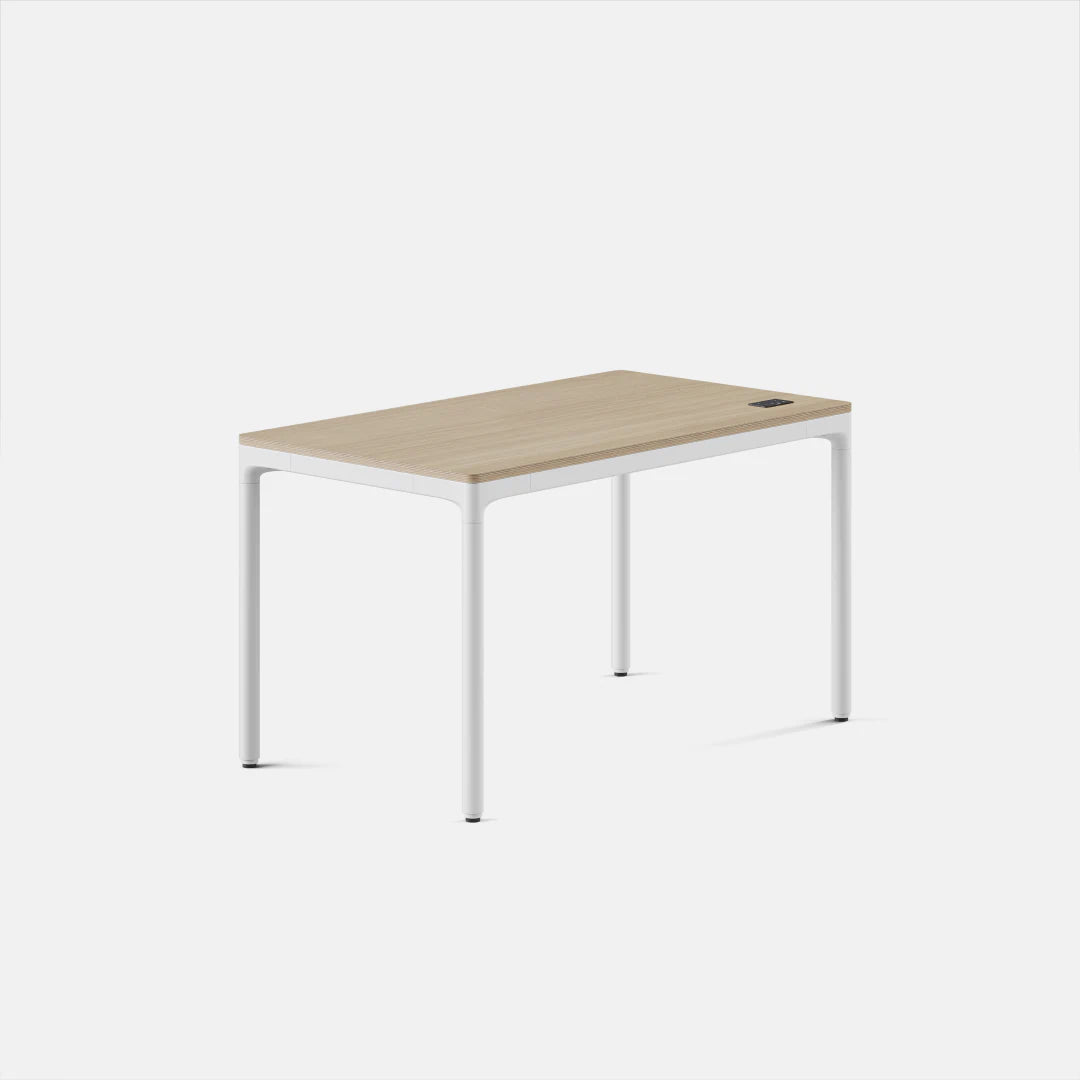
Four Leg Standing Desk
The Branch Four Leg is the only quad-motor standing desk in our guide — a configuration that places an independent motor in each of its four legs for exceptionally balanced lifting. That is a genuine engineering differentiator. The desk’s critical limitation, however, is its height range: a maximum work surface height of 44.6 inches is the lowest ceiling in our guide and will leave users taller than approximately 5’8″ unable to stand at an ergonomically correct height. For buyers whose height and seated-to-standing range fall within these constraints, the 10-year warranty and stable quad-motor platform offer real value. For everyone else, the height range is a disqualifying spec.
How We Scored It
Category Deep-Dives
Structural Stability
6.5 / 10 30% weightingThe Branch Four Leg’s defining structural feature is its quad-motor configuration — an independent motor in each of the four leg columns, all synchronized through a single controller. Most standing desks use two motors (one per column in a two-leg frame); the Four Leg’s architecture places a motor in every leg, which distributes the lifting force across four contact points rather than two and eliminates the torque asymmetry that can develop in dual-motor designs under off-center loads. In theory, four synchronized drive points provide the most balanced lift platform of any configuration. In the context of a home office desk, this is meaningful for setups where load distribution is uneven — large monitors on one side, accessories on the other.
The structural caveat is the same one that limits every 2-stage desk in our guide: two telescoping sections per leg must each extend over a longer distance than a 3-stage design would at the same height, producing greater cantilevered leverage against lateral rigidity at full extension. Four synchronized motors drive the lift smoothly and evenly, but the column geometry of a 2-stage design still results in measurably more sway at maximum standing height than a 3-stage alternative of comparable quality. The Four Leg’s relatively low maximum height of 44.6 inches means users rarely approach the top of its travel range — which incidentally limits how far each leg must extend and partially mitigates the stability penalty of 2-stage design. However, this comes at the cost of usability for taller users.
With a 225-pound lifting capacity, the Four Leg is rated for typical home office loads but offers less headroom than most competitors in this guide. Users with heavier setups — a solid hardwood top plus multiple large monitors and equipment — should verify their total load is comfortably below this ceiling. At 225 lbs, the Four Leg provides less safety margin than the 275–355 lb ratings common in higher-ranked alternatives.
Bottom line on structural stability: The quad-motor configuration is the Four Leg’s strongest structural argument — four synchronized drive points produce the most balanced lifting geometry in our guide. The 2-stage leg design limits rigidity at full extension, and the 225-lb capacity is the lowest among two-motor or quad-motor desks reviewed. A 6.5 gives credit for the quad-motor innovation while acknowledging the leg architecture constraint.
Ergonomic Range
5.0 / 10 25% weightingThe Branch Four Leg’s height range of 27.3″ to 44.6″ (work surface height with desktop) is the most constrained in our guide by a significant margin. The total travel of 17.3 inches is roughly 8 inches narrower than the next most limited desk in our evaluation. Both ends of this range create practical problems. At the low end, a 27.3-inch minimum work surface is above the ergonomic sitting height for most users under 5’6″ — anyone in this group will be unable to achieve a neutral elbow angle while seated, a fundamental ergonomic requirement for extended computer work. BIFMA’s G1 guideline targets a sitting range reaching approximately 22–25 inches at the work surface for the 5th–95th percentile of users.
The upper end is the more significant concern. A 44.6-inch maximum work surface height corresponds to an ergonomic standing position for users approximately 5’6″ to 5’8″. Users taller than this — a substantial portion of the adult population — will find the desk’s maximum height below the level where a neutral elbow angle can be achieved while standing. For a product whose defining purpose is enabling alternation between sitting and standing positions, a maximum height that excludes a significant fraction of the user population from proper standing ergonomics is a fundamental limitation, not a minor specification gap.
The 225-pound lifting capacity is adequate for the configurations the Four Leg’s height range can accommodate — users whose seated and standing heights both fall within the available range are unlikely to be running heavy equipment setups. But the capacity figure does not compensate for the range constraint; it simply confirms the desk is appropriately rated for the narrower use case it serves.
Bottom line on ergonomic range: The 17.3-inch total travel and 44.6-inch maximum height are the lowest in our guide and represent the primary driver of the Four Leg’s ranking at #10. The desk serves a specific height band — roughly 5’3″ to 5’8″ — well; outside that range, either the sitting position or the standing position cannot be made ergonomically correct. Buyers should verify their height falls within the usable window before purchase.
Motor & Controls
7.5 / 10 20% weightingThe Four Leg’s quad-motor system is controlled through a single synchronized controller that coordinates all four drive units simultaneously. During height adjustment, all four motors move in concert to maintain a perfectly level work surface regardless of load distribution — a capability that is harder to achieve with two-motor designs under asymmetric loads and impossible with single-motor shaft-drive systems. In practice, this produces a lift that feels planted and wobble-free during travel, which is noticeably different from the slight flex that can occur in two-motor frames mid-adjustment. Motor noise is rated at under 50 dB — acceptable for a home office environment, though notably less quiet than the sub-45 dB specification of the Autonomous SmartDesk Pro directly above it in our rankings.
The control panel provides four height memory presets and real-time height display, covering the essential functions for daily sit-stand transitions without unnecessary complexity. Anti-collision detection is included — the system monitors resistance during descent and stops and reverses the motors when unexpected contact is sensed. For a desk with four independent drive points, the anti-collision implementation must coordinate across all four motors, and Branch’s execution of this is functionally reliable. The keypad itself is clean and minimal, which is consistent with Branch’s broader design aesthetic across its product line.
The main limitation of the motor and controls package relative to higher-scored competitors is the noise floor: 50 dB is comfortable but not exceptional, and the top-ranked desks in this category achieve quieter operation at comparable or lower prices. Within the Four Leg’s specific market position, the control package is complete and well-executed.
Bottom line on motor and controls: A quad-motor synchronized system, four memory presets, anti-collision detection, and a clean control interface together make a capable package. The <50 dB noise rating is adequate but trails the quietest competitors. The 7.5 reflects a genuinely strong control implementation held back only by the noise specification.
Warranty & Longevity
8.0 / 10 15% weightingBranch covers the Four Leg Standing Desk with a 10-year warranty on both frame and motor — the same unified coverage period that Branch applies across its standing desk product line and a meaningful step above the 7-year coverage offered by the Autonomous SmartDesk Pro ranked directly above it. A 10-year motor warranty is a substantive commitment: the motor and control electronics are the components most likely to fail in a standing desk over its service life, and backing them for a decade with the same term as the welded steel frame signals genuine confidence in the drivetrain’s durability. This is the correct way to structure a standing desk warranty, and Branch executes it without the split-term structure that makes some competitors’ long headline warranties less meaningful in practice.
Branch has operated in the direct-to-consumer office furniture market since 2019, making it a relatively newer entrant compared to UPLIFT or FlexiSpot. The brand has grown substantially through the remote-work period and maintains an active support operation. Owner-reported warranty service experiences are generally positive in community forums — responses are described as prompt, and replacement parts have been available in documented cases. As a younger brand with a shorter track record, Branch has not yet accumulated the same depth of long-term reliability data as more established standing desk manufacturers, but the signals available are encouraging.
The 10-year warranty positions the Four Leg alongside the IKEA IDÅSEN and Branch’s own Duo Standing Desk in our guide — meaningfully better than Autonomous’s 7 years and meaningful step below UPLIFT and FlexiSpot’s 15-year coverage. For a desk in the budget-to-mid-range price tier, 10 years is a strong warranty and the clearest positive in the Four Leg’s scorecard.
Bottom line on warranty and longevity: A unified 10-year warranty on frame and motor is the Four Leg’s best individual score and the only green bar in this review. It meaningfully exceeds competitors in its price tier, and Branch’s service track record is positive. For buyers who weight long-term confidence heavily, this is the Four Leg’s most compelling specification.
Value
5.0 / 10 5% weightingThe Branch Four Leg Standing Desk is priced in the mid-to-upper tier of the standing desk market — comparable to desks in our guide that offer 3-stage legs, wider height ranges, and equivalent or longer warranties. The quad-motor configuration adds genuine engineering value, but the height range limitation narrows the addressable buyer population significantly. A desk that cannot accommodate users taller than approximately 5’8″ in a proper standing position is not a general-purpose home office desk — it is a desk for a specific subset of users whose standing ergonomic needs happen to align with the available range. At its price point, that restriction is difficult to justify against alternatives that serve a broader user population without compromise.
The 10-year warranty and quad-motor platform are the strongest components of the value case, and for buyers whose height and usage profile fit within the Four Leg’s parameters, those are real advantages. The value score of 5.0 reflects not a quality problem — the Four Leg is well-built — but a mismatch between price positioning and the fundamental range limitation that restricts who can use the desk as intended. Buyers who verify their compatibility should find value in the warranty and motor quality; buyers who discover the height range incompatibility after purchase will find the value case collapses entirely.
Bottom line on value: Strong warranty and a distinctive quad-motor platform are genuine assets, but a height range that excludes users above average stature from proper standing ergonomics limits value to a narrow buyer profile. At mid-range pricing, alternatives without this constraint are available. Verify height compatibility before purchase.
Assembly & Usability
5.0 / 10 5% weightingThe Branch Four Leg’s assembly is more involved than a standard two-leg standing desk by virtue of its four-leg architecture. Four individual leg columns must be installed, each with its own motor cable routed and connected to the central controller. The crossbeam structure connecting the legs is a more complex sub-assembly than in two-leg designs, and the desktop must be positioned and secured to four mounting points rather than two. Most users report completing assembly in 90–120 minutes with one person, with two making the desktop positioning and securing significantly easier. Branch provides assembly instructions and video support; the process is documented clearly but the additional hardware count relative to a two-leg desk means more steps and more opportunities for sequencing errors.
Once assembled and calibrated, the operational experience is straightforward: the keypad is intuitive, the four-motor lift is smooth and noticeably planted, and the preset system works as expected. Branch’s support documentation covers common assembly questions and initial calibration. The brand’s customer service is accessible and generally responsive based on owner community reports. The 5.0 assembly score is not a reflection of poor documentation or quality — it reflects that four-leg assembly is categorically more demanding than two-leg assembly, and that this additional complexity is a direct cost of the quad-motor design.
Bottom line on assembly and usability: Four-leg assembly is inherently more involved than two-leg — plan for 90–120 minutes and consider having a second person available for the desktop positioning step. The operational experience post-assembly is smooth and the control interface is clean. Branch’s support materials and service are adequate.
About the Manufacturer
Branch is a direct-to-consumer office furniture company founded in 2018 and headquartered in New York. The company entered the market during the remote-work expansion of the early 2020s and has grown its product line from chairs and desks into a broader range of office furniture and accessories. The Four Leg is sold only through Branch’s own website (branchfurniture.com); some other Branch products, such as the Branch Duo, are also available on Amazon. For the Four Leg specifically, this means customer interactions occur directly through the brand rather than a third-party retailer.
Branch’s design philosophy centers on clean aesthetics and practical functionality. Its standing desk line includes the Duo (two-leg, dual-motor) and the Four Leg (four-leg, quad-motor), with the Four Leg representing the brand’s engineering flagship. Branch’s products carry a consistent 10-year warranty across the line, which is one of the stronger coverage terms in its price tier. Owner community feedback on Branch’s service responsiveness and warranty fulfillment is generally positive, though the brand’s shorter operating history means less long-term reliability data is available compared to more established competitors.
Branch does not sell through Amazon, which eliminates Amazon affiliate revenue for our guide — all links to Branch products are non-affiliate external links to their website. Buyers who prefer Amazon’s return policy or fulfillment infrastructure should note that Branch’s products require purchase directly from branchfurniture.com.