ZenWiFi BT10
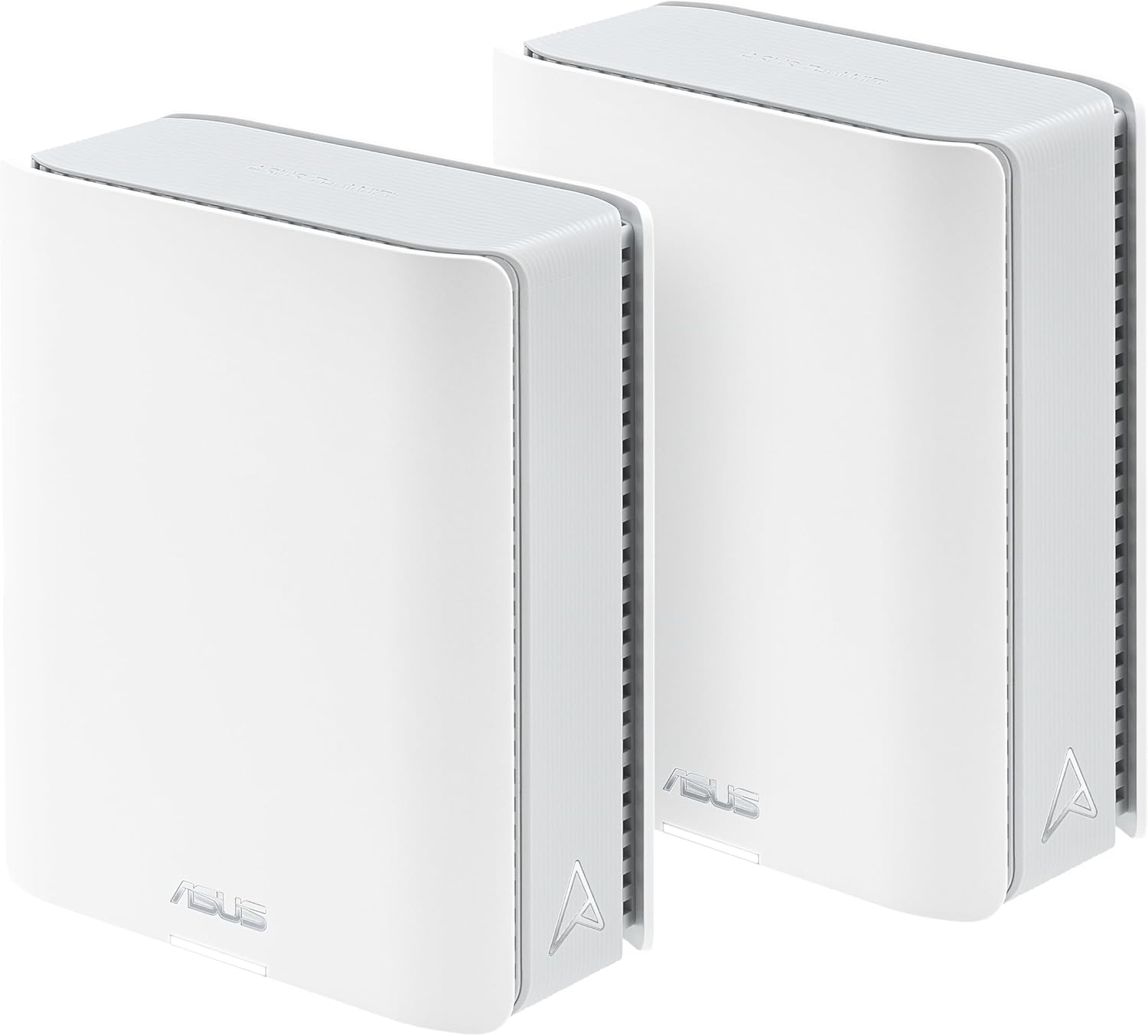
The ASUS ZenWiFi BT10 is the best Wi-Fi router for a home office and the #1 pick in our router guide. It is a tri-band Wi-Fi 7 mesh system that covers roughly 6,000 sq ft from a two-node kit, puts two 10G ports on every node, and includes lifetime AiProtection Pro security with no subscription. It is not the cheapest mesh, and quad-band rivals offer more raw backhaul — but no other system we evaluated balances coverage, multi-gig wiring, stability, and zero recurring fees this well for a network you earn a living on.
How We Scored It
Category Deep-Dives
Coverage & Range
9.0 / 10 20% weightingThe two-node BT10 kit is rated for roughly 6,000 sq ft — six-plus rooms — which comfortably blankets the large majority of U.S. homes, including multi-story layouts where the office sits a floor away from the modem. Each node carries eight internal antennas and ten high-power front-end modules, and in practice the system’s real strength is not the headline square footage but how much usable signal it holds at the far edge of that footprint, where a home office often lives.
The mesh link between nodes is where the BT10’s Wi-Fi 7 hardware earns its keep. Without a dedicated backhaul band, the system uses Multi-Link Operation (MLO) to bond the 5 GHz and 6 GHz bands into a single resilient backhaul — if interference degrades one band, traffic shifts to the other without dropping the link. Better still, the dual 10G ports on every node make a 10-gigabit wired backhaul trivial if your home has Ethernet between floors, which eliminates wireless backhaul loss entirely.
If the footprint isn’t enough, AiMesh lets you add a third BT10 node — or nearly any other ASUS router you own — to extend coverage without replacing the system. That expandability is a quiet long-term advantage over closed ecosystems.
Bottom line on coverage: ~6,000 sq ft with a resilient MLO or 10G wired backhaul covers almost any home office scenario. The 9.0 reflects that quad-band systems like the ZenWiFi BQ16 Pro and Orbi 970 offer even more raw reach and a fully dedicated backhaul band — at a substantially higher price.
Reliability & Stability
9.0 / 10 20% weightingReliability shares top weighting in our router framework because a home office network has one job above all: stay up through a full day of calls. The BT10 is built for that. Each node runs a capable quad-core processor with 2 GB of RAM — generous headroom for a consumer mesh — which is what keeps a router responsive when a household piles dozens of devices onto it at peak hours. Heavy concurrent load is handled in spectrum, too, via OFDMA and MU-MIMO rather than by making devices queue.
Just as important is the vendor behind the firmware. ASUS has one of the longest firmware-support track records in consumer networking — its routers routinely receive security and stability updates for many years after release, and automatic updates can be enabled and forgotten. Owner-reported stability for the ZenWiFi line is consistently strong, and the BT10’s early-firmware Wi-Fi 7 quirks at launch were ironed out through 2024–2025 updates.
We also fold long-term support risk into this score, and here the BT10 is clean: ASUS is a Taiwan-based manufacturer unaffected by the 2026 FCC restrictions on newly certified foreign-made routers and by the TP-Link-specific U.S. review. For a device you expect to anchor your network for five-plus years, that regulatory clarity is a genuine reliability asset, not just a footnote.
Bottom line on reliability: Strong hardware headroom, a proven multi-year firmware record, and zero U.S. regulatory exposure make this one of the safest long-term bets in the category. It loses half a point only to the truly boring-in-the-best-way set-and-forget consistency of eero’s auto-managed platform.
Speed & Throughput
9.0 / 10 15% weightingThe BT10 is a BE18000-class tri-band Wi-Fi 7 system: up to 688 Mbps on 2.4 GHz, 5,764 Mbps on 5 GHz, and 11,529 Mbps on the 6 GHz band. The 6 GHz radio supports the full Wi-Fi 7 toolkit — 320 MHz channels, 4K-QAM, and MLO — which is what lets a Wi-Fi 7 laptop near a node pull multi-gigabit speeds over the air, and what keeps latency low and steady when several devices contend for airtime.
The honest framing for a home office buyer: those numbers exceed what most internet plans can use. Where the throughput actually matters is local headroom — fast transfers to a NAS, a clean 6 GHz lane you can reserve for the work laptop while the household lives on 5 GHz, and the ability to saturate a multi-gig fiber plan (2–5 Gbps) that would bottleneck on a Wi-Fi 6 system. With 10G wired ports on both ends, the BT10 is one of the few mesh kits that won’t be the slowest link in any realistic home setup.
Bottom line on speed: Multi-gig wireless near the nodes, a full-strength 6 GHz band, and 10G wiring give the BT10 more throughput than almost any home office will exhaust. Quad-band flagships post higher aggregate numbers, hence 9.0 rather than higher — but the real-world difference for remote work is minimal.
Call & VPN Performance
8.5 / 10 15% weightingVideo calls live and die on latency consistency, and the BT10 gives you the two tools that matter. Adaptive QoS lets you prioritize the work machine or video-conferencing traffic in one toggle, so a Zoom call jumps the queue ahead of a 4K stream or a game download elsewhere in the house. And MLO means a Wi-Fi 7 client can hold links on two bands simultaneously — when one band takes an interference hit mid-call, traffic continues on the other instead of stuttering. For roaming between rooms on a call, the mesh handoff is smooth and quick.
On VPN, ASUS ships the most complete consumer toolkit of any major brand: built-in WireGuard, OpenVPN, and IPSec servers, the one-tap Instant Guard client for secure connections back to your home network from anywhere, and VPN Fusion, which routes specific devices through a VPN tunnel while the rest of the network runs clean — ideal if only the work laptop needs to live on a VPN. Router-level WireGuard throughput is solid and more than covers typical broadband plans.
The half-step down to 8.5 is the specialist comparison: the GL.iNet Flint 2 sustains roughly 900 Mbps over WireGuard, well beyond what the BT10’s CPU manages with encryption running. If router-level VPN is the center of your workflow, the Flint 2 is the stronger pick; for everyone else, the BT10’s flexibility is more useful than that raw ceiling.
Bottom line on calls & VPN: Adaptive QoS, MLO stability, and the broadest built-in VPN feature set in the mainstream market. Only dedicated VPN hardware meaningfully outruns it.
Security & Management
9.5 / 10 15% weightingThis is the BT10’s strongest category, and the reason is simple: everything is included, forever. AiProtection Pro — commercial-grade threat protection powered by Trend Micro, with malicious-site blocking, intrusion prevention, and infected-device quarantine — is free for the life of the device. So are the full parental controls. Several major competitors paywall the equivalent features: eero Plus and NETGEAR Armor are recurring subscriptions, and over a five-year ownership window those fees can exceed the cost of the hardware itself. Our framework applies an explicit penalty for subscription-gated security; the BT10 takes none of it.
Network segmentation — the practical security move for a home office — is handled by Smart Home Master: purpose-built SSIDs that put IoT gadgets, guests, and kids’ devices on isolated networks away from your work machine. WPA3 is standard, and scheduled or automatic firmware updates close the loop.
Management is the classic ASUS dual-track: the ASUS Router app covers day-to-day tasks cleanly, while the full web UI exposes a depth of control (VLANs, per-device QoS, detailed logs) that app-only ecosystems like eero simply don’t offer. The setup flow is longer than eero’s five-minute experience — the cost of all that capability — which is the only thing keeping this score off a 10.
Bottom line on security: Lifetime subscription-free protection, real network segmentation, and the deepest management toolkit in the category. The benchmark every other mesh system is judged against in this column.
Connectivity & Value
9.0 / 10 15% weightingThe BT10’s port array is unmatched in its tier: every node carries a 10G WAN/LAN port, a second 10G LAN port, and a gigabit port. In practice that means you can take a multi-gig fiber plan in at full speed, run a 10G wired backhaul between nodes, and hard-wire the work desk at 10G from the satellite — the single most reliable upgrade a home office network can make. Most competing mesh kits offer one multi-gig port per node at best; the eero Pro 7 tops out at 5G, and many systems still ship gigabit-only satellites.
The USB-A 3.2 Gen 1 port adds a capability unique among the systems we tested: plug in a 4G/5G USB modem or tether a phone and the BT10 fails over to cellular backup internet when your main line goes down. For remote workers without a second wired ISP option, that is a meaningful continuity feature that normally requires business-class gear.
On value: the BT10 sits in the premium mesh tier, but it undercuts the quad-band flagships (ZenWiFi BQ16 Pro, eero Max 7, Orbi 970) while matching or beating them on wired connectivity — and the subscription-free security means the sticker price is the whole price. Total cost of ownership over five years is lower than nominally cheaper systems that need a security subscription to reach feature parity.
Bottom line on connectivity & value: Dual 10G on every node, cellular failover via USB, and no recurring fees. Premium up front, but the strongest five-year value among flagship mesh systems.
About the Manufacturer
ASUS is a Taiwan-based electronics manufacturer whose networking division has built the strongest enthusiast reputation in consumer Wi-Fi. Its router lineup spans the RT standalone series, ROG gaming routers, and the ZenWiFi mesh family — all sharing the same ASUSWRT firmware platform, which is the foundation for the brand’s signature features: AiMesh cross-model mesh networking, AiProtection security included for the life of the device, Adaptive QoS, and the most complete built-in VPN toolkit in the mainstream market.
The ZenWiFi BT10, released in 2024, is the tri-band Wi-Fi 7 entry in the ZenWiFi line, sitting below the quad-band BQ16 Pro flagship. ASUS positioned it as the practical Wi-Fi 7 mesh — full 320 MHz 6 GHz performance and dual 10G wiring without the quad-band price premium.
For home office buyers, ASUS’s multi-year firmware support record and its freedom from the 2026 U.S. regulatory concerns surrounding some competitors are practical reasons it is our most-recommended router brand for work-from-home networks.