ZenWiFi BQ16 Pro
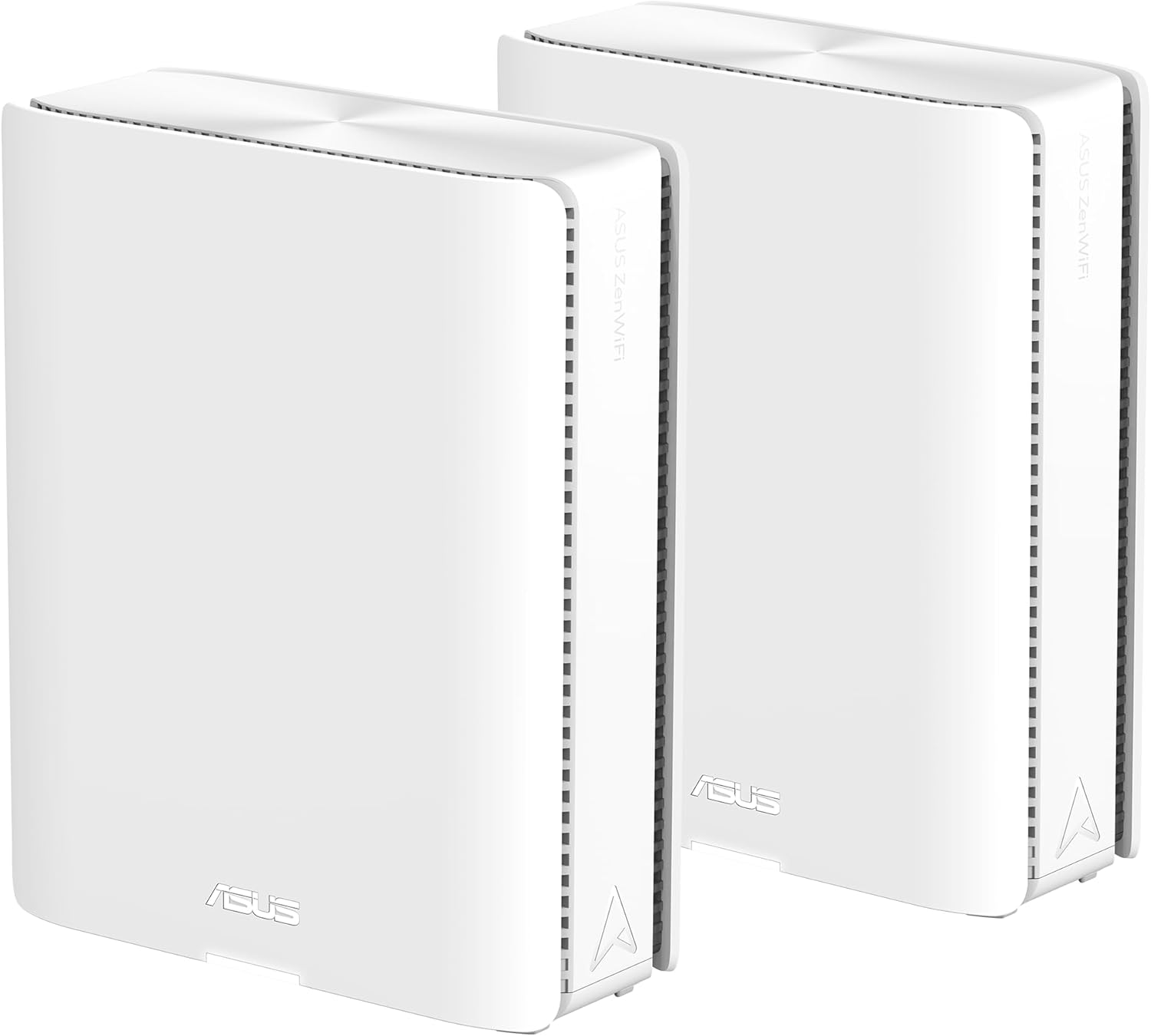
The ASUS ZenWiFi BQ16 Pro is the maximalist mesh: a quad-band Wi-Fi 7 system with two full 6 GHz radios, roughly 8,000 sq ft of coverage from a two-node kit, dual 10G ports on every node, and the same lifetime subscription-free security as our #1 pick. If your home is large enough — and your budget deep enough — to use what it offers, nothing in our lineup reaches further or moves data faster over the air. It ranks #2 rather than #1 for one reason only: at this price, most home offices are paying for headroom they will never touch, and the tri-band ZenWiFi BT10 delivers the same work-from-home experience for substantially less.
How We Scored It
Category Deep-Dives
Coverage & Range
9.5 / 10 20% weightingThis is what you are paying for, and the BQ16 Pro delivers it. The two-node kit is rated for roughly 8,000 sq ft — the largest footprint of any ASUS mesh and 2,000 sq ft more than the BT10 — which covers large multi-story homes, finished basements, and detached-office scenarios that strand most mesh systems. The reach comes from sheer radio hardware: a quad-band, high-stream antenna array per node with the transmit power to hold a usable signal at the property line, not just inside it.
The quad-band design matters more than the raw square footage. With two full 6 GHz radios, the system can dedicate one entirely to node-to-node backhaul while the second serves your devices — so the far node delivers near-full speed instead of the halved throughput that shared-backhaul mesh suffers. MLO bonds bands for resilience on top of that, and if your home is wired, the dual 10G ports support a 10-gigabit wired backhaul as the no-compromise option. AiMesh expandability (add a third node, or any spare ASUS router) extends the ceiling further.
Bottom line on coverage: The strongest coverage package ASUS makes and the equal of anything in our rankings — a dedicated 6 GHz backhaul band plus ~8,000 sq ft of reach. Only NETGEAR’s Orbi 970 plays in the same tier, and it charges even more for the privilege.
Reliability & Stability
9.0 / 10 20% weightingThe BQ16 Pro runs the same ASUSWRT platform as the rest of the ZenWiFi line, with 2 GB of RAM and 256 MB of flash behind a capable quad-core processor — ample headroom for device-dense smart homes, which is exactly the buyer this system targets. OFDMA and MU-MIMO handle many-device contention in spectrum, and the dedicated backhaul band means household load on the client bands never destabilizes the link between nodes — a structural reliability advantage over tri-band designs under heavy use.
ASUS’s multi-year firmware support record applies here as it does to the BT10: regular security and stability updates long after release, with automatic updates available. Early Wi-Fi 7 firmware for the quad-band flagships took longer to settle than the simpler tri-band models — more radios mean more to tune — but the platform matured through 2025 and owner-reported stability is now strong.
On long-term support risk: ASUS is Taiwan-based and unaffected by the March 2026 FCC order restricting newly certified foreign-made routers, and carries none of the TP-Link-specific regulatory uncertainty. For a flagship purchase you expect to run for five-plus years, that clarity matters.
Bottom line on reliability: Generous hardware headroom, a structurally protected backhaul, a proven firmware record, and zero U.S. regulatory exposure. The 9.0 matches the BT10 — the extra radio complexity offsets the dedicated-backhaul advantage.
Speed & Throughput
9.5 / 10 15% weightingThe BQ16 Pro is a BE30000-class system: 1,376 Mbps on 2.4 GHz, 5,764 Mbps on 5 GHz, and 11,529 Mbps on each of its two 6 GHz bands. That is the highest aggregate wireless capacity in our rankings, and it translates into real-world results: a Wi-Fi 7 laptop on a clean 6 GHz band with 320 MHz channels and 4K-QAM can sustain multi-gigabit transfers, while the second 6 GHz radio keeps backhaul traffic out of the way entirely. No other system here moves data over the air this fast at distance.
The honest caveat is the same one we attach to every flagship: most internet plans cannot use this. On gigabit cable, the BQ16 Pro and the BT10 feel identical for video calls, cloud work, and streaming. The speed advantage materializes with multi-gig fiber (which the 10G WAN ingests at full rate), heavy local traffic to a NAS, or a household dense with Wi-Fi 7 clients. If that describes your setup, this is the fastest mesh we have scored; if it doesn’t, the headroom is unused potential.
Bottom line on speed: The throughput ceiling of our entire router lineup — class-leading aggregate capacity with a dedicated backhaul that protects it under load. Withholding the last half-point only because rated maxima exceed what any current home setup, even a demanding one, fully exercises.
Call & VPN Performance
8.5 / 10 15% weightingFor call quality, the BQ16 Pro inherits the full ASUS toolkit — Adaptive QoS to prioritize the work machine or conferencing traffic in one toggle, MLO for band-failover stability mid-call, and smooth mesh roaming between rooms. The quad-band design adds a structural bonus: because backhaul never competes with client traffic, latency at the far node stays flat even when the household saturates the network — the exact scenario that produces the 7 p.m. frozen screen-share on lesser mesh systems.
The VPN story is identical to the BT10’s, which is to say the best in the mainstream market: built-in WireGuard, OpenVPN, and IPSec servers, the one-tap Instant Guard client, and VPN Fusion for routing only specific devices (the work laptop) through a tunnel while everything else runs clean. Throughput with encryption running is solid and covers typical broadband, but the CPU is doing the same work as the BT10’s — the extra radios don’t accelerate VPN crypto, so the specialist GL.iNet Flint 2 (~900 Mbps WireGuard) still owns the router-level VPN crown.
Bottom line on calls & VPN: Flat latency under household load thanks to the dedicated backhaul, plus the broadest built-in VPN feature set available. Same 8.5 as the BT10 — only dedicated VPN hardware does meaningfully better.
Security & Management
9.5 / 10 15% weightingEverything is included, forever — the signature ASUS advantage at full strength. AiProtection Pro (Trend Micro-powered threat blocking, intrusion prevention, infected-device quarantine) and complete parental controls are free for the life of the device. On a flagship purchase this matters even more than usual: the buyers cross-shopping the BQ16 Pro against the eero Max 7 and Orbi 970 should price in five years of eero Plus or NETGEAR Armor subscriptions on those systems — recurring costs the ASUS simply doesn’t have. Our framework penalizes subscription-gated security; the BQ16 Pro takes no penalty.
Smart Home Master provides purpose-built SSIDs to quarantine IoT devices, guests, and kids’ devices away from work machines — with up to three isolated networks managed from the app. WPA3 is standard; firmware updates can run automatically on a schedule.
Management is ASUS’s dual-track approach: a clean app for daily tasks, and the full ASUSWRT web UI underneath for VLANs, per-device QoS, traffic analysis, and the deep controls app-only ecosystems omit. Setup takes longer than an eero — the cost of capability — and the sheer number of radio options gives the uninitiated more rope than they need, which is the half-point off a perfect score.
Bottom line on security: Lifetime subscription-free protection and real network segmentation on hardware whose closest competitors charge yearly for the same capability. Tied with the BT10 for the strongest security package in our rankings.
Connectivity & Value
6.5 / 10 15% weightingThe connectivity half of this category is excellent: every node carries a 10G WAN/LAN port, a second 10G LAN port, and a gigabit port, matching the BT10 and exceeding every non-ASUS mesh in our rankings. Multi-gig fiber comes in at full rate, a 10G wired backhaul is available if your home is wired, and the desk at the satellite node can be hard-wired at 10G. The USB-A 3.2 Gen 1 port supports 4G/5G modem tethering for cellular failover internet — the same business-continuity feature we highlighted on the BT10.
The value half is where the score falls, and it deserves a plain-spoken explanation. The BQ16 Pro is the most expensive ASUS mesh and sits at the very top of the consumer market alongside the Orbi 970. Against our #1 pick the math is stark: the BT10 delivers the same security, same VPN toolkit, same 10G wiring, and the same day-to-day experience for a typical home office at a substantially lower price. What the extra outlay buys — 2,000 more square feet, a dedicated backhaul band, higher aggregate wireless capacity — is real, but it only converts into experienced value in genuinely large or extraordinarily device-dense homes.
If that is your home, the premium is rational and this score understates what you’ll get. For the median buyer, it isn’t, and a value-weighted criterion has to say so.
Bottom line on connectivity & value: Best-in-class ports and failover; flagship pricing that most buyers can’t convert into experienced benefit. Buy it for a big house — buy the BT10 for everything else.
About the Manufacturer
ASUS is a Taiwan-based electronics manufacturer whose networking division has built the strongest enthusiast reputation in consumer Wi-Fi. Its router lineup spans the RT standalone series, ROG gaming routers, and the ZenWiFi mesh family — all sharing the same ASUSWRT firmware platform, which is the foundation for the brand’s signature features: AiMesh cross-model mesh networking, AiProtection security included for the life of the device, Adaptive QoS, and the most complete built-in VPN toolkit in the mainstream market.
The ZenWiFi BQ16 Pro, released in 2024, is the flagship of the ZenWiFi line — the quad-band, dual-6 GHz statement piece above the tri-band BT10. ASUS positioned it for very large homes and device-dense smart households where a dedicated backhaul band and maximum aggregate capacity justify the premium.
For home office buyers, ASUS’s multi-year firmware support record and its freedom from the 2026 U.S. regulatory concerns surrounding some competitors are practical reasons it is our most-recommended router brand for work-from-home networks.