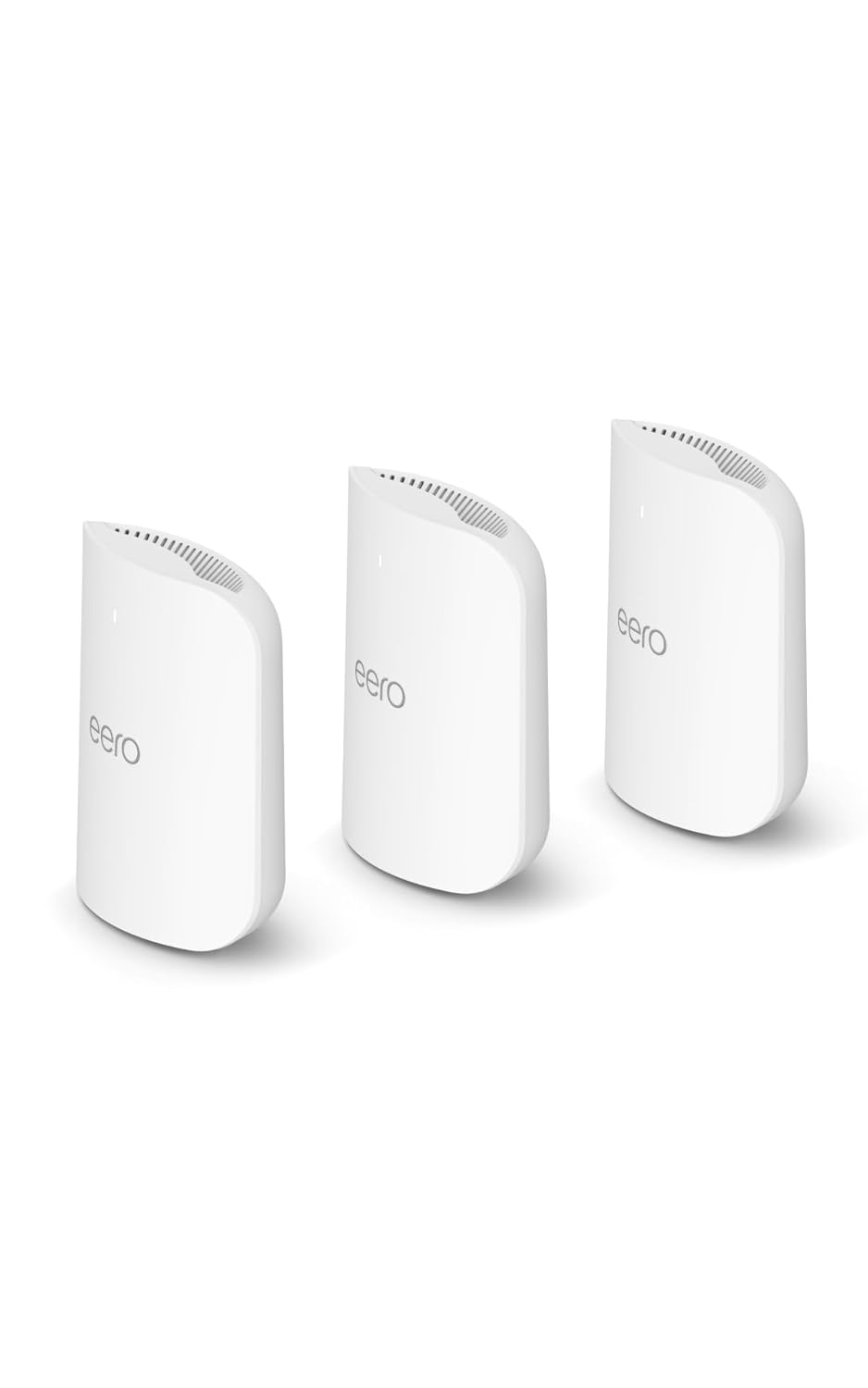
eero Pro 7
The Amazon eero Pro 7 is the router for people who never want to think about their router. Its TrueMesh routing, silent automatic updates, and five-minute app setup make it the most reliably hands-off system we evaluated — the one we recommend to remote workers who want flawless calls without ever opening a settings page. It earns the highest reliability score in our rankings. What keeps it at #3 is the fine print: advanced security and VPN live behind the eero Plus subscription, management is app-only with no deep controls, and wired connectivity tops out at 5 GbE. A fair trade for simplicity — but a trade.
How We Scored It
Category Deep-Dives
Coverage & Range
8.0 / 10 20% weightingeero rates the Pro 7 at roughly 2,000 sq ft per node — about 6,000 sq ft for the three-pack — and the modular approach is the point: you buy exactly the coverage your home needs and add a node later if it changes. Where eero’s coverage genuinely shines is not raw reach per node but placement intelligence. TrueMesh continuously maps the best path between nodes (including multi-hop routes competitors handle poorly), TrueRoam hands devices off as you move, and TrueChannel steers around interference — so the coverage you get is unusually even, with fewer of the soft spots that rated square footage hides.
The structural limitation is the tri-band radio design without a dedicated backhaul band: node-to-node traffic shares spectrum with your devices, so the far node gives up some throughput in a busy wireless mesh. The practical fix is wired backhaul over the 5 GbE ports, which eero supports cleanly and which we recommend for any home with Ethernet runs. Per-node reach also trails the big ASUS units — expect to use more eero nodes to cover the same footprint as a two-node ZenWiFi kit.
Bottom line on coverage: Exceptionally even, self-optimizing coverage that scales node by node — but less raw reach per unit than the ASUS systems, and no dedicated wireless backhaul. Wire the nodes together if you can.
Reliability & Stability
9.5 / 10 20% weightingThis is the highest reliability score in our router rankings, and it is the entire reason the eero Pro 7 exists. The system is engineered around one promise: it just works, and keeps working. Firmware updates install silently and automatically — no notification badge you ignore for six months — and eero’s update cadence and track record across a decade of mesh hardware is the best in the consumer space. TrueMesh quietly reroutes around interference and node hiccups before you notice them. The 7 p.m. household pile-on that destabilizes lesser routers simply doesn’t register; the Pro 7 handles 200+ devices by spec and does so without the slow degradation that forces weekly reboots elsewhere.
Aggregated owner-reported stability backs this up: eero consistently posts the lowest complaint rates for disconnects and the highest “set it and forget it” satisfaction in the category. Amazon’s scale matters here too — eero firmware ships to millions of devices, so regressions are caught and rolled back fast, and the platform’s three-year warranty is the longest of any major mesh brand. On long-term support risk, eero is a U.S. company (Amazon-owned) with zero exposure to the 2026 FCC import restrictions.
Bottom line on reliability: The most dependable hands-off platform in consumer networking — automatic updates, self-healing mesh, and a decade-long track record. The benchmark the rest of our reliability column is measured against.
Speed & Throughput
8.5 / 10 15% weightingThe Pro 7 is a BE9300-class tri-band Wi-Fi 7 system — a deliberate step down from the spec-sheet arms race. eero quotes real numbers rather than lab aggregates: up to 3.9 Gbps wireless to a single device and wired throughput that supports internet plans up to 5 Gbps. With MLO and the 6 GHz band doing the heavy lifting, a Wi-Fi 7 laptop near a node gets genuinely multi-gigabit performance, and — more relevant to daily work — speeds hold up well at distance and through walls, where TrueChannel’s interference management earns its keep.
Against the ASUS flagships the raw numbers are lower: fewer spatial streams, no 320 MHz-everything design, and shared backhaul trims the far node’s ceiling in wireless mesh mode. But the honest home office framing is the one we apply across this guide: on a gigabit-or-slower plan, the Pro 7 and a BE30000 flagship are indistinguishable in daily use. The Pro 7’s speed budget is spent where remote work feels it — consistency under load — rather than on peak figures no broadband plan reaches.
Bottom line on speed: Fast where it matters and honest about its numbers — multi-gig to the desk, 5 Gbps plan support, and steady throughput under household load. Spec-sheet maximalists should look at the ASUS systems; most buyers won’t feel the difference.
Call & VPN Performance
8.0 / 10 15% weightingFor video calls, the Pro 7’s strengths compound: automatic traffic optimization prioritizes conferencing and gaming flows without any configuration, MLO keeps a Wi-Fi 7 laptop’s connection stable across bands, and TrueRoam delivers the smoothest mid-call room-to-room handoff we’ve seen — the scenario where many mesh systems drop a beat. Latency under household load is well controlled. The trade-off is the eero philosophy itself: there is no manual QoS to pin absolute priority to the work machine; you trust the automation, and the automation is very good.
The VPN column is where the score gives ground. The Pro 7 has no built-in VPN server or client — VPN functionality arrives only with the eero Plus subscription (which bundles a consumer VPN), and there is no WireGuard/OpenVPN server for connecting back to your home network, no per-device tunnel routing, nothing comparable to the ASUS toolkit or the GL.iNet Flint 2’s ~900 Mbps WireGuard. A corporate VPN client running on your laptop works exactly as well as on any router, so many remote workers will never notice — but anyone who wants VPN at the router level should look elsewhere.
Bottom line on calls & VPN: Among the best call experiences in the category with zero configuration — and effectively no router-level VPN story without a subscription. Score reflects excellence on one half and a real gap on the other.
Security & Management
7.0 / 10 15% weightingThe included security basics are solid: WPA3, automatic firmware updates (the single most valuable security feature on any router, and eero’s are best-in-class), a guest network, and a built-in Zigbee/Thread/Matter smart home hub that can keep IoT chatter off your main network. For many households that baseline, maintained automatically forever, is more real-world security than a feature-rich router that never gets updated.
But our framework applies an explicit penalty to subscription-gated security, and the Pro 7 takes it squarely. Advanced threat protection, content filtering, ad blocking, and the VPN all live behind eero Plus at $9.99/month or $99.99/year. Over a five-year ownership window that subscription approaches $500 — real money that can exceed the price of a node — while ASUS includes AiProtection Pro free for the life of the device. The comparison is not subtle, and it is the main reason the Pro 7 sits at #3 rather than challenging for the top spot.
Management is the eero app, full stop — clean, fast, and excellent at what it exposes, with no web UI and no deep controls: no VLANs, no granular radio settings, no per-device QoS dials. For the target buyer this is a feature, not a bug. For a power user it is disqualifying, and we score for the home office buyer in between: simplicity executed superbly, capability deliberately withheld.
Bottom line on security: Best-in-class automatic updates and a strong free baseline, but the good stuff costs $99.99/year for as long as you own the system, and the app-only management offers no escape hatch for advanced needs. The subscription penalty lands here.
Connectivity & Value
8.5 / 10 15% weightingEach Pro 7 node carries two auto-sensing 5 GbE ports — enough to ingest a 5 Gbps fiber plan at full rate, run wired backhaul between nodes, or hard-wire the work desk at multi-gig speeds. That covers the realistic needs of nearly every home office, though it concedes the 10G tier to the ASUS systems and the eero Max 7, and two ports per node means a small switch joins the shopping list if you wire backhaul and a desktop at the same node. There is no USB port, so no cellular-failover trick like the ZenWiFi systems offer.
On value, the Pro 7 sits in the upper-middle of the market and earns its price if you weight your dollars toward reliability: you are paying for the TrueMesh software, the update pipeline, and the three-year warranty as much as the radios. The honest asterisk is total cost of ownership — add eero Plus for five years and the “cheaper than a ZenWiFi” math inverts. Buyers who will never subscribe get a strong deal; buyers who want the full security suite should price the subscription in before comparing stickers.
Bottom line on connectivity & value: Dual 5 GbE per node covers real-world home office needs, and the hardware price is fair for what ships. Just do the eero Plus math before you buy — the subscription is where the value calculus can flip.
About the Manufacturer
eero effectively created the consumer mesh Wi-Fi category in 2016 and was acquired by Amazon in 2019. Its identity has never wavered: hide the complexity of networking behind software that manages itself. The TrueMesh routing platform, silent automatic updates, and an app-first experience define every product in the line, and the company’s update support for even its oldest hardware is among the longest-running in consumer networking.
The eero Pro 7, released in 2025, is the mainstream flagship of eero’s Wi-Fi 7 generation — positioned below the quad-band eero Max 7 and above the entry eero 7, pairing tri-band Wi-Fi 7 with dual 5 GbE ports and the full TrueMesh stack. As an Amazon company, eero is a U.S. vendor with no exposure to the 2026 FCC restrictions on foreign-made routers.
For home office buyers, eero’s pitch is simple: this is the brand you choose when network downtime is unacceptable and network tinkering is unappealing — accepting the eero Plus subscription model as the cost of that simplicity.