eero Max 7
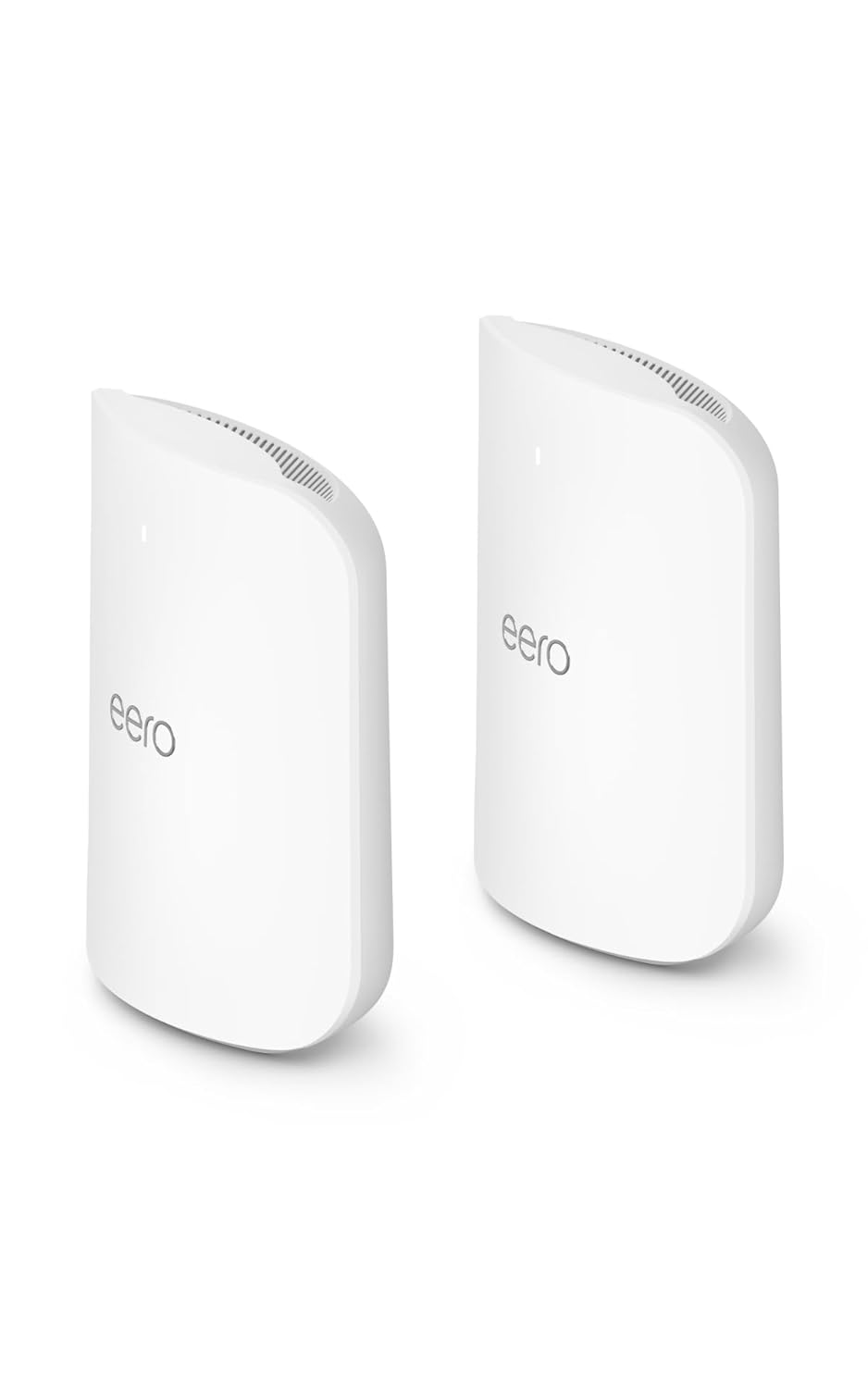
The eero Max 7 is eero’s answer to the question “what if the hands-off router were also the fast one?” It keeps everything that earns the eero platform the best reliability score in our rankings — TrueMesh routing, silent automatic updates, five-minute setup — and bolts it to BE20800-class tri-band Wi-Fi 7 radios with dual 10G and dual 2.5G ports on every node. It ties the eero Pro 7’s 8.3 with a different shape: more speed and the best eero wired story, traded against a flagship price that pushes deep into ASUS ZenWiFi territory — where the security suite those systems include free remains, on eero, a subscription.
How We Scored It
Category Deep-Dives
Coverage & Range
8.0 / 10 20% weightingEach Max 7 node is rated for roughly 2,500 sq ft — eero’s largest footprint per unit — putting the two-pack at about 5,000 sq ft and a three-pack comfortably past 7,000. As with the Pro 7, the headline numbers undersell what eero does best: TrueMesh, TrueRoam, and TrueChannel produce unusually even coverage, continuously remapping paths around interference and handing devices off cleanly as you move. The Max 7’s stronger radios stretch that quality over more floor area per node.
The structural note carries over from the Pro 7: the tri-band design has no dedicated backhaul band, so node-to-node traffic shares spectrum with your devices in a wireless mesh. The Max 7’s mitigation is the best in the eero line — wired backhaul over 10 GbE, which doesn’t just fix the far-node penalty but turns each node into a full-speed access point. If your home has Ethernet between floors, a wired Max 7 mesh is functionally immune to the shared-backhaul critique. Quad-band systems (BQ16 Pro, Orbi 970) still hold the raw-reach and wireless-backhaul edge, which is what separates this 8.0 from their scores.
Bottom line on coverage: eero’s biggest per-node reach with its signature evenness, and a 10G wired-backhaul option that erases the shared-backhaul penalty entirely. Wireless-only large homes are still better served by a dedicated-backhaul system.
Reliability & Stability
9.5 / 10 20% weightingEverything we wrote about the Pro 7’s reliability applies verbatim, because it is the same platform: silent automatic updates with the best track record in consumer networking, TrueMesh self-healing around interference and node hiccups, and aggregated owner-reported stability that leads the category. The Max 7 adds capacity headroom on top — eero rates a two-pack for 500+ devices, with the processing muscle to keep the network responsive while the whole household piles on.
The three-year warranty is the longest among major mesh brands, eero firmware ships and gets validated at Amazon scale, and eero (a U.S. company) carries no exposure to the 2026 FCC import restrictions. For a home office, this remains the platform you are least likely to ever think about after setup day — which is the entire reliability brief.
Bottom line on reliability: The same best-in-category 9.5 as the eero Pro 7 — identical platform, more headroom. The benchmark for hands-off dependability in our rankings.
Speed & Throughput
9.0 / 10 15% weightingThis is where the Max 7 earns its name. The BE20800-class radios — 320 MHz channels on 6 GHz, 240 MHz on 5 GHz, 4K-QAM, MLO — deliver eero’s quoted 4.3 Gbps wireless to a single device and up to 9.4 Gbps wired, more than double the Pro 7’s ceiling on both counts. In practice that means a Wi-Fi 7 laptop near a node genuinely operates in multi-gigabit territory, and the system can ingest the fastest residential fiber plans sold today without the router being the bottleneck.
The honest qualifiers: the ASUS BQ16 Pro and Orbi 970 still post higher aggregate capacity with their quad radios, and in a wireless mesh configuration some of the Max 7’s speed at the far node is spent on shared backhaul — wire the nodes and you get all of it back. And as always in this guide: on a gigabit plan, none of this is felt. The Max 7’s speed case is specifically for multi-gig fiber households and wired-backhaul setups, where it is the fastest eero by a wide margin and competitive with anything here.
Bottom line on speed: More than double the Pro 7’s wireless and wired ceilings, with support for the fastest residential plans — the first eero with genuinely flagship-class throughput. Wire the backhaul to collect all of it.
Call & VPN Performance
8.0 / 10 15% weightingIdentical platform, identical strengths: automatic prioritization of conferencing traffic with zero configuration, TrueRoam’s class-leading mid-call handoff between rooms, MLO band-failover stability for Wi-Fi 7 clients, and well-controlled latency under household load — now with more radio and CPU headroom absorbing contention before it ever reaches your call. For a remote worker who wants flawless call behavior out of the box and never wants to see a QoS settings page, the Max 7 is as good as this category gets.
And the identical gap: no router-level VPN without the eero Plus subscription, no WireGuard/OpenVPN server, no per-device tunnel routing. A corporate VPN client on the laptop works as well as anywhere, but the ASUS systems’ built-in VPN suite and the GL.iNet Flint 2’s ~900 Mbps WireGuard have no answer here. Same 8.0 as the Pro 7: excellence on the call half, a real gap on the VPN half.
Bottom line on calls & VPN: The best zero-effort call experience in our rankings, unchanged from the Pro 7 — and the same near-empty VPN column. Router-level tunnel needs point you to ASUS or GL.iNet.
Security & Management
7.0 / 10 15% weightingThe free baseline is genuinely strong: WPA3, the category’s best automatic updates, a guest network, and the built-in Zigbee/Thread/Matter hub for corralling smart-home devices. Maintained silently forever, that baseline outperforms many feature-rich routers that never get patched.
But the subscription math stings more here than on any other eero. Advanced threat protection, content filtering, ad blocking, and VPN live behind eero Plus at $9.99/month or $99.99/year — on hardware already priced against the ASUS ZenWiFi BQ16 Pro, which includes its entire AiProtection Pro suite free for life. Five years of eero Plus added to the Max 7’s flagship sticker makes it among the most expensive ownership propositions in our rankings, and our subscription-gated-security penalty applies in full.
Management remains the eero app, full stop — superb at what it exposes, with no web UI, no VLANs, and no deep controls. On a premium flagship, the absent escape hatch for power users is felt a little more keenly, but the philosophy and the score are unchanged.
Bottom line on security: Excellent free fundamentals, with the good stuff behind $99.99/year — the same amber 7.0 as the Pro 7, weighing heavier at this price point.
Connectivity & Value
8.0 / 10 15% weightingThe port array is the best eero has ever shipped and among the best in this guide: two 10 GbE and two 2.5 GbE ports on every node. That is four wired drops per node — multi-gig internet in, 10G wired backhaul between nodes, a 10G desk connection at the satellite, and a spare for a NAS or dock, all without buying a switch. It comprehensively fixes the Pro 7’s two-port squeeze and matches the ASUS systems’ wired story. Still no USB port, so no cellular-failover option.
Value is where the half-point comes off. The Max 7 sits at the top of eero’s range and squarely in flagship territory — overlapping the BQ16 Pro, which brings quad-band radios, a dedicated wireless backhaul, and subscription-free security to the same price conversation. The Max 7’s counter is real (eero’s reliability record, the 10G-everywhere port layout, genuinely effortless ownership), but a buyer maximizing hardware per dollar has cheaper paths to most of this: the Pro 7 for the eero experience, or ASUS for the spec sheet. Factor in eero Plus and the gap widens. As with every flagship here, the premium is rational for the buyer who uses it — and the score prices in how many won’t.
Bottom line on connectivity & value: Four multi-gig ports per node — the best wired eero ever — at a price that invites direct comparison with quad-band ASUS hardware that includes its security for free. Superb kit; sharpen your pencil.
About the Manufacturer
eero effectively created the consumer mesh Wi-Fi category in 2016 and was acquired by Amazon in 2019. Its identity has never wavered: hide the complexity of networking behind software that manages itself. The TrueMesh routing platform, silent automatic updates, and an app-first experience define every product in the line, and the company’s update support for even its oldest hardware is among the longest-running in consumer networking.
The eero Max 7, released in late 2023, was eero’s first Wi-Fi 7 product and remains its flagship — positioned above the Pro 7 with bigger radios and the line’s only 10 GbE ports. As an Amazon company, eero is a U.S. vendor with no exposure to the 2026 FCC restrictions on foreign-made routers.
For home office buyers, eero’s pitch is simple: this is the brand you choose when network downtime is unacceptable and network tinkering is unappealing — accepting the eero Plus subscription model as the cost of that simplicity.