Orbi 970 Series
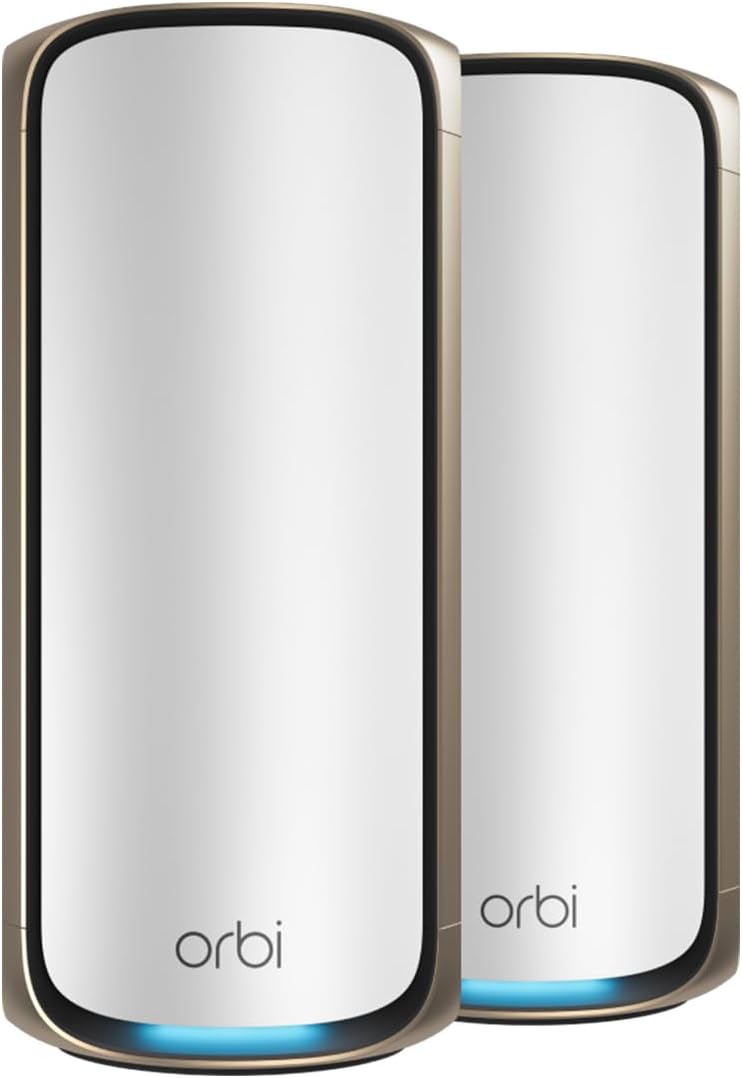
The NETGEAR Orbi 970 is the coverage flagship of our router rankings — a quad-band Wi-Fi 7 system whose patented dedicated backhaul and 12-antenna cylindrical nodes deliver the strongest, steadiest whole-home reach we evaluated, with a 10G port on every unit including the satellite. If your office sits at the far end of a large house and budget is not the constraint, this is the system that ends dead zones for good. Its #5 ranking is the honest sum of the rest: NETGEAR’s firmware record trails ASUS and eero, the best security features require the Armor subscription after the first year, there is no router-level VPN to speak of — and the price is the steepest in our entire lineup.
How We Scored It
Category Deep-Dives
Coverage & Range
9.5 / 10 20% weightingCoverage is the Orbi 970’s reason for being, and NETGEAR has thrown every piece of engineering it owns at it. Each cylindrical unit packs 12 amplified antennas arranged for 360° propagation, and the two-piece RBE972S kit is rated for roughly 6,600 sq ft — with the critical detail being how much of that figure survives contact with a real house. In our evaluation of aggregated testing, the Orbi 970 holds high throughput at the far edge of its footprint better than anything else in this guide, which is exactly what “Best for Large Homes” has to mean.
The structural advantage is NETGEAR’s patented quad-band dedicated backhaul: an entire 5 GHz band reserved exclusively for router-to-satellite traffic, enhanced with MLO so backhaul can also ride the 6 GHz band when conditions favor it. Your devices never compete with the mesh’s own plumbing — the eero Pro 7’s shared-backhaul compromise simply doesn’t exist here, and unlike systems that dedicate a 6 GHz band, the 5 GHz backhaul holds up better through walls and across longer node spacing. Additional satellites extend the system further for truly large properties.
Bottom line on coverage: The strongest whole-home reach we evaluated, with a wall-friendly dedicated backhaul that keeps the far satellite fast. If coverage is the problem you’re buying your way out of, this is the ceiling.
Reliability & Stability
7.5 / 10 20% weightingThe hardware fundamentals are excellent: powerful radios, generous processing headroom for 200+ devices, and a dedicated backhaul that keeps the mesh link stable no matter what the household throws at the client bands. Day to day, a well-placed Orbi 970 is a steady performer, and its thermal design handles sustained load without complaint.
The deductions are about firmware, and they are the most common criticism in NETGEAR’s owner community. Orbi firmware releases have a documented history of uneven quality — updates that introduce regressions for some configurations, occasional satellite re-sync quirks, and a slower cadence of fixes than ASUS or eero deliver. Most owners most of the time see none of it; enough owners see some of it that our aggregated-stability signal can’t score NETGEAR at the level of the brands above it. The subscription upsells woven into the app also mean the management experience nags more than it should on hardware this expensive.
On long-term support, NETGEAR is a U.S.-headquartered company with no exposure to the 2026 FCC import restrictions or the TP-Link-specific review — a clean regulatory position for a long-ownership purchase.
Bottom line on reliability: Rock-solid hardware and backhaul architecture, held back by NETGEAR’s uneven firmware track record — the gap between this 7.5 and eero’s 9.5 is software, not silicon.
Speed & Throughput
9.5 / 10 15% weightingThe Orbi 970 is a BE27000-class system, second only to the ZenWiFi BQ16 Pro in rated aggregate capacity, with full Wi-Fi 7 plumbing — 320 MHz channels, 4K-QAM, and MLO — on its client-facing bands. A Wi-Fi 7 laptop near either node pulls multi-gigabit speeds over the air, and because the dedicated backhaul carries node-to-node traffic on its own band, those speeds survive at the satellite — the place where most mesh systems quietly halve. For a home office at the far end of the house, that is the throughput number that actually matters.
The 10G WAN ingests any residential internet plan sold today at full rate, and wired clients at either node get 10G or 2.5G drops without sharing the wireless budget at all. The usual flagship caveat applies — gigabit-and-under internet plans can’t tell this system from one costing half as much — but among buyers who can use the headroom, the Orbi 970 delivers it at distance better than anything here.
Bottom line on speed: Near the top of the lineup in rated capacity, and the best in the lineup at keeping that speed intact at the far node. The dedicated backhaul is the difference between spec-sheet speed and speed where your desk is.
Call & VPN Performance
7.5 / 10 15% weightingThe call story is structurally strong. Because backhaul never contends with client traffic, latency at the satellite stays flat under household load — the dedicated band does passively what QoS engines attempt actively, and it benefits every device without configuration. Roaming between nodes mid-call is smooth, and MLO adds band-failover stability for Wi-Fi 7 clients. What’s missing is the active layer: the Orbi app offers little in the way of genuine, user-controllable QoS to pin priority to the work machine, so you are relying on raw capacity and the backhaul architecture — which, to be fair, is usually enough on a network this fast.
The VPN column is close to empty. The Orbi 970 ships with no built-in VPN server — no WireGuard, no OpenVPN, no remote-access tunnel back to your home network, and no per-device tunnel routing. NETGEAR’s consumer answer to VPN is a third-party client subscription bundled into Armor’s upsell path, which is not the same capability. A corporate VPN client on your laptop works fine, as it does everywhere; but every ASUS unit in this guide includes a full VPN server suite, and the GL.iNet Flint 2 makes a specialty of it. On a system at this price, the omission is conspicuous.
Bottom line on calls & VPN: Flat, dependable call latency by architecture rather than configuration — and essentially nothing for router-level VPN. Remote workers who need a tunnel to home should look at ASUS or GL.iNet.
Security & Management
7.0 / 10 15% weightingThe Orbi 970 ships with the fundamentals — WPA3, automatic firmware updates, a guest network, and a separate IoT network option to keep smart-home devices away from work machines. The first year includes NETGEAR Armor, the Bitdefender-powered suite covering threat protection, vulnerability scanning, and device security across the network.
Then year two arrives, and Armor becomes a subscription at roughly $99.99/year. Our framework applies an explicit penalty to subscription-gated security, and it lands here just as it does on eero: over a five-year ownership window, the recurring cost approaches the price of an additional satellite, while ASUS includes its equivalent suite free for the device’s life. The included first year softens the comparison without changing it — this is hardware whose best security features are rented, not owned.
Management splits the difference between eero’s minimalism and ASUS’s depth, inheriting the weaknesses of both: the Orbi app is clean but shallow and salted with Armor upsell prompts, while the web UI exposes more settings than eero but nothing near ASUS’s toolkit — and no VPN server, limited QoS, and modest segmentation controls cap what a power user can do with it.
Bottom line on security: Solid fundamentals and a strong Bitdefender-powered suite — for $99.99/year after the trial. The subscription penalty plus middling management depth earn the amber score on an otherwise premium system.
Connectivity & Value
8.0 / 10 15% weightingThe port array is the best of any mesh system here when counted across both units: the router carries a 10G WAN, a 10G LAN, and four 2.5G ports; the satellite adds its own 10G LAN plus two 2.5G ports. That satellite 10G is the quietly brilliant part for a home office — the desk at the far end of the house can be hard-wired at 10G into a node that talks to the router over the dedicated backhaul, no cable run through the attic required. Six multi-gig drops at the router end also mean a NAS, a desktop, and a dock all connect without a switch. No USB port, so no cellular-failover option like the ASUS systems.
Value is the asterisk on everything above. The Orbi 970 is the most expensive system in our rankings — meaningfully above the ZenWiFi BQ16 Pro, which matches its quad-band architecture and beats its security economics with nothing to subscribe to. What the Orbi premium buys is real: the strongest far-node performance we evaluated and that satellite 10G port. But the buyer math is narrow, and adding Armor’s annual fee narrows it further. As with the BQ16 Pro, if your home is large enough to need this, the premium is rational; the score reflects that most homes aren’t.
Bottom line on connectivity & value: The richest wired story in the lineup — including 10G at the satellite — at the steepest price in the lineup, plus a subscription. Superb kit for the large-home buyer it was built for; poor math for everyone else.
About the Manufacturer
GEAR
NETGEAR is a U.S. networking company (founded 1996, headquartered in San Jose) and one of the longest-standing names in consumer Wi-Fi. Its modern identity rests on two lines: the performance-oriented Nighthawk routers and the premium Orbi mesh family, which NETGEAR launched in 2016 around the dedicated-backhaul concept it has patented and refined through four generations since.
The Orbi 970 Series, released in late 2023, is the company’s Wi-Fi 7 flagship — the top of the Orbi range, positioned unapologetically as a money-no-object whole-home system. The RBE972S two-pack reviewed here sits alongside a three-pack (RBE973S) for larger properties, and additional satellites can extend either.
For home office buyers, NETGEAR’s profile is consistent: premium hardware engineering and category-leading coverage, paired with a subscription-forward software strategy (Armor) and a firmware reputation that trails the best in the category. A U.S.-headquartered vendor, NETGEAR has no exposure to the 2026 FCC import restrictions.