Deco BE85 (Deco 7 Elite)
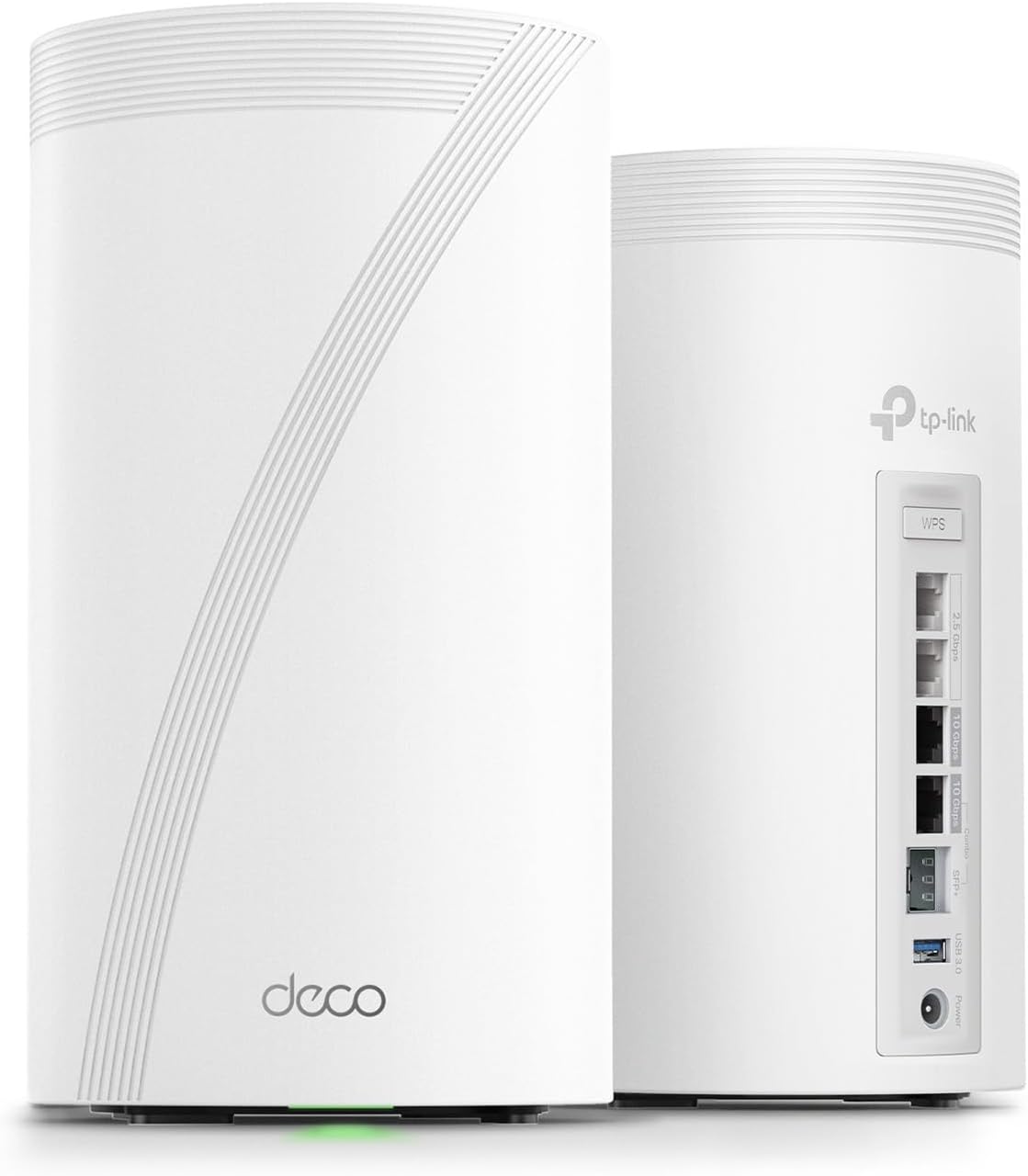
Judged purely as hardware, the TP-Link Deco BE85 belongs near the very top of this guide: BE22000-class tri-band Wi-Fi 7, eight high-gain antennas per node, and a port array — dual 10G including an SFP+ fiber combo, dual 2.5G, and USB — that no mesh system at its price approaches. It is the spec sheet of a flagship at a meaningful discount to one. Two things hold it to #6: HomeShield gates its best security behind a paid tier, and TP-Link’s unresolved U.S. regulatory situation introduces a long-term-support question we weight explicitly in our reliability score — and explain in full below, because buyers deserve the whole picture.
How We Scored It
Category Deep-Dives
Coverage & Range
9.0 / 10 20% weightingThe two-node BE85 kit is rated for roughly 6,400 sq ft (3,200 per node), with eight high-gain internal antennas per unit pushing signal further than the Deco line has ever reached. Add a third node and the system scales past 9,000 sq ft — Deco’s modular expansion is among the simplest in the industry, and the AI-driven mesh picks paths and steers clients without user involvement.
The backhaul story is strong despite the tri-band design. Without a dedicated backhaul band, node-to-node traffic shares spectrum — but the BE85’s enormous 5 GHz and 6 GHz capacity (8,640 and 11,520 Mbps rated) leaves more headroom after backhaul than slimmer tri-band systems, and the dual 10G ports per node make a full-speed wired backhaul trivial in any home with Ethernet runs. TP-Link rates the wired option at up to 10 Gbps between nodes, which converts the far satellite into a no-compromise access point.
Bottom line on coverage: Flagship-grade reach with painless expansion and a first-class wired-backhaul option. Only the dedicated-backhaul quad-band systems (BQ16 Pro, Orbi 970) clearly beat it in wireless-only configurations.
Reliability & Stability
7.5 / 10 20% weightingTwo different questions live in this score, and they deserve to be separated. The first — does the hardware run well? — has a clear answer: yes. The BE85 carries serious processing headroom, handles 200+ devices without strain, and owner-reported stability for the Deco 7-series flagships is strong. Firmware updates arrive regularly through the Deco app, and day-to-day the system disappears into the background the way a good mesh should.
The second question is the one our framework folds into this category: what does the next five years of support look like? The March 2026 FCC order added foreign-made routers to its Covered List, restricting newly certified models from every overseas brand — but TP-Link also faces company-specific scrutiny the others here don’t. In October 2025 the U.S. Commerce Department proposed blocking new sales of TP-Link products on national-security grounds, citing the company’s China ties; that proposal was still pending as of mid-2026, and the FTC opened a separate inquiry that December. None of this affects the router you’d buy today — it is authorized, sold, and fully functional — but it creates real uncertainty about the firmware-update and support horizon a multi-year purchase depends on. TP-Link disputes the allegations (see our 2026 import-rule note); we don’t exclude the brand over an unresolved proceeding, but we do apply an explicit long-term-support deduction rather than pretend the question doesn’t exist.
Bottom line on reliability: Excellent hardware stability today; an honest deduction for the regulatory cloud over tomorrow. Buyers comfortable with that uncertainty get a very dependable system — buyers who aren’t should look at ASUS or eero.
Speed & Throughput
9.5 / 10 15% weightingThe BE85 is a BE22000-class system — 1,376 Mbps on 2.4 GHz, 8,640 Mbps on 5 GHz, and 11,520 Mbps on 6 GHz — with the full Wi-Fi 7 toolkit: 320 MHz channels, 4K-QAM, and MLO. That 5 GHz figure deserves a second look: it is the highest in our entire lineup, which matters because 5 GHz is where most of today’s devices actually live. In aggregated testing the BE85 posts some of the fastest real-world Wi-Fi 7 numbers measured at realistic distances, trading blows with systems that cost considerably more.
Multi-gig internet is fully served by the 10G WAN options, and wired clients ride the same ports. The standard caveat applies — gigabit-plan households won’t feel the difference — but among the systems here, only the quad-band flagships post higher aggregate numbers, and not by margins most buyers would ever observe.
Bottom line on speed: Lineup-leading 5 GHz capacity and near-flagship Wi-Fi 7 throughput at a clear price discount. On raw speed per dollar, nothing in this guide beats it.
Call & VPN Performance
8.0 / 10 15% weightingFor call quality, the BE85’s huge radio capacity does the heavy lifting: with this much spectrum headroom, household contention rarely reaches the point where a Zoom call feels it, and AI-driven roaming hands devices between nodes smoothly mid-call. MLO gives Wi-Fi 7 laptops band-failover stability. QoS controls live in the Deco app and cover device prioritization adequately, though they are simpler than ASUS’s Adaptive QoS and less self-sufficient than eero’s automation — set the work laptop as a priority device and the system behaves.
The VPN column is better than the mainstream average: current Deco firmware supports OpenVPN and WireGuard (server and client) for remote access to the home network and router-level tunnels, plus the usual client configurations. Throughput with encryption running is modest compared to the GL.iNet Flint 2’s ~900 Mbps — this CPU was not specced for crypto — but the capability exists where eero and NETGEAR offer little or nothing built in.
Bottom line on calls & VPN: Capacity-driven call stability, competent app-based prioritization, and real OpenVPN/WireGuard support that beats eero and NETGEAR — at throughput well below the VPN specialists.
Security & Management
7.0 / 10 15% weightingTP-Link’s HomeShield sits between the free-everything ASUS model and the subscription-everything eero model. The free tier covers a real baseline: WPA3, network security scans, basic parental controls, guest network, and IoT device isolation. The HomeShield Pro paid tier adds the advanced layer — real-time intrusion prevention, malicious-content filtering, comprehensive parental controls, and detailed reporting. Our framework’s subscription penalty applies to the gated portion, which is why this lands at 7.0 alongside eero and NETGEAR rather than with ASUS and GL.iNet.
Management is the Deco app: polished, fast, and genuinely easy — setup rivals eero for simplicity, which is no small praise. The web interface exists but exposes far less than the app, and power-user depth (VLANs, granular radio control) is limited across the board. For the target buyer this trade reads as friendliness; for tinkerers it reads as a ceiling.
One more consideration belongs in a security column for this brand: the regulatory scrutiny described in our reliability section stems from data-security and supply-chain concerns raised by U.S. agencies. No public finding has established a deliberate, manufacturer-built backdoor in TP-Link consumer routers, and the products remain authorized for sale — but TP-Link devices have been prominent targets of real-world exploitation, most notably the China-linked “Flax Typhoon” botnet of compromised routers that the FBI disrupted in 2024, and the company’s vulnerability-response track record is part of what U.S. agencies cite. A security-weighted buyer deciding between this and an unaffected brand at similar capability should weigh that context alongside the feature list.
Bottom line on security: A genuinely useful free tier with the best features paywalled behind HomeShield Pro, an excellent app with limited depth — and brand-level context worth reading before you buy.
Connectivity & Value
7.5 / 10 15% weightingThe port array is, plainly, the most interesting in this guide: each node carries a 10G RJ45 port, a second 10G SFP+/RJ45 combo port, two 2.5G ports, and a USB 3.0 port. The SFP+ option is unique among consumer mesh — fiber-to-the-home users can terminate fiber directly at the router, skipping a media converter entirely. Four multi-gig drops per node covers internet-in, wired backhaul, a 10G desk run, and a NAS without a switch. It is a strictly better wired story than anything else here, including the eero Max 7.
On value, the BE85 delivers flagship silicon at a price meaningfully below the BQ16 Pro, Orbi 970, and eero Max 7 — classic TP-Link, and the reason the brand owns the price-to-performance conversation in Wi-Fi 7. Two factors temper the score: HomeShield Pro’s recurring cost narrows the gap against ASUS’s all-inclusive pricing over a five-year window, and the regulatory uncertainty is itself a value consideration — a discount on hardware whose support horizon carries a question mark is a smaller discount than it appears. Net: strong value with eyes open, which is precisely how we’d describe the whole product.
Bottom line on connectivity & value: The best port array in our rankings — SFP+ fiber, dual 10G, quad multi-gig per node — at a real discount to the flagships it matches. The discount prices in the asterisks; make sure you’ve read them.
About the Manufacturer
Link
TP-Link is the world’s largest consumer networking vendor by volume, and its Deco mesh line and Archer router family have built their position on aggressive price-to-performance — frequently delivering the newest Wi-Fi generation’s features at prices a tier below ASUS, NETGEAR, and eero. The Deco BE85, also sold as the Deco 7 Elite, launched in 2023 as the line’s Wi-Fi 7 flagship.
The company’s U.S. position carries unusual context. U.S. agencies have scrutinized TP-Link’s China ties on national-security grounds since 2024, and that scrutiny has intensified rather than receded: in October 2025 the Commerce Department proposed blocking new sales of TP-Link products (a proposal still pending as of mid-2026), and the FTC opened a separate inquiry in December 2025. The March 2026 FCC Covered-List order on newly certified foreign-made routers does not affect models already authorized — including everything TP-Link currently sells. TP-Link disputes the allegations, says it has separated from the China-based TP-LINK Technologies Co., and has reorganized its U.S. operations as California-based TP-Link Systems. We cover the full situation in our import-rule note and reflect it in our scoring rather than excluding the brand: the hardware earns its place in these rankings on merit.
For home office buyers, the practical summary: TP-Link offers the strongest hardware value in Wi-Fi 7, with a support-horizon question the other brands here don’t carry. Buy on merit, with eyes open.