AU120MA
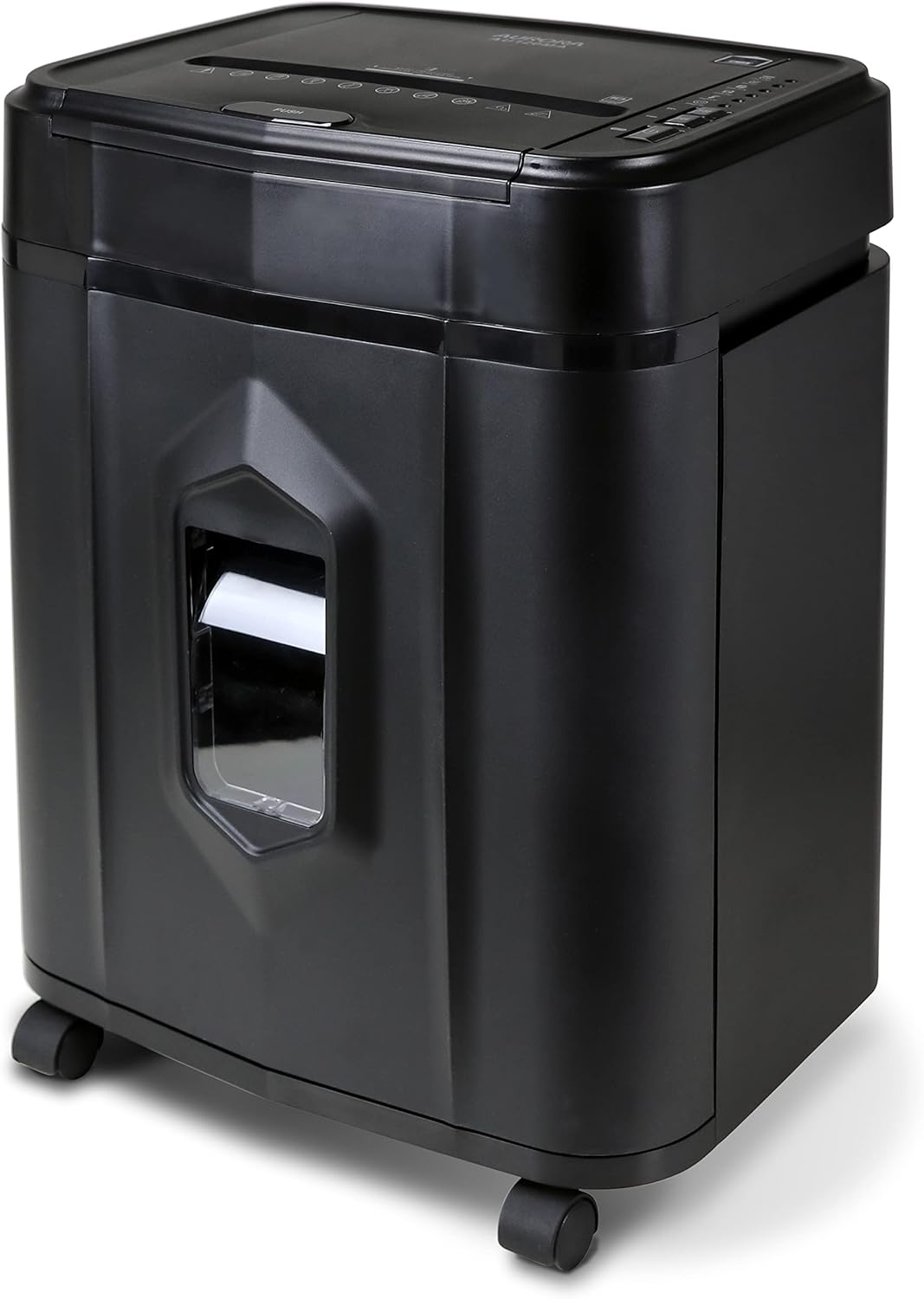
The Aurora AU120MA is the best auto-feed shredder in our home-office lineup, and it earns that title by doing something most auto-feed machines don’t: cutting to true P-4 micro-cut security rather than the larger cross-cut particles that auto-feed designs usually settle for. Drop up to 120 sheets in the tray, close the lid, and walk away — it works through the stack unattended into a 5-gallon pull-out basket, with a 30-minute continuous run time and a 10-sheet manual slot for cards and one-off pages. It gives up some ground to the Fellowes machines on jam-prevention sophistication and touch-sensing safety, which is why it lands at #3 rather than higher — but for clearing a backlog of stored documents, nothing else here is as effortless. It’s our auto-feed pick at 8.7.
How We Scored It
Category Deep-Dives
Security Level
9.0 / 10 25% weightingThe AU120MA cuts to P-4 micro-cut under DIN 66399, producing 5/32″ × 15/32″ particles — the same high baseline we require of any machine destined for documents with personal data. What makes it notable is the context: the great majority of auto-feed shredders compromise to cross-cut particles, because pulling sheets through a tray mechanism and then micro-cutting them demands more torque and slows the feed. Aurora didn’t take that shortcut. You get true micro-cut security and a 120-sheet tray, a combination that’s genuinely uncommon below commercial price points.
In practical terms that’s well over a thousand particles per page, dense enough to pack efficiently into the bin and far beyond any reassembly effort a household realistically needs to defend against. The credit-card slot cuts cards to the same micro-cut standard.
As with our #1 Fellowes LX210, the score stops at a strong 9.0 rather than a perfect 10 only because this is P-4, not P-5 — the half-again-smaller particle size reserved for our maximum-security pick, the Aurora AU1060MA. For the home office, P-4 micro-cut is the correct standard, and getting it in an auto-feed machine is the AU120MA’s whole reason for being.
Bottom line on security: True P-4 micro-cut in an auto-feed body is rare and exactly what you want — the same protection as our top manual machines, with none of the standing-and-feeding. Only step up to the P-5 AU1060MA for third-party confidential records.
Capacity & Speed
9.5 / 10 20% weightingThis is the AU120MA’s highest score and its headline strength. The 120-sheet auto-feed tray changes what shredding is: instead of standing at the slot feeding pages, you load a stack, close the lid, and leave the room while the machine works through it. For anyone with years of stored statements, old tax files, or a filing-cabinet purge ahead of them, this is the difference between a chore you keep postponing and one that happens in the background.
Backing the tray is a 30-minute continuous run time — long enough to clear several full trays in a session — and a 10-sheet manual slot for the everyday case where you just need to destroy a couple of pages or a card without loading the tray. Shredded output collects in a 5-gallon pull-out basket, which empties cleanly without lifting a heavy cutter head.
The 9.5 reflects how completely this package solves the capacity problem for a home office. It isn’t a perfect 10 only because the highest-duty Aurora machines (the AU1060MA and AU1210MA) push continuous run time to a full 60 minutes; for batch auto-feed work, the AU120MA’s 30 minutes is rarely the limiting factor.
Bottom line on capacity: A 120-sheet tray plus a 30-minute duty cycle makes backlog destruction effortless — load it and walk away. This is the category where the AU120MA decisively beats every manual machine in our lineup.
Reliability & Jam Resistance
8.0 / 10 20% weightingThe AU120MA is a dependable machine, but this is the category where its auto-feed architecture costs it points relative to the Fellowes leaders — and that trade-off is honest rather than a flaw. An auto-feed tray adds moving parts: grip rollers that pull sheets in and feed sensors that meter them. Those components do occasionally misfeed on glossy, heavily folded, or stapled-corner paper, and they’re simply more mechanism than a manual slot has to go wrong. We apply that same small deduction to every auto-feed machine in the lineup.
Where the AU120MA defends itself is the protection suite. It relies on auto-reverse jam clearing — which backs paper out when a jam starts — plus overload protection and a set of status LEDs that diagnose exactly what’s happening: overheat, overload, bin-full, feed error, and door-open. That’s a genuinely useful feedback system; you’re rarely guessing why the machine stopped. The honest gap is that auto-reverse is reactive, whereas Fellowes’ 100% Jam Proof on the LX210 measures sheet thickness and prevents the over-stuffed pass before it binds. Preventing jams beats clearing them, and that’s the core of why the AU120MA scores 8.0 here while the LX210 reaches 9.5.
One shared maintenance note: like every micro-cut machine, the cutters need periodic oiling with a lubricant sheet to hold rated performance — and it matters a little more on an auto-feed unit, where a steady tray feed keeps the cutters working continuously.
Bottom line on reliability: Solid and well-instrumented, with overload protection and clear status LEDs — but auto-reverse is reactive where Fellowes prevents jams outright, and the feed mechanism adds parts. Keep the cutters oiled and feed clean, unfolded stacks.
Value & Versatility
9.0 / 10 15% weightingValue is one of the AU120MA’s strongest cases. Auto-feed micro-cut shredding has historically been commercial-tier equipment, and Aurora delivers it at a price a home office can justify — that capability-per-dollar is exactly why Aurora is the value champion of this category and why the AU120MA earns a 9.0 here despite the premium that any auto-feed machine carries over a basic manual one.
On versatility, the dual-feed design is the quiet advantage: the 120-sheet tray handles batch jobs while the 10-sheet manual slot covers the quick one-off without you opening the lid, and the card slot adds credit cards to what it destroys. The 5-gallon pull-out basket is a practical, tidy touch. It doesn’t shred CDs/DVDs the way some siblings do, which is the small versatility gap — but for a paper-and-cards home office, the feature set lands where it counts.
Bottom line on value: Auto-feed micro-cut at a home-office price is a genuine bargain, and the dual-feed body adds real flexibility. The 9.0 reflects capability-per-dollar that the rest of the lineup can’t match in this form factor.
Safety
7.5 / 10 10% weightingSafety is the AU120MA’s lowest score, and it comes down to one specific gap: it does not have the electronic touch-sensing shutoff that defines the Fellowes machines. Fellowes’ SafeSense stops the cutters the instant fingers touch the paper opening; the AU120MA instead relies on a more conventional safety package — auto start/stop, a door-open sensor that halts operation when the cabinet is opened, overload protection, and overheat cutoff. That’s adequate and standard, but it isn’t equivalent to active touch sensing, and we score it accordingly.
There’s a structural mitigation worth crediting, though, and it’s specific to the auto-feed design: during the main job, the lid is closed and your hands are nowhere near the cutters — the machine pulls paper from a covered tray rather than from an open slot you’re feeding by hand. For the bulk of its work, the AU120MA keeps fingers away from the mechanism simply by how it operates. The manual slot is the one place ordinary slot caution applies.
Bottom line on safety: A conventional but complete protection set — auto stop, door sensor, overload and overheat cutoffs — held back from a higher score only by the lack of Fellowes-style touch sensing. If a home with small children or pets is the priority, the SafeSense-equipped LX210 is the safer choice.
Noise
8.5 / 10 10% weightingAuto-feed machines have a built-in noise advantage, and the AU120MA uses it: because it shreds a loaded tray unattended, its noisiest work happens while you’re out of the room. A shredder you set running and walk away from is far less disruptive to a workday than one you have to stand over, regardless of the raw decibel figure. Aurora’s mechanism runs in the typical-to-quiet range for a micro-cut machine of this capacity.
As with every model in this guide, we score Noise from engineering design and aggregated owner-reported experience under load rather than a single decibel number, because manufacturers don’t publish measured figures consistently enough to compare. On that basis the AU120MA rates well — an 8.5 — helped as much by the walk-away workflow as by the hardware itself. It isn’t quite at the level of the Fellowes SilentShred models, which are purpose-engineered for quiet, but it’s comfortably above the budget tier.
Bottom line on noise: The auto-feed workflow is its own noise solution — load it, leave, and let it run. Not as acoustically refined as Fellowes’ SilentShred units, but quiet enough not to dominate the room, and you needn’t be present anyway.
About the Manufacturer
ora
Aurora is the duty-cycle and value champion of the home-office shredder market. Where Fellowes leads on safety and jam-prevention engineering, Aurora competes on capability per dollar — long continuous run times, high-capacity auto-feed trays, and true micro-cut security at prices that consistently undercut the comparable competition. Three of the five top-rated machines in our lineup are Aurora models.
The AU120MA is Aurora’s auto-feed micro-cut flagship for the home office, pairing a 120-sheet tray with the brand’s signature value positioning. It sits alongside two notable siblings in our rankings: the AU1060MA, the only P-5 high-security unit we rate, and the AU1210MA, a 12-sheet manual workhorse with a 60-minute run time — both built on the same value-first philosophy.
The practical trade with Aurora is fewer safety and acoustic refinements than the premium brands — there’s no touch-sensing shutoff or purpose-built quiet mode — in exchange for substantially more capability at a given price. For a buyer who prioritizes getting the job done over the last increment of polish, that trade is usually the right one.