AutoMax 150C
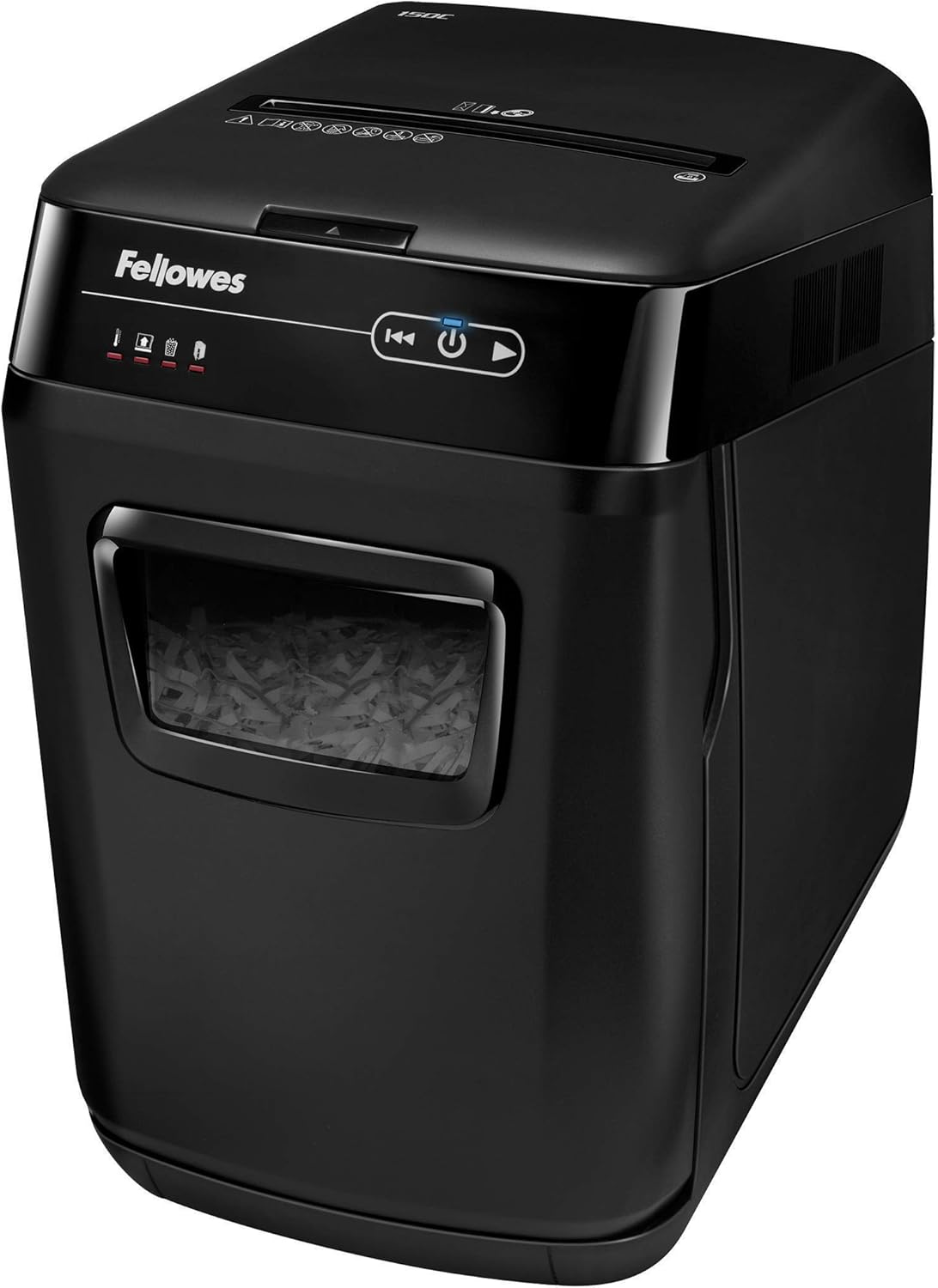
The Fellowes AutoMax 150C has the highest auto-feed capacity in our lineup — drop up to 150 sheets in the tray, push start, and walk away — paired with the largest bin we tested (8.5 gallons) and Fellowes’ build quality. The catch, and the whole story of this review, is that it cuts P-4 cross-cut, not micro-cut: it meets the same DIN security level as our top picks by particle area, but its 5/32″ × 1½″ strips are several times larger than the micro-cut confetti the higher-ranked machines produce. If your priority is maximum hands-free throughput and P-4 is sufficient, it’s an excellent tool. If you want the densest, hardest-to-reassemble particles, a micro-cut machine is the better choice. That trade-off — capacity over particle size — is why it lands at #7, tied with the cross-cut Fellowes 79Ci but ranked above it on auto-feed convenience.
How We Scored It
Category Deep-Dives
Capacity & Speed
8.5 / 10 20% weightingRaw capacity is what you buy the AutoMax 150C for. Its AccuFeed tray holds 150 sheets — the largest auto-feed tray in our lineup, ahead of the Aurora AU120MA (120) and Bonsaii C233-B (110) — and it empties into the biggest bin we tested at 8.5 gallons. Load the tray, push start, walk away: for someone with a genuine backlog of documents to destroy, that hands-free throughput is the single most valuable thing a shredder can offer.
Two specs keep this from scoring higher, and they’re worth being honest about. First, the manual slot takes only 8 sheets — the smallest in the lineup — so for the one-off items you don’t want to drop in the tray, this is a notably modest hand-feed machine. Second, the continuous run time is just 12 minutes before a 25-minute cool-down. That’s short for an auto-feed machine; the micro-cut Aurora and Bonsaii trays run roughly 30 minutes. In practice a 150-sheet tray often empties inside a single 12-minute window, but if you’re feeding tray after tray in one session, the cool-down will interrupt you sooner than the rivals would.
The net is a machine optimized for big, occasional purges rather than marathon sessions: enormous tray, huge bin, but a duty cycle that asks you to work in one-tray bursts. For most home offices clearing a filing cabinet a few times a year, that’s exactly the right shape — hence the strong 8.5.
Bottom line on capacity: The biggest tray (150 sheets) and biggest bin (8.5 gal) in our lineup, ideal for hands-free purges. A short 12-minute run time and an 8-sheet manual slot are the honest limits.
Security Level
8.0 / 10 25% weightingThis is the category that defines the AutoMax 150C’s place in our rankings. It is rated P-4 under DIN 66399 — the same security level as our top-ranked Fellowes Powershred machines — but it gets there with a cross-cut, producing 5/32″ × 1½″ strips, roughly 397 particles per letter page. The micro-cut machines at the top of our lineup cut to the same width but a fraction of the length, producing well over 1,200 particles from the same page. Both clear the P-4 bar by particle area; one clears it with a lot more margin.
For the documents a home office actually destroys — statements, tax forms, anything with an account number — P-4 cross-cut is genuinely sufficient; reassembling 397 pieces is not a project any realistic household adversary will attempt. But “sufficient” is why this scores 8.0 rather than the 9.0 the micro-cut machines earn. The 25% weight we put on security is the heaviest in our framework precisely because it’s the reason you own the machine, and a cross-cut leaves measurably larger pieces than a micro-cut. The score reflects that gap honestly, not a deficiency.
There’s also a practical knock-on effect: cross-cut strips pack less densely than micro-cut particles, so even this machine’s large 8.5-gallon bin holds fewer shredded pages than its size suggests — the same bin would go further with a micro-cut head. If maximum security and bin efficiency matter more than tray size, the micro-cut auto-feed Aurora AU120MA is the machine to compare against.
Bottom line on security: Genuine P-4, but via cross-cut — larger strips than micro-cut, sufficient for home documents and the reason it scores 8.0. Choose micro-cut if you want the densest, hardest-to-reassemble particles.
Reliability & Jam Resistance
8.5 / 10 20% weightingThe AutoMax 150C is the most reliable auto-feed machine in our lineup, and two things earn it that. The first is Fellowes build quality and warranty: a 2-year machine warranty plus a 5-year cutter warranty, the cutters being the part that actually wears. The second is a quiet mechanical advantage — because it’s cross-cut rather than micro-cut, the cutting head takes less torque per sheet than a micro machine does, which means less strain over a long service life. Cross-cut gives up particle size, but it earns some of that back in cutter longevity.
It’s not flawless, and the 8.5 rather than the 9.5 our top manual machines reach comes down to two factors. Auto-feed adds moving parts — the AccuFeed grip rollers and feed sensors that every tray machine carries, which can misfeed on glossy, folded, or stapled-corner paper. And its jam handling is reactive auto-reverse — it backs paper out after sensing an over-thick pass — rather than the active, thickness-sensing 100% Jam Proof system on the manual Powershred line that stops a jam before it starts. Auto-reverse clears most jams effectively; it’s just a step behind prevention.
One ownership note applies to any cross-cut machine too: the cutters benefit from periodic oiling to stay at rated capacity, and a tray feeding 150 sheets at a time runs a lot of paper past them. A lubricant sheet every bin-empty or two is the cheapest reliability insurance there is.
Bottom line on reliability: The most dependable auto-feed pick here — Fellowes build, a 5-year cutter warranty, and cross-cut’s lower cutting strain. Held below the manual Fellowes only by auto-feed complexity and reactive (not preventive) jam handling.
Value & Versatility
7.0 / 10 15% weightingValue is the AutoMax 150C’s one amber category, and the reasoning is specific. It carries a full Fellowes premium, and what that premium buys is capacity and convenience — the 150-sheet tray, the AccuFeed system, the big bin — rather than the top-tier security you’d get from a micro-cut machine at a similar price point. You’re paying for throughput, and if your priority were particle size instead, the money would be better spent elsewhere. That’s the honest tension the 7.0 captures.
Where it does well is versatility. Beyond paper it shreds credit cards, CDs/DVDs, staples, paper clips, and unopened junk mail, so the awkward items don’t need special handling, and the Sleep Mode auto-shutoff is a sensible touch on a deskside machine. The value verdict comes down entirely to fit: for a buyer whose defining need is hands-free volume and for whom P-4 cross-cut is genuinely enough, the price is justified. For a buyer who would actually use micro-cut security, it isn’t — and that’s why it’s an amber rather than a green.
Bottom line on value: You pay a Fellowes premium for capacity and convenience, not for top-tier particle size. Worth it if hands-free volume is your priority; overpriced if you really want micro-cut.
Safety
8.5 / 10 10% weightingThe AutoMax 150C’s safety comes from its design rather than from an electronic sensor, and on an auto-feed machine that’s a strong position. Because the bulk of the work happens hands-free — you load a stack into the tray, close the lid, and the cutters do their job behind a closed cover — the dangerous opening simply isn’t exposed during normal use. That’s a structurally safer arrangement than a manual machine whose feed slot is open every time it runs.
It backs that up with conventional protections: auto-reverse to back paper (or anything else) out of the feed path, an overheat shutoff tied to the run-time limit, and a Sleep Mode that powers the cutters down when idle. The one caveat keeping it from a top score is the absence of active touch-sensing — the AutoMax does not carry Fellowes’ SafeSense, the sensor on the manual Powershred line that kills the cutters the instant fingers touch the opening. The small 8-sheet manual slot is the only routinely exposed cutting surface, so for most users this matters little, but a household with young children or pets gets a higher margin from a SafeSense-equipped machine for that slot.
Bottom line on safety: The hands-free closed-tray design is inherently safe and earns a strong 8.5; just note there’s no active SafeSense touch-shutoff on the manual slot.
Noise
8.0 / 10 10% weightingA shredder loud enough to interrupt a call doesn’t get used during work hours — and a shredder that doesn’t get used is a security hole with a power cord. The AutoMax 150C is a SilentShred model, Fellowes’ quiet-operation engineering, which keeps it noticeably below the vacuum-cleaner range of typical consumer machines even while working through a full tray. For an auto-feed machine that may run unattended for several minutes at a stretch, that engineering is more than a nicety.
We score Noise from quiet-operation engineering claims cross-checked against owner-reported experience under load, rather than from a single decibel figure — manufacturers are inconsistent about publishing measured numbers, so we won’t present one we can’t stand behind. On that basis the SilentShred design and generally favorable owner feedback place the 150C at a solid 8.0, a touch below the quietest manual Fellowes machines but clearly among the better-behaved auto-feed units. And because it’s hands-free, you can start a tray and step away, so whatever noise it does make is easy to leave behind.
Bottom line on noise: SilentShred keeps it among the quieter auto-feed machines; an 8.0, with the bonus that hands-free operation lets you walk away while it runs.
About the Manufacturer
owes
Fellowes is the category’s engineering leader and the most consistently recommended name in home and small-office shredders. Founded in 1917 and still family-run, the company built its modern reputation on technologies that recur across its line — the 100% Jam Proof system and SafeSense touch-sensing shutoff on the manual Powershred machines, and SilentShred acoustics throughout — which together are why Fellowes holds our top two overall spots.
The AutoMax 150C comes from Fellowes’ auto-feed line rather than the manual Powershred range, and it’s engineered around a different priority: hands-free volume. The AccuFeed System handles up to 150 sheets unattended, and the machine adds conveniences suited to deskside use, like Sleep Mode. Note that the auto-feed line uses auto-reverse rather than the Powershred line’s active Jam Proof, and does not carry SafeSense — the trade for its big-tray convenience.
For buyers weighing a long-term purchase, Fellowes’ 5-year cutter warranty and its history of honest specifications — published sheet counts and run times that match real-world behavior — are practical reasons the brand is so often the default recommendation. With the AutoMax 150C, the thing to go in clear-eyed about is the cut: this is the capacity-and-convenience Fellowes, not the maximum-security one.